










Vikran Engineering Q2 Revenue Rises 25% as EBITDA Margin Falls
Key highlights
- Q2 FY27 standalone revenue increased 25% year-on-year to ₹220 crore.
- Q2 FY27 standalone EBITDA margin declined to 9.1% from 14.4% a year earlier.
- H1 FY27 standalone revenue rose 26.5% to ₹424.12 crore and PAT grew 71.6% to ₹25.37 crore.
- Vikran Engineering disclosed PowerGrid orders worth ₹120.69 crore and ₹153.76 crore.
powered by IRIS
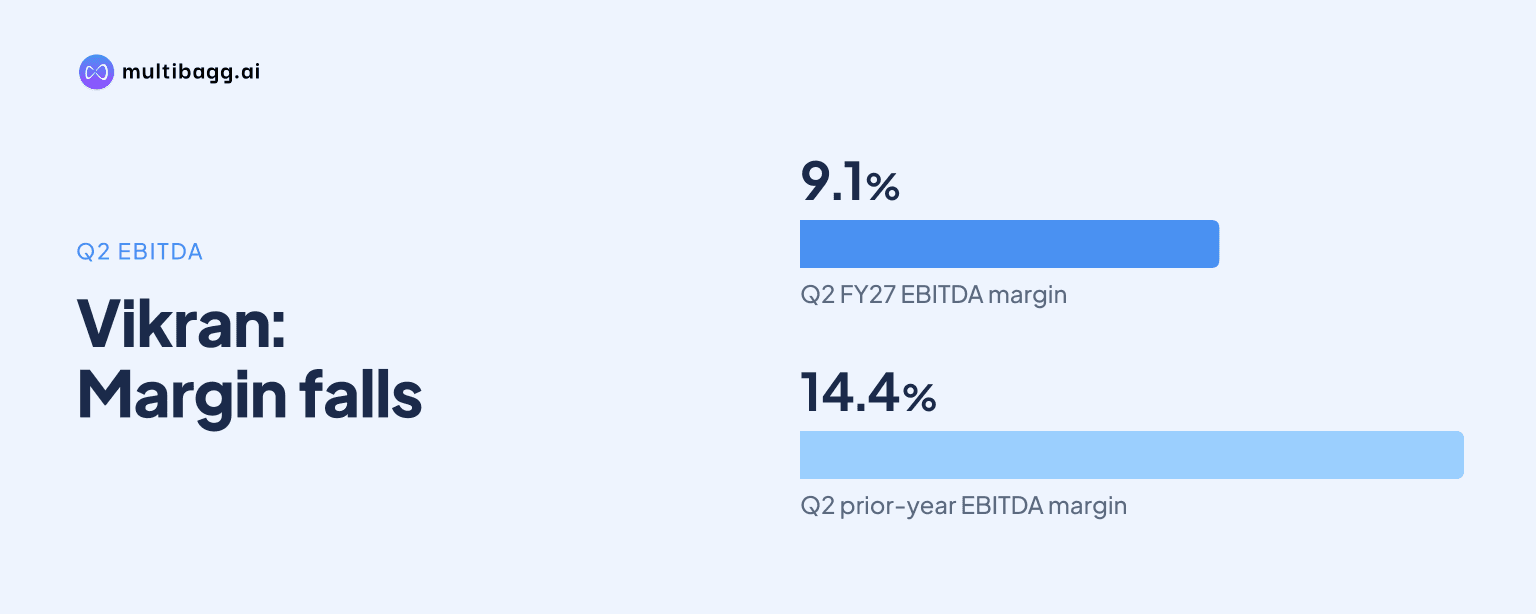
Vikran Engineering Limited reported 25% year-on-year growth in Q2 FY27 standalone revenue to ₹220 crore, but its EBITDA margin fell to 9.1% from 14.4% a year earlier as price escalation remained unrecovered and NOPL funding was delayed.
Know Vikran Engineering inside out
Results, valuation, peers and who's buying, in one view.
What did Vikran Engineering report for Q2 FY27?
Vikran Engineering reported higher standalone revenue in Q2 FY27, alongside lower operating and net profit margins. Standalone revenue from operations was ₹220 crore, compared with ₹176 crore in Q2 FY26. EBITDA was ₹20.12 crore, lower than ₹25.43 crore in the year-earlier quarter, despite the increase in revenue.
The resulting EBITDA margin declined to 9.1% from 14.4%. Standalone profit after tax was ₹7.87 crore, compared with ₹9.12 crore in Q2 FY26, while PAT margin narrowed to 3.6% from 5.2%. The figures show that revenue growth during the quarter did not translate into a corresponding increase in operating profit.
On a consolidated basis, Q2 FY27 revenue from operations was ₹211.84 crore, up about 20% from ₹176 crore a year earlier. Consolidated net profit was ₹2.8 crore, down 69.2% year-on-year, according to the Q2 results summary. The difference between standalone and consolidated profitability was a central issue discussed around the company's NOPL-related business.
Why did Vikran Engineering's margins decline?
Management attributed the margin pressure to unrecovered price escalation and delayed funding linked to NOPL. In the earnings-call summary, these factors were identified as the reasons behind lower profitability even as the standalone engineering business continued to report revenue growth.
The company did not provide a quantified amount for the price escalation pending recovery in the supplied call material. It also did not provide a timetable for funding resolution. These constraints are significant because unrecovered project costs can reduce reported profitability, while funding delays can affect the pace and economics of project execution.
For the first half, standalone EBITDA was ₹48.13 crore, almost unchanged from ₹48.09 crore in H1 FY26. However, the EBITDA margin fell to 11.3% from 14.3%, reflecting that the increase in revenue was not matched by EBITDA growth. The investor presentation cited an H1 margin of 11.4%, a minor difference from the 11.3% stated during the call.
How did the H1 FY27 standalone business perform?
Vikran Engineering's H1 FY27 standalone revenue increased 26.5% to ₹424.12 crore from ₹335.45 crore in H1 FY26, while standalone PAT rose about 71.6% to ₹25.37 crore. The half-year numbers indicate continued growth in the company's core business despite the pressure visible in second-quarter margins.
Management said the H1 figures reflected progress in scaling the standalone business. The company has retained its focus on power transmission and distribution while also working on the NOPL solar EPC project. Its stated strategy includes moving towards solar independent power producer activity, which has a different capital and execution profile from conventional EPC work.
Vikran Engineering also cited new PowerGrid Corporation of India orders. These included a ₹120.69 crore GIS service station package and a ₹153.76 crore 400 kV AIS substation package. The company further said it commissioned India's first 400 kV GIS substation with a process bus system for PowerGrid at Malair Kotla, two months ahead of schedule.
Got a follow-up? Ask IRIS
What was the impact of NOPL on consolidated results?
NOPL had a material effect on Vikran Engineering's consolidated financial reporting. Consolidated revenue for H1 FY27 was ₹353 crore, compared with ₹335 crore in H1 FY26, representing growth of about 5%. This was notably slower than the 26.5% growth reported in standalone revenue.
The investor presentation said H1 FY27 consolidated PAT fell to ₹6.7 crore because of an NOPL intra-group elimination. In Q2, consolidated PAT of ₹2.8 crore was sharply below the standalone PAT of ₹7.87 crore. These reported differences underline the impact of group-level accounting and the NOPL transaction on consolidated earnings.
For investors, the distinction between standalone and consolidated numbers is important. The standalone performance captures the growth in the core operating business, while the consolidated accounts include the effects of the NOPL-related structure, funding position and intra-group adjustments disclosed by the company.
What does the earnings call mean for investors and operations?
The earnings call showed a mixed operating picture: Vikran Engineering expanded standalone revenue and added large transmission and substation orders, but margins weakened in Q2 and consolidated profitability declined. The reported order wins support activity in the power transmission and distribution segment, where execution capability is important for converting orders into revenue.
The solar expansion adds another element to the company's operating profile. Management has described NOPL as part of a strategy to scale solar EPC work and pursue solar IPP activity. But the call summary also highlighted capital intensity, delayed funding and pending dispute resolutions, making these factors relevant to any assessment of consolidated financial performance.
The company announced that the audio recording of the earnings conference call held on 6 November 2026 was available, with the transcript to be shared with exchanges and placed on its website. Management maintained its guidance during the call, according to the call summary, although the supplied material does not specify the detailed assumptions behind that guidance.
Conclusion
Vikran Engineering's Q2 FY27 results combined 25% standalone revenue growth with weaker profitability, as EBITDA margin fell by 5.3 percentage points to 9.1%. H1 standalone revenue and PAT growth remained strong, while the consolidated numbers reflected the effect of NOPL-related intra-group elimination and the funding situation.
The next areas to watch are the recovery of price escalation, progress on NOPL funding and the execution of the newly disclosed PowerGrid orders. Investors will also look for further disclosures on the planned solar IPP pivot and the assumptions supporting management's maintained guidance.