










Vikran retains Rs 2,300 crore FY27 goal despite H2 gap
Key highlights
- Vikran retained its Rs 2,300 crore standalone FY27 revenue target after Rs 424 crore of H1 revenue.
- Management expects Rs 850 crore to Rs 900 crore of revenue in Q3, with the remaining FY27 target to be delivered in Q4.
- Vikran plans to push about 500 megawatts of NOPL work during the current financial year.
- Management expects NOPL power-sale revenue of Rs 40 crore to Rs 50 crore in H2.
powered by IRIS
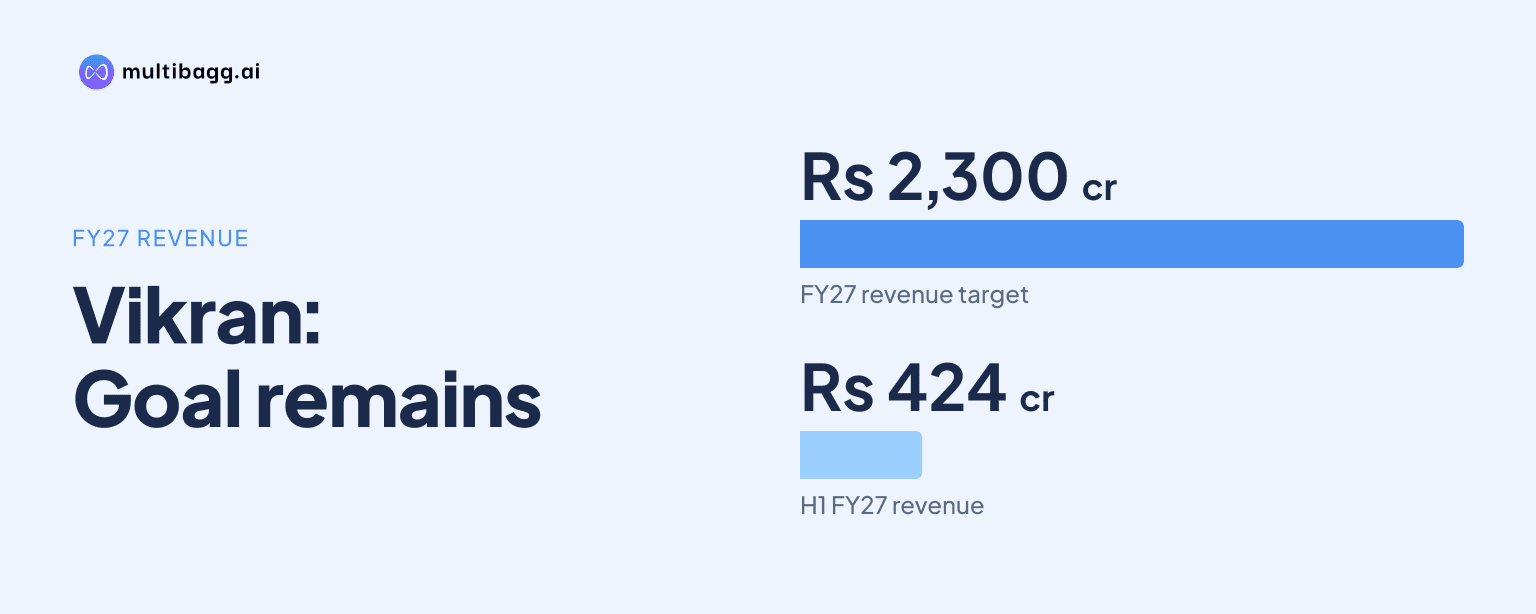
Vikran Engineering retained its Rs 2,300 crore standalone revenue goal for FY27, although Rs 424 crore of first-half revenue leaves Rs 1,875 crore to deliver in H2; management said it expects Rs 850 crore to Rs 900 crore in Q3 after an anticipated IREDA disbursement supports faster NOPL execution.
Know Vikran Engineering inside out
Results, valuation, peers and who's buying, in one view.
Can Vikran meet its FY27 standalone revenue target?
Vikran said it remains confident of reaching its Rs 2,300 crore standalone FY27 target, but management acknowledged that the required H2 delivery of Rs 1,875 crore is challenging. An investor calculated the requirement after citing Rs 424 crore of revenue in H1. Management responded that it had earlier targeted roughly Rs 500 crore by the end of Q2, and said the gap against that expectation arose only from NOPL rather than its non-NOPL operations.
Management’s near-term bridge is an expected Rs 850 crore to Rs 900 crore of Q3 revenue, with the remaining amount required in Q4. It described the previous Q2 plan as Rs 200 crore from non-NOPL projects and Rs 100 crore from NOPL. The company said it saw the shortfall on the NOPL side, where execution was constrained before the expected funding disbursement, rather than withdrawing the FY27 revenue objective.
The implied Q4 requirement of Rs 975 crore to Rs 1,025 crore uses the call’s Rs 1,875 crore H2 requirement and management’s Rs 850 crore to Rs 900 crore Q3 range. This makes the annual outcome dependent on two heavily weighted quarters rather than an even run rate. Management said the anticipated Indian Renewable Energy Development Agency, or IREDA, disbursement was “right around the corner” and would allow Vikran to push operations to meet revenue targets.
Why did NOPL delay Vikran’s revenue recognition?
Vikran said the NOPL delay came from deferred execution while it awaited disbursement, not from a stated procurement shortfall. Management explained that it chose not to expand exposure while the funds had not been received, completing projects with substantial work already done instead. It said formalities for the disbursement had been completed and expected it before the following week, which it believes will allow a significant acceleration in revenue.
The mechanism matters because management said solar panels account for about 60% to 65% of project cost. Vikran continued groundwork and invested the remaining roughly 30% needed toward commissioning, but did not send panels to site at the earlier pace because of the funding delay. Management said this held back commissioning and the related revenue recognition, even as EPC, or engineering, procurement and construction, work continued on NOPL.
Vikran reported about Rs 70 crore of NOPL EPC revenue recognition in H1 and said cumulative NOPL EPC revenue recognized had exceeded Rs 700 crore. In the standalone quarter referenced in the call, it recognized about Rs 7 crore from NOPL within Rs 220 crore of revenue, with the balance mainly from non-NOPL projects. The contrast indicates that the planned acceleration concerns future commissioning and execution volumes, rather than an absence of activity at NOPL.
Got a follow-up? Ask IRIS
What NOPL milestones support the second-half plan?
Vikran’s stated plan is to push about 500 megawatts of NOPL work in the current financial year after funding is available. Management said procurement capacity had already been blocked and equipment orders had been placed, so it did not see an equipment-procurement delay. It identified the remaining land requirement as the execution issue: the final 15% of land, including 10% not yet identified, still needed to be resolved.
The operating contribution is expected to build later than the EPC push. Management said the project generated about Rs 4.66 crore of revenue and free cash flow this year. It expects H2 power-sale revenue of about Rs 40 crore to Rs 50 crore, while noting that 10% of the project already commissioned represents approximately Rs 50 crore of annual expected generation revenue.
Management expects NOPL completion by the end of Q1 FY28, with possible spillover into Q2 FY28, and said peak generation should start from Q2 FY28. It also said it expected to deliver around 200 megawatts in H1 and was commissioning a further 150 megawatts in the current quarter, which should add revenue in Q4. These milestones show that the Rs 2,300 crore FY27 standalone goal relies primarily on EPC execution, while power-generation income is expected to scale further into FY28.
Can Vikran maintain margins and cash generation during the ramp-up?
Vikran said it could maintain margins above 14% for the full year, despite the operational disruption cited in the call. Management attributed the period’s lower profitability to unrecognized price variation, revenue-recognition delays and NOPL execution deferment, which left overheads insufficiently absorbed. It said most purchases and sales are covered by pass-through or price-variation mechanisms, limiting the stated exposure to cost inflation for most contracts.
Management drew a distinction between solar and its other businesses. It said power projects and most water projects have price-escalation clauses, whereas solar contracts are generally fixed-price. Some price-variation claims are expected in Q3, but management said most would come in Q4, based on work progress at site. Until then, the company said it must carry the related cost and interest expense continues to accrue.
Vikran said it was already cash-positive and expected to remain so throughout FY27. It also said debtors had fallen by more than Rs 200 crore compared with last year and forecast a 40- to 50-day reduction in debtor days versus last year, supported by NOPL disbursement and the shorter solar-project cycle. Management cited Rs 45 crore of Jal Jeevan Mission receipts in H1 and said it expects that government funding flow to continue.
Conclusion
Vikran’s retained Rs 2,300 crore standalone FY27 target rests on a sharp shift from Rs 424 crore in H1 to Rs 1,875 crore in H2. Management’s Rs 850 crore to Rs 900 crore Q3 expectation and remaining Q4 requirement make NOPL funding, panel deployment and commissioning the central operating variables. The company also maintained its expectation of margins above 14%, while saying most non-solar contract costs are subject to pass-through arrangements.
The next items to watch are the anticipated IREDA disbursement, progress toward pushing 500 megawatts during the financial year, and whether price-variation receipts arrive mostly in Q4 as management indicated. Investors can also track the stated completion target of end-Q1 FY28, subject to possible Q2 FY28 spillover, because management expects peak NOPL generation only from Q2 FY28.