










Voltas targets 75%-80% in-house RAC production annually
Key highlights
- Voltas targets 75%-80% in-house RAC production on an annualised basis.
- Voltas said its southern factory, commissioned in August 2024, has capacity of around 1.5 million units.
- Voltas expects OEMs to cover demand gaps, with outsourced output described as around 20% annually.
- Voltas estimated RAC channel inventory at around three weeks, versus four to six weeks a year earlier.
powered by IRIS
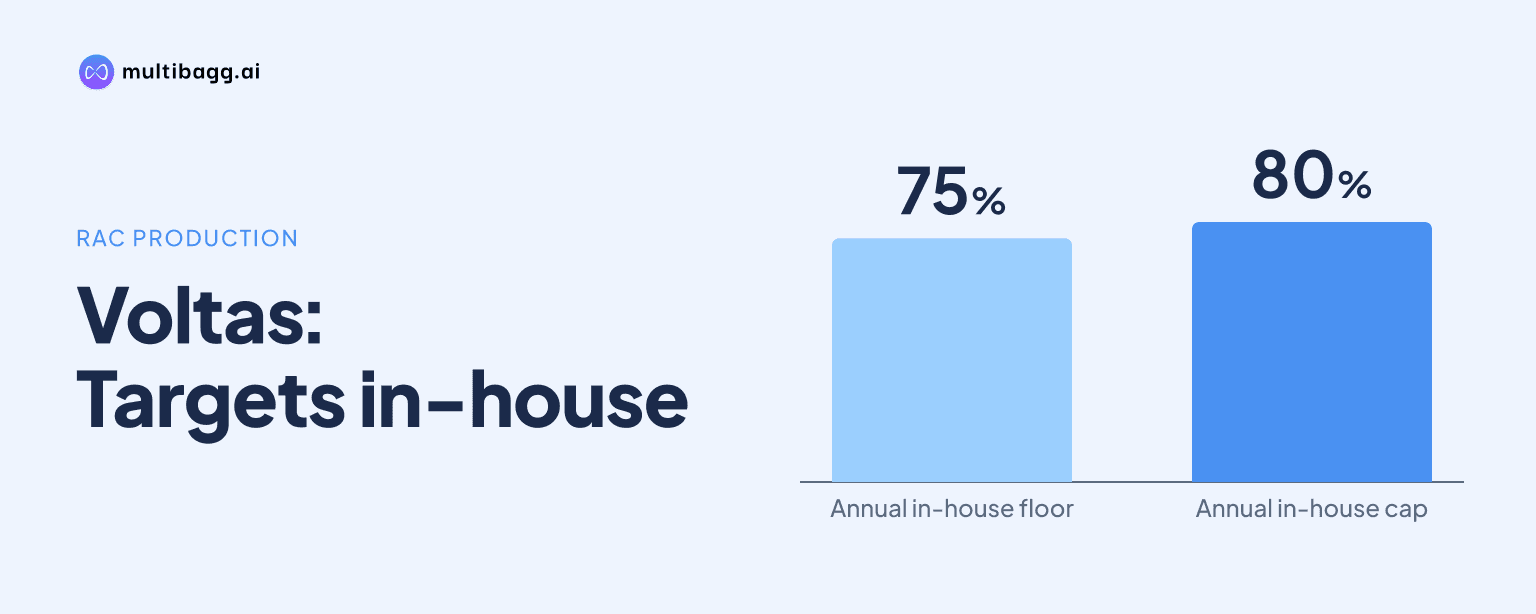
Voltas plans to manufacture 75%-80% of its room air conditioners, or RACs, in-house on an annualised basis, using original equipment manufacturers, or OEMs, to meet the remaining demand gap. The model is supported by the southern factory commissioned in August 2024, which had capacity of around 1.5 million units at the time of the call.
Know Voltas inside out
Results, valuation, peers and who's buying, in one view.
What is Voltas's annual in-house RAC production target?
Voltas's stated annualised target is to manufacture roughly 75%-80% of RAC output internally. K.V. Sridhar said the share can vary by quarter, but placed the broad annual production mix at 75%-80% in-house and around 20% outsourced. The figures describe management's intended yearly manufacturing framework rather than a fixed allocation for every quarter.
The range also indicates that the non-in-house share can differ with sales requirements. A 75%-80% internal mix mathematically leaves 20%-25% for external supply, while management described outsourced production as around 20% on an annualised basis. Voltas did not disclose a target in units for OEM procurement or a quarterly outsourcing ceiling.
The approach is intended to maximise production at Voltas facilities, not to eliminate OEM sourcing. Management said it would assess any requirement across north, south, east and west and use OEMs where its internally produced volumes leave a gap against the top-line requirement. This preserves a source of supply when regional sales patterns differ from planned factory output.
How will Voltas use its southern RAC factory?
Voltas plans to run production uniformly across its facilities through the year, including the southern factory that began operations in August 2024. The southern site had capacity of around 1.5 million units, according to management. Rather than operating plants only around the air-conditioner selling season, the company intends to maintain a steadier production run over 12 months.
Management said a uniform factory schedule may still leave a volume gap when demand exceeds internally planned supply. OEMs are intended to fill that gap, whether it arises in north, south, east or west. Thus, the southern plant's capacity is part of a national production model, not a disclosed commitment to meet only southern-market demand.
The factory plan responds to the seasonal nature of RAC sales. Mukundan Menon described the third quarter as generally not very different from the second quarter for air conditioners, while calling the fourth quarter a large quarter for the category. Management expects channel stocking in January, February and March, with southern demand earlier in January and February and demand in north and east extending through March, April and May.
Voltas did not give utilisation percentages for the southern plant or total company RAC capacity. It instead set out the operational objective of maximising internal manufacturing through full-year production. The stated 75%-80% annual in-house range is therefore the clearest disclosed measure of how management expects its plants and OEM partners to share supply.
Why will Voltas continue to use OEMs for RACs?
Voltas will retain OEMs to provide units when sales-side requirements exceed the output available from its factories under the planned production schedule. Sridhar said the company would “lean back” on OEMs wherever there is a gap, while its intent remains to maximise own production. This makes outsourced supply a balancing mechanism for changing demand rather than a replacement for internal manufacturing.
The OEM requirement may change materially by quarter because RAC demand is seasonal. Management expects the fourth quarter to benefit from pre-season stocking, but did not provide a unit sales forecast or a quarterly outsourcing estimate. It said the anticipated stocking period is important because January through March precedes the principal summer sales months in several regions.
Management also cited channel inventory as an indicator relevant to production and replenishment needs. It estimated inventory in the channel at roughly three weeks at the end of the period discussed, versus four to six weeks at the same point last year. The change means channel stocks were lower by roughly one to three weeks year on year, based on management's estimates.
Menon attributed the lower inventory to an extended summer and stronger secondary sales across most parts of India. Management said it was hopeful of a good fourth quarter and referred to hotter-than-normal summer conditions associated with El Niño. That was management's expectation, rather than a formal sales forecast, and the company said commodity prices, currency movements and the West Asia crisis remained uncertain variables.
Got a follow-up? Ask IRIS
How does full-year production address factory overheads?
Voltas said its 12-month production plan is intended to avoid material under-absorption of factory overheads. The company acknowledged some under-absorption in the first year of operations at the Chennai factory, but Sridhar said there was no material under-absorption in the first half of the period under discussion. Full-year output is intended to spread fixed factory costs over production more evenly.
Management did not quantify the first-year Chennai under-absorption, identify the first-half period by date, or disclose a cost-per-unit target. It did say the factory had been in its first year of operations, following the southern facility's August 2024 commissioning. The absence of a quantified impact means the call does not establish how much profitability could change from higher plant utilisation.
The plan differs from merely producing more during the peak quarter. Voltas intends to continue factory production through the year and then use OEM support for incremental demand from sales. Management said fourth-quarter volume could improve overhead absorption as a percentage of sales, while also noting that the level of commodity, freight and currency costs would need monitoring.
Pricing actions are another part of the near-term margin context. Management said it implemented an additional 5%-7% price increase in the third quarter beginning in October, after price increases that included the Bureau of Energy Efficiency, or BEE, rating change in January 2026. Menon said the latest increase covered the cost inflation discussed, but Voltas did not provide a specific RAC margin target.
What demand factors could influence Voltas's production mix?
Voltas said its installed RAC base was roughly 26 million units and that it tracks almost 20 million customers in its database. Management said it observed a trend of customers buying Voltas again for another room or when replacing an existing unit. It did not disclose a repeat-purchase percentage, the age profile of the installed base or the number of customers targeted through loyalty offers.
Management described replacement demand as a potential support because machines that are seven to nine years old may be replaced over the coming years. It also said it offers existing customers special pricing through loyalty campaigns. The product range includes Vertis AI, which management said was performing extremely well, although the call did not give its sales volume, revenue or share of RAC output.
Demand must still be matched with the full-year manufacturing plan. A rise in pre-season orders could require more OEM supply if it exceeds the output available from evenly run factories, while lower demand could affect the factory absorption objective. The disclosed annual 75%-80% in-house target therefore depends on both sales requirements and the ability to keep plants producing consistently.
Voltas also highlighted supply-cost factors that can affect the operating backdrop. Management identified compressors, copper, aluminium, printed circuit board assembly boards and motors as important components with locked prices, while saying currency and ocean freight remain volatile. It said ocean freight had almost doubled from the level factored into costs, and noted that plastic and insulation have shorter, often monthly, pricing cycles.
Conclusion
Voltas is setting a manufacturing model in which internal facilities supply roughly 75%-80% of annual RAC output and OEMs cover the balance when demand exceeds planned factory production. The 1.5 million-unit southern facility, commissioned in August 2024, is central to the effort to run production more evenly and reduce the risk of material factory overhead under-absorption.
The next point to watch is the fourth quarter, when management expects channel stocking in January through March and better overhead absorption from higher volume. The key unresolved factors disclosed on the call are whether three weeks of channel inventory drives replenishment, how much OEM support is needed during seasonal demand, and how commodity prices, currency and ocean freight move after the October 5%-7% price increase.