










Voltas says 5%-7% RAC hike supports Q3 margin recovery outlook
Key highlights
- Voltas reported about 18% RAC cost inflation against 14% price increases by Q2 FY 2027.
- Voltas implemented a further 5%-7% RAC price increase from October in Q3 FY 2027.
- Voltas said 70% of RAC calendar-year sales occur between January and June.
- Voltas' lead over the number-two RAC brand widened to 4.2 percentage points in year-to-date September 2026 from 1.2 points a year earlier.
powered by IRIS
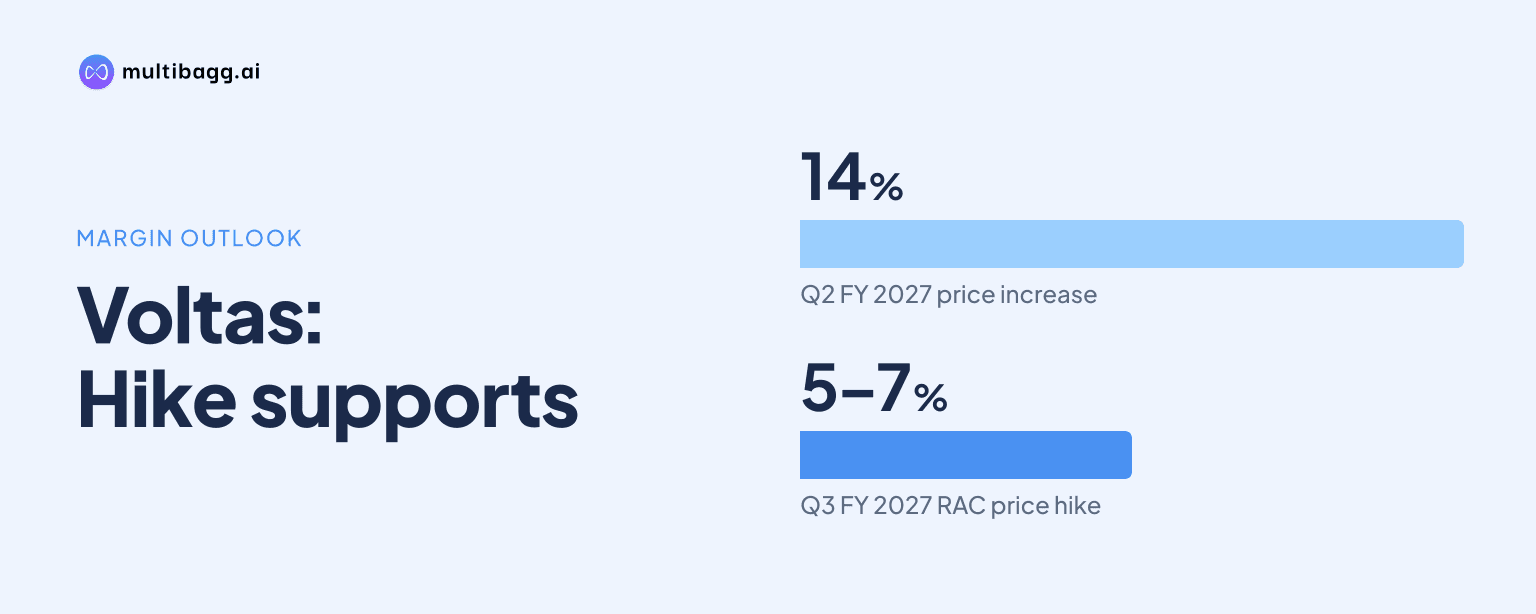
Voltas says its additional 5%-7% Room Air Conditioner (RAC) price increase, implemented from October in Q3 FY 2027, is intended to address an 18% cost inflation against 14% earlier price increases, with management expecting the usual profitability improvement in Q3 and Q4 after a softer Q2.
Know Voltas inside out
Results, valuation, peers and who's buying, in one view.
Why did Voltas' RAC margins come under pressure?
Voltas says RAC margins were pressured because costs rose sharply after selling prices had been agreed for the season. Management said it typically decides RAC prices in February and locks them for four, five or six months, broadly covering the March-to-July or August primary buying period. The company described the six-month cost volatility as unusually severe, driven by currency, ocean freight, plastics, copper, aluminium, controllers and other inputs.
The commercial structure limited Voltas' ability to react during the highest-volume period. Management said organised trade, around 70 regional retailers, and modern trade partners together account for 35% of its RAC volume where seasonal prices are locked. RAC sales are also highly concentrated: 70% of calendar-year sales occur between January and June, while 30% occur in the second half. That seasonality differs from sectors with more evenly distributed sales and quicker price pass-through.
How much of RAC cost inflation has Voltas passed through?
Voltas said cumulative RAC cost inflation was about 18%, while price increases already taken totalled about 14% by Q2 FY 2027. The difference is therefore about 4 percentage points on a price-versus-cost basis, rather than a disclosed operating-margin gap. Management said the 14% number includes the Bureau of Energy Efficiency, or BEE, table change that took effect in January 2026, as well as currency- and commodity-related increases.
Voltas said the extra 5%-7% increase was implemented in Q3 starting in October, rather than being part of the 14% cited for Q2. Management said the latest move was designed to cater to the remaining cost effect and further anticipated increases. It did not give a numerical RAC margin target or state that the increase guarantees full recovery, noting that it must also remain sensitive to consumer demand when deciding how much to pass on.
When does Voltas expect RAC profitability to improve?
Voltas expects the normal seasonal pattern to reassert itself in Q3 and Q4 FY 2027. K.V. Sridhar said Q2 is generally a softer quarter than Q1 and that the company expects profitability to improve through the next two quarters, with operating leverage expected to contribute more to earnings before interest and tax, or EBIT. This is management's expectation, not formal margin guidance.
Management's stated benchmark is performance against the corresponding quarter a year earlier, rather than a sequential comparison alone. Sridhar said Voltas intends to improve on the same quarter of the preceding year, while also aiming to exceed its Q3 and Q4 FY 2026 results. He noted that Q3 FY 2026 benefited from the BEE table change and Q4 FY 2026 was a decent category quarter, so management does not portray the second-half comparison as purely a low-base effect.
Got a follow-up? Ask IRIS
What could still affect Voltas' RAC margin recovery?
Voltas identified foreign-exchange movements and ocean freight as major variables that can remain after certain material rates are fixed. Management said the prices of five key components, compressors, copper, aluminium, printed circuit board assembly boards and motors, can be locked, but payments are made in US dollars or Chinese renminbi after credit periods. Ocean freight charges factored into costs rose to nearly twice their previous level during the period discussed.
Other inputs have shorter purchasing cycles and can move more quickly. Voltas said plastic polymers and insulation materials are priced almost month to month, which can create fresh pressure even where major-component pricing is set. The company said it monitors currency rates, forward premiums and estimated landed costs over the next three to four months, and hedges accordingly. This process manages exposure but does not eliminate the risk of further changes in currency, freight or input prices.
How does market-share strategy shape Voltas' RAC pricing?
Voltas said market share and the absolute quantum of gross margin, rather than percentage gross margin alone, guide its RAC approach. Management said its lead over the number-two brand widened from 1.2 percentage points in September of the prior year to 4.2 percentage points in year-to-date September 2026. It views that lead as important because market share can be difficult to regain once lost.
That emphasis means Voltas is balancing profitability recovery with the need to remain competitive in a category where price changes affect consumer sentiment. Management said its intention is to improve profitability versus the comparable prior-year quarter while sustaining market-share progress. The October 5%-7% increase therefore represents a calibrated response to costs, not a disclosed change away from the company's market-share focus.
Conclusion
Voltas' explanation for RAC margin erosion is primarily one of timing: a seasonal pricing lock-in overlapped with rapid movements in costs, currency and freight. The company had passed through about 14% against 18% cost inflation by Q2 FY 2027, and the further 5%-7% increase from October is intended to address that shortfall and anticipated additional costs. Management expects Q3 and Q4 profitability to improve, while continuing to measure progress against the corresponding quarters of FY 2026.
The next points to watch are whether the October Q3 price increase holds across channels representing 35% of RAC volume, whether commodity, freight and currency movements stabilise, and whether Voltas exceeds its Q3 and Q4 FY 2026 profitability. Management has not provided a specific RAC margin target, so reported second-half results will be the key measure of whether the planned recovery is occurring.