










Voltas Says RAC Channel Inventory Fell to About Three Weeks
Key highlights
- Voltas said channel RAC inventory was about 3 weeks, versus 4 to 6 weeks at the same time last year.
- Voltas said it has roughly 26 million air conditioners currently operating in its installed base.
- Voltas expects major Q4 channel stocking in January to March, with northern and eastern demand extending into May.
- Voltas indicated an annualized production mix of roughly 75% to 80% in-house and about 20% outsourced.
powered by IRIS
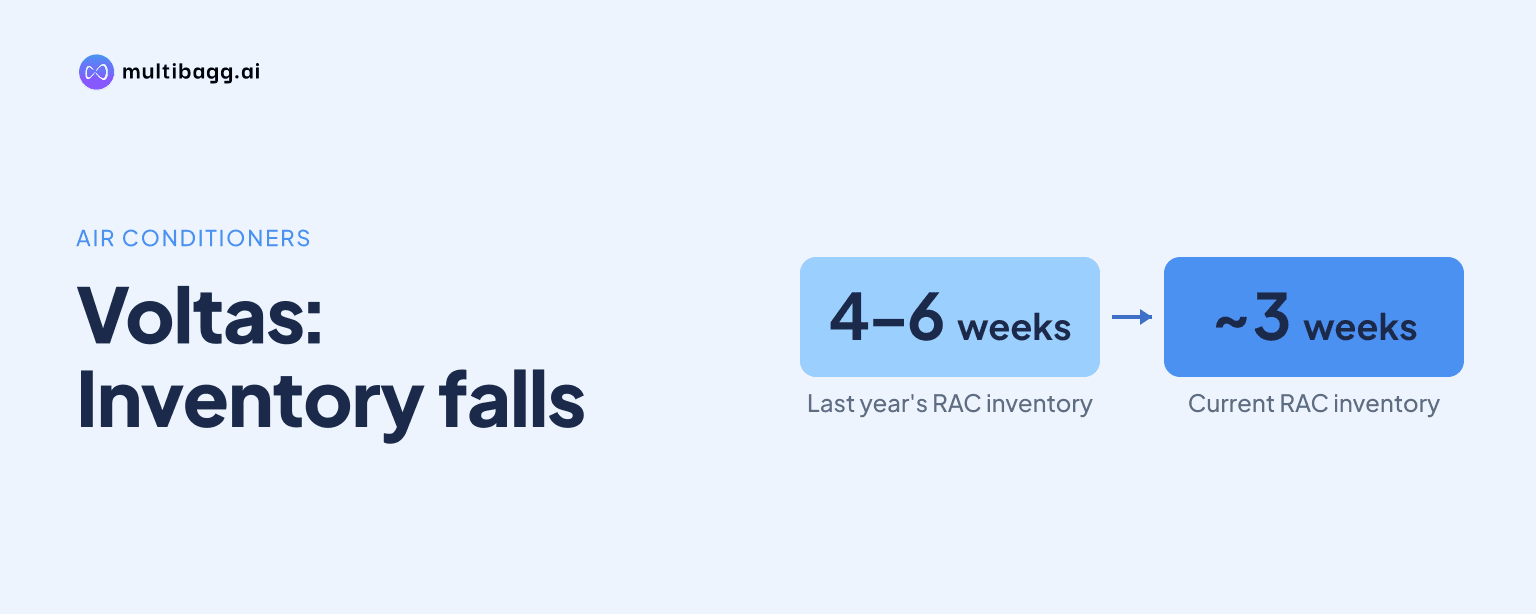
Voltas said channel room air-conditioner, or RAC, inventory was about three weeks in its Q2-end comparison, versus four to six weeks at the same time a year earlier. Management attributed the reduction to an extended summer and good secondary-sales traction across most parts of India.
Know Voltas inside out
Results, valuation, peers and who's buying, in one view.
What is Voltas's current channel RAC inventory?
Voltas said its channel was carrying roughly three weeks of RAC inventory and “not more for sure” at the point discussed on the call. The estimate covers stock held in the sales channel rather than Voltas’s own factory inventory, and management described it as materially lower than the prior-year level.
Management linked the three-week position to continued demand after the main summer. It said the season had been extended, with a “second summer” going strong, and cited good traction across most parts of the country. Voltas specifically pointed to unusually uncomfortable temperatures in Mumbai as an illustration of conditions supporting RAC offtake.
The distinction matters because channel inventory reflects the gap between company shipments and sales to end customers. Voltas said it was seeing a distinctly different pattern of secondary sales, meaning sales through dealers to consumers, and expressed confidence that dealer stock had been minimized to about three weeks. The company did not disclose channel inventory in unit terms or provide a regional break-up.
How does Voltas's RAC inventory compare with last year?
Voltas said channel RAC inventory was about three weeks this time, compared with four to six weeks at the same time last year. The change represents a reduction of at least one week from the low end of the prior-year range and three weeks from its high end.
The comparison was provided in response to an analyst’s question framed as a Q2-end assessment. Voltas did not report a precise average for last year, so the appropriate comparison is the current three-week estimate against the stated four-to-six-week range, rather than against a single prior-year number.
Why did Voltas's channel inventory decline this season?
Voltas attributed the lower inventory primarily to extended summer conditions and good secondary sales, rather than to a disclosed reduction in supply. Management said demand remained strong during the second summer across most parts of the country, allowing channel stock to move to consumers and bringing estimated inventory duration down to about three weeks.
The company also described a sizeable installed base that management said may support repeat purchases and upgrades. Voltas said it tracks nearly 20 million customers in its database and estimated its currently operating installed base at roughly 26 million units. Management said it was seeing a trend in which customers who bought a first Voltas air conditioner also chose Voltas for another room or a replacement unit.
Voltas is seeking to address that base through loyalty campaigns that offer existing customers a special price on a product. It also cited its Vertis AI product and campaigns encouraging consumers to upgrade for power savings, design and features. These are management’s commercial actions, while the stated reason for the current three-week channel inventory was seasonal demand and secondary-sale traction.
The company said it intends to maximize internal production and use original equipment manufacturers, or OEMs, to fill supply gaps by region across the north, south, east and west. On an annualized basis, management indicated a broad mix of around 75% to 80% in-house production and about 20% outsourced production, with the actual split varying by quarter.
Got a follow-up? Ask IRIS
What could affect RAC restocking before the next summer?
Voltas expects the channel to begin stocking up substantially in Q4, particularly in January, February and March, but said commodity prices, currency movements and the West Asia crisis remain variables. Management expects southern markets to stock in January and February, while demand in the north and east is expected across March, April and May.
Management also cited expectations of a hotter-than-normal summer associated with El Niño as a reason for its Q4 optimism. That expectation is a management view, not a sales forecast. Voltas said Q4 is the larger RAC quarter, whereas Q3 is generally not very different from Q2 for air conditioners, which explains why management declined to provide a percentage-margin forecast based on the smaller quarter.
Pricing and costs could also affect the conditions under which inventory is replenished. Voltas said it had taken a further 5% to 7% price increase and that, after this move, the gap created by earlier cost inflation and delayed selling-price realization should normalize. Management said a 3% to 4% erosion would be corrected going forward, with the benefit visible from Q3 and more fully in Q4 because higher volume absorbs overheads better.
Voltas added that 35% of the channel had been subject to pricing lock-ins, which delayed realization of earlier price increases even as costs rose. It said a clearer winding down of the West Asia crisis could accelerate an easing of margin pressures in Q3. Management’s plan for the seasonal build-up is to maintain year-round factory production and use OEMs where sales requirements exceed internal output.
Conclusion
Voltas’s stated three-week channel RAC inventory, down from four to six weeks a year earlier, indicates faster stock movement through dealers during an extended summer. Management connected the decline to secondary-sales traction, while its 26 million-unit operating installed-base estimate, loyalty activity and product-upgrade campaigns describe additional mechanisms it is using to pursue consumer demand.
The next indicator is Q4 restocking, which Voltas expects in January through March in the south and March through May in the north and east. Management’s plan is to maintain year-round factory production, use OEMs for supply gaps and seek annualized production of roughly 75% to 80% in-house, but commodity prices, currency and the West Asia crisis remain unresolved factors it identified.