










Voltas widens RAC lead to 4.2 points in September YTD data
Key highlights
- Voltas reported 17.4% room air-conditioner market share in YTD September.
- Voltas’s lead over the number-two RAC brand rose to 4.2 percentage points from 1.2 percentage points a year earlier.
- Voltas cited about 18% RAC cost inflation against roughly 14% price increases through Q2.
- Voltas implemented an additional 5% to 7% RAC price increase from October in Q3.
powered by IRIS
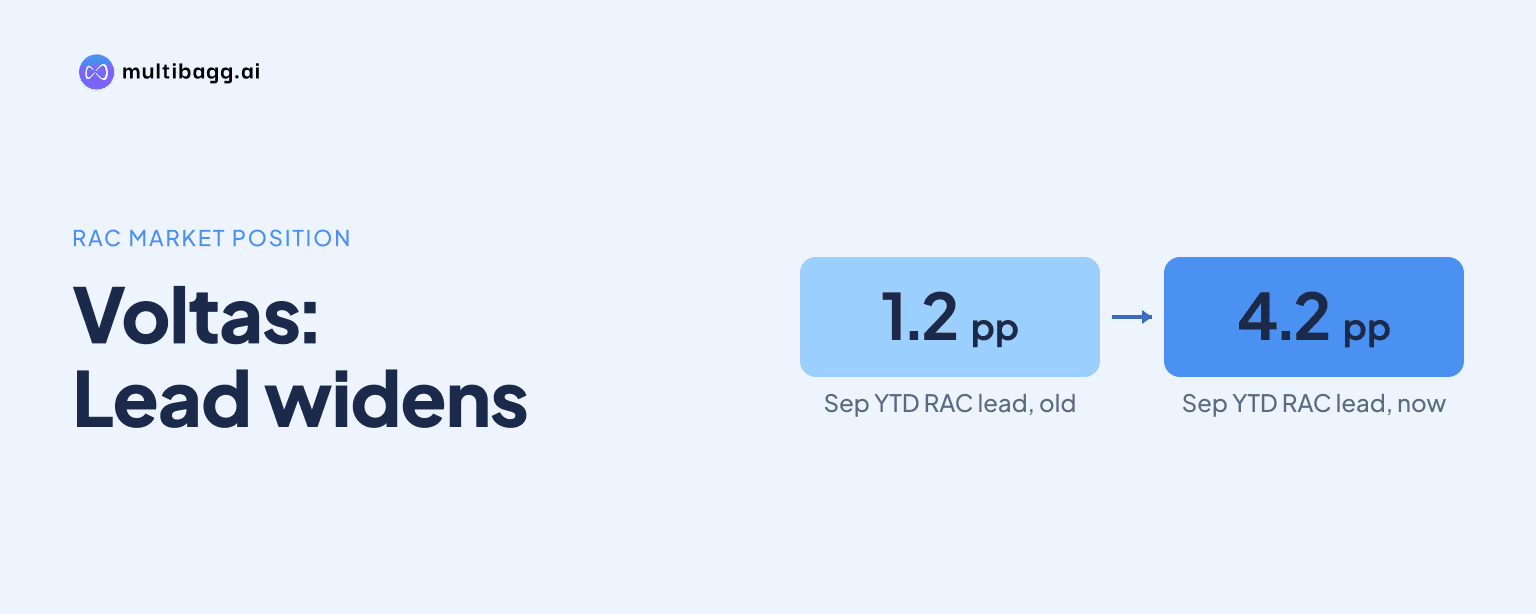
Voltas reached 17.4% room air-conditioner market share in the year to date through September, widening its lead over the number-two brand to 4.2 percentage points from 1.2 percentage points a year earlier. Management said Voltas will focus on market share and the absolute quantum of gross margin rather than gross-margin percentage alone.
Know Voltas inside out
Results, valuation, peers and who's buying, in one view.
How much did Voltas widen its room AC market-share lead?
Voltas widened its lead over the second-ranked room air-conditioner brand to 4.2 percentage points in the year to date through September, compared with 1.2 percentage points in September of the previous year. The lead therefore increased by 3.0 percentage points as Voltas reached 17.4% share in room air conditioners, or RACs.
Management also said Voltas had established a significant lead in value terms, although it did not disclose a value-market-share percentage or sales value during the call. The reported widening of the RAC lead occurred during a six-month period marked by input-cost, currency and ocean-freight volatility.
Why is Voltas prioritising market share over percentage margin?
Voltas said market share and the absolute quantum of gross margin will guide its RAC strategy, rather than percentage gross margin alone. Management said market share is difficult to regain after it is lost and described a wider gap from competitors as central to Voltas’s long-term leadership objective.
The approach comes after RAC cost inflation of about 18% exceeded price increases of around 14% implemented through the second quarter. Voltas then implemented an additional 5% to 7% RAC price increase from October in the third quarter, which management said covered the cost increase identified at that point.
Management did not give a numerical RAC margin target for the current or next financial year. Instead, it said profitability should be assessed against the corresponding quarter of the previous year because RAC demand is seasonal, with the stated aim of improving on the previous year’s third- and fourth-quarter results.
What limited Voltas’s ability to pass through RAC cost increases?
Voltas said RAC prices are generally set around February and locked for four to six months, limiting price changes when input costs rise during the selling season. Management said 70% of calendar-year RAC sales take place from January through June, concentrating sales and pricing commitments in the first half.
The company said organised trade, including about 70 regional retailers, and modern-trade partners account for 35% of RAC volume, and seasonal pricing is locked with these channels. Management cited currency, ocean freight, plastics, copper, aluminium, controllers and other air-conditioner inputs as sources of cost pressure during the six months under discussion.
For five components, compressors, copper, aluminium, printed circuit board assembly boards and motors, Voltas said purchase rates are locked but payments remain exposed to foreign-currency movements after the credit period and bill of lading. Management said ocean freight nearly doubled from the level factored into costs, while polymer prices for plastics can change monthly.
Voltas said it monitors currency rates, forward premiums and landed costs over the following three to four months before hedging accordingly. Management did not provide a hedging ratio or an exchange-rate sensitivity, but said forward premiums had risen over the preceding six to nine months.
Got a follow-up? Ask IRIS
What does the October pricing reset mean for Voltas profitability?
Voltas said the additional 5% to 7% RAC price increase implemented from October covers the cost increase then identified by management. Management added that any easing in commodities, ocean freight or the US dollar would help RAC profitability, but it did not forecast such easing.
Management characterised the earlier margin pressure as a timing issue because selling prices were committed while costs moved sharply from February through July and August. It said RACs differ from automobiles because only 30% of calendar-year RAC sales occur in the second half, leaving less flexibility to revise prices during the core season.
Voltas said profitability improved year on year across verticals, including Segment A, while sequential comparisons can be misleading because the second quarter is generally softer than the first. Management expects the usual seasonal improvement in the third and fourth quarters and said operating leverage should improve earnings before interest and tax, or EBIT, going forward.
How do Voltas’s other businesses affect the outlook?
Voltas said its Electro-Mechanical Projects and Services business, or Segment B, is expected to sustain margins of 4% to 6% over the longer term. Management said one-off items and other debits had a net impact of around 2.5% to 3% in the reported quarter, without providing segment revenue or profit in this exchange.
For Voltbek, management said higher costs for plastics, metals and insulation materials delayed the recovery expected in the first six months. It said Voltbek is targeted to achieve earnings before interest, tax, depreciation and amortisation, or EBITDA, break-even sometime in the next financial year.
Voltas also said it received Rs 5 crore of production-linked incentive, or PLI, support in the quarter and expects a similar amount for the next five to six quarters. Management said it expects quarterly recognition rather than one large future PLI item.
Conclusion
Voltas’s 17.4% RAC market share and 4.2-percentage-point September YTD lead show that its position expanded despite about 18% cost inflation initially exceeding the roughly 14% price increase through the second quarter. Management’s stated strategy is to protect and grow share while generating an adequate absolute gross-margin quantum.
The next measures to watch are the effect of the 5% to 7% October RAC price increase in the third quarter, management’s plan to improve on the previous year’s third- and fourth-quarter results, and Voltbek’s target of EBITDA break-even in the next financial year. Segment B’s stated 4% to 6% longer-term margin range and expected Rs 5 crore quarterly PLI receipts for five to six quarters are further disclosed milestones.