










Zetwerk aerospace, defence and space orders reach Rs 2,000 crore
Key highlights
- Zetwerk reported approximately Rs 1,500-2,000 crore of aerospace, defence and space orders in H1.
- Management said the aerospace, defence and space category was almost non-existent one year earlier.
- Zetwerk's overall order backlog was almost Rs 15,000 crore, up 67% year on year.
- The precision category's order book grew 80% in H1, but management gave no category-level guidance.
powered by IRIS
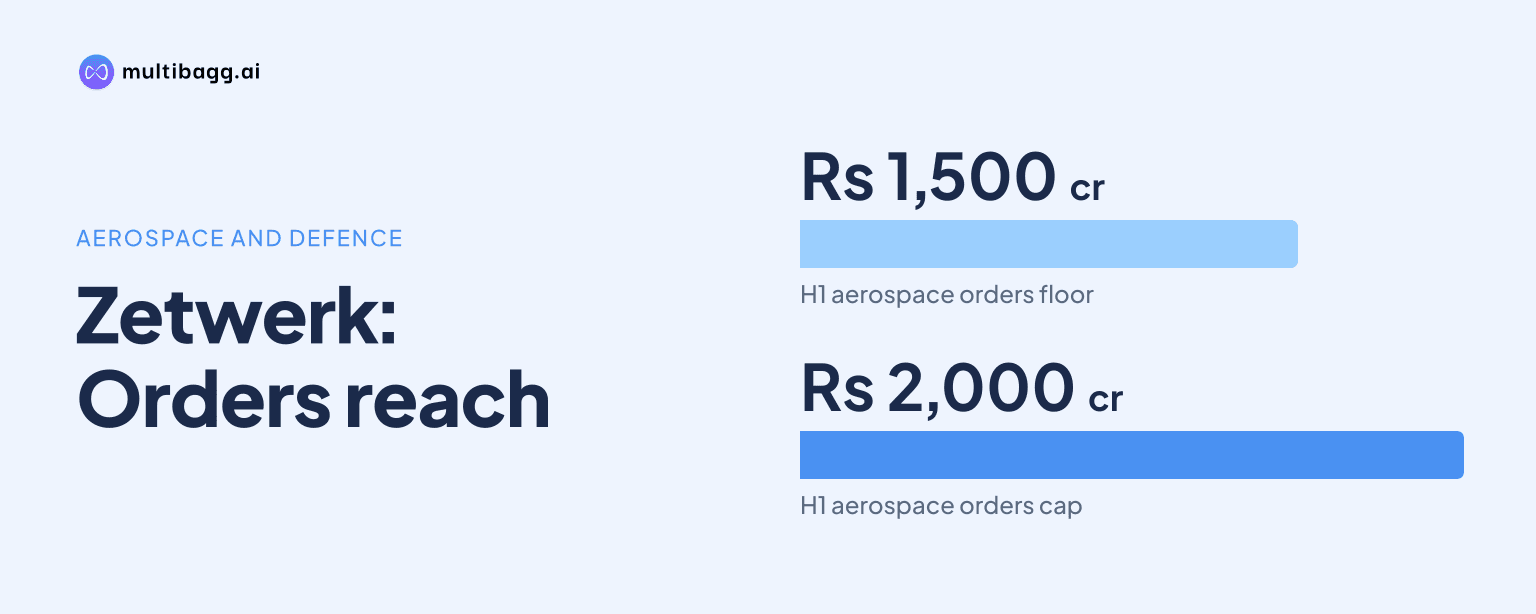
Zetwerk said in the first half (H1) that aerospace, defence and space orders had reached approximately Rs 1,500-2,000 crore, from almost non-existent a year earlier, making the combined category a material part of its order book. Management attributed the position to three to five years of category building and orders from defence public-sector undertakings, space companies and private companies.
Know Zetwerk Manufacturing Businesses inside out
Results, valuation, peers and who's buying, in one view.
How large is Zetwerk's aerospace, defence and space order book?
Zetwerk said its combined aerospace, defence and space order book was approximately Rs 1,500-2,000 crore in H1. Management said the orders were already in hand rather than a forward-looking statement, and identified defence public-sector undertakings, space companies and private companies as customers in the category.
The category was almost non-existent one year earlier, according to management. It is now part of an overall order backlog of almost Rs 15,000 crore, which grew 67% year on year and gives the company visibility into the next three years, management said. Zetwerk did not disclose how much of the Rs 1,500-2,000 crore range relates separately to aerospace, defence or space.
How did Zetwerk build this category?
Zetwerk said it has worked on aerospace and defence for three to five years, rather than building the category through an overnight expansion. Management said new categories can take years to develop and that the company can pursue them without requiring revenue contributions in the next one to three years because its business is diversified.
Management described a founder-led model in which one founder can spend 100% of their time on a new category for two to three years. It cited transformers as an earlier example: the business was not large three years ago, and Zetwerk subsequently hired a senior executive from Hitachi to lead its transformer business. Management said mature categories are handed from founders to industry leaders through this approach.
Will aerospace and defence drive Zetwerk's future growth?
Zetwerk did not give formal guidance that aerospace, defence, space or precision would become its main growth driver. Management reported that the precision category's order book grew 80% in H1, but said defence is a cyclical industry and declined to provide guidance at a sub-product or sub-category level.
Instead, management's overall guidance was that Zetwerk's order book would grow faster than revenue. The Rs 1,500-2,000 crore order position shows progress in a new category, but the company did not provide a revenue-recognition schedule, segment margin or delivery timetable for those orders. Management also said its effort to extend defence capabilities into space may or may not work out.
How does the category fit Zetwerk's margin and capacity plans?
Zetwerk includes aerospace and defence in its “mix, model and market” strategy for increasing gross margin. Management said mix means selling higher-margin products such as aerospace and defence, model means using a combination of captive, in-house and third-party production, and market means expanding international business. It described gross margin as an input to earnings before interest, tax, depreciation and amortisation (EBITDA).
Management said the nearly Rs 15,000 crore order backlog also indicates Zetwerk is supply-constrained. Its stated response is to improve capacity through its own, captive and third-party networks while strengthening distribution with major customers in India and overseas. The company gave no separate capacity target or timeline for aerospace, defence or space production.
Got a follow-up? Ask IRIS
What does Zetwerk's existing profit mix show?
Manufacturing generated almost Rs 211 crore of segmental EBITDA in H1, compared with Rs 20 crore from the ecosystem segment. The ecosystem segment supplies raw materials, including aluminium, steel, zinc and copper, rather than finished products. The comparison identifies manufacturing as the larger disclosed contributor to segmental EBITDA in H1.
Management said the ecosystem business intentionally operates on 2-3% gross profit and 1% EBITDA because it does not take inventory or raw-material positions. Zetwerk said the segment helps it control raw-material inputs, including in products such as transformers where management said steel can account for 50% of value. Aerospace and defence are part of the company's plan to alter the manufacturing product mix rather than the ecosystem model.
How could Zetwerk support execution across its supplier network?
Zetwerk said its software tools cover the process from a customer request for quotation through pricing, supplier selection, project management, quality, shipping, order-to-cash and procure-to-pay. Management said the tools use data gathered over the past seven to eight years, while its Zeus artificial-intelligence platform can analyse drawings and help identify suppliers.
Management said Zetwerk previously took seven to 10 days to respond to a customer request for quotation and aims to reduce that period to 24 hours. It also gave an example of supplier selection moving from days to minutes or hours by comparing past on-time delivery, including 80% for one supplier against 50% for another. These are internal operating tools and goals, not a disclosed delivery guarantee for aerospace, defence or space orders.
Conclusion
Zetwerk's Rs 1,500-2,000 crore aerospace, defence and space order book marks a substantial change from a category that was almost non-existent a year earlier. The disclosed order position sits within an almost Rs 15,000 crore backlog, while H1 manufacturing EBITDA of almost Rs 211 crore was more than 10 times the Rs 20 crore reported by the ecosystem segment.
The next issue is conversion of the expanded order book into revenue while capacity is increased through owned, captive and third-party networks. Management has not offered category-level guidance because it describes defence as cyclical, but it has said the overall order book should grow faster than revenue and reported 80% H1 order-book growth in precision.