










Zetwerk says no demand slowdown despite 10%-20% AI exposure
Key highlights
- Zetwerk said US AI-linked capital expenditure represents about 10%-20% of its almost Rs 14,500 crore backlog.
- Zetwerk said it has seen no current change in RFQs or customer requests for faster delivery.
- Zetwerk said quarter-two operating cash flow was 60%-70% better than quarter one.
- Zetwerk said it won about Rs 500 crore to Rs 1,000 crore of relevant Indian solar orders in the first half.
powered by IRIS
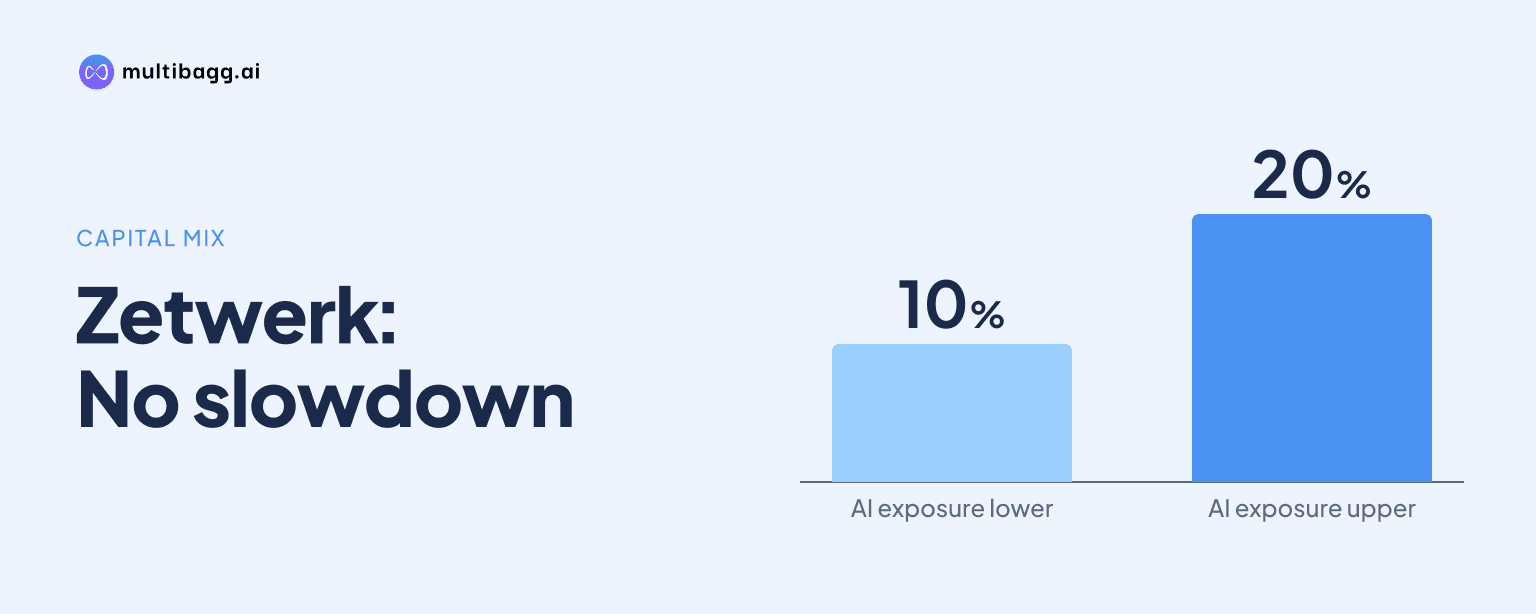
Zetwerk said US artificial-intelligence-linked capital expenditure accounts for about 10%-20% of its order backlog, but it had seen no change so far in requests for quotations or customer demands for faster delivery. Management said India thermal power, renewables, electrification and defence provide growth avenues beyond the US data-centre cycle.
Know Zetwerk Manufacturing Businesses inside out
Results, valuation, peers and who's buying, in one view.
How much of Zetwerk's backlog is linked to US AI spending?
Zetwerk said US AI capital expenditure could account for 10%-20% of its order book. The disclosure came in response to a question about a cooling AI-driven market and the associated data-centre investment cycle in the US. Management did not disclose the rupee value of that range, identify customers, or separate direct data-centre work from energy-related orders.
The total order backlog was almost Rs 14,500 crore, which management said gave the company work to convert into revenue over the next three years. Zetwerk said 80% of revenue comes from repeat customers and added that repeat ordering also characterises its backlog, although it did not provide a separate percentage for repeat-customer backlog.
Management distinguished its acknowledged AI exposure from dependence on that cycle. It said the company has multiple growth options and therefore did not expect the 10%-20% exposure to determine its overall outcome. That is management's assessment of its diversification, not a forecast that US data-centre investment will remain unchanged.
Has Zetwerk seen a slowdown in US customer demand?
Zetwerk said it has not seen a slowdown so far in either new requests for quotations, or RFQs, or customer pressure for quicker delivery. Management said customers were still asking Zetwerk to deliver in substantially more compressed time periods, which it cited as the current evidence from customer behaviour rather than stock-market movements.
Management also said it could not know whether demand conditions would change in a few quarters or in the next year. The company therefore reported an absence of a current change in RFQs and delivery urgency, while leaving the medium-term direction of US AI-linked capital expenditure unresolved.
Operational indicators showed improvement across periods. Zetwerk said operating cash flow was 60%-70% better in quarter two than in quarter one, while first-half performance was materially improved from the prior-year first half. Management put working capital at around 30-31 days and said it expected operating cash flow to be neutral to positive for the current financial year, followed by positive operating cash flow from next year onwards.
Zetwerk also said it was Rs 100 crore cash profit-before-tax positive in quarter two after adjustments for non-cash charges, hedging and depreciation. Management expected reported profit before tax to turn positive in the second half, partly because a higher employee stock option charge in quarter two reflected initial public offering-related vesting that it described as one-time.
Got a follow-up? Ask IRIS
What businesses diversify Zetwerk beyond US data centres?
Zetwerk identified thermal power in India, renewables in India, and electrification and defence in India as three growth drivers that did not exist last year. Management cited these segments as the reason a shift in one category, including US AI-related data-centre demand, would not be the sole driver of the company's growth.
The company described its engineering capability as a mechanism for entering adjacent segments. Zetwerk said it has 3,500 employees, including almost 800 in design and engineering, or nearly 20% of its workforce. Management gave the example of a Coimbatore die-casting supplier that historically served automotive customers but could use its machinery to supply a renewable-energy component.
Battery energy storage systems, or BESS, and wire and cable are nearer-term expansion areas, according to management. Zetwerk said it already supplies solar modules, transformers and switchgear to solar developers in India and the US, and these customers may also require BESS products. The stated opportunity is to supply additional products to established energy customers rather than rely on one data-centre category.
For space and robotics, Zetwerk said it would initially use teams of five to 10 people rather than a 100-member team. Management estimated investment in such new categories at Rs 1 crore to Rs 10 crore and said they are not material to near-term profitability. It described a three-to-five-year approach to building a potential new US$100 million category, rather than presenting those initiatives as current revenue drivers.
What is Zetwerk seeing in Indian solar and Europe?
Zetwerk said it had not yet seen an effect on its order book from concerns about an Indian solar slowdown following regulatory changes. In the first half, management said it won about Rs 500 crore to Rs 1,000 crore of orders for the relevant solar product, largely from domestic Indian customers. It said changes involving ALCM, ALMM and Domestic Content Requirement rules can create discontinuities for at most a couple of quarters.
Management said India data-centre capital expenditure had not yet begun in a significant way, in contrast with its description of a much more developed US cycle. It nevertheless expects renewable energy to remain a long-term trend and said the company is not dependent on one category for growth. No India data-centre backlog figure or revenue target was disclosed.
On Europe, Zetwerk said it would focus on markets already working for it, namely India and the US. Management said Europe remains a theoretically large market but has not yet experienced the same supply-chain decoupling from China that it sees in India and the US. It said it would consider Europe more seriously after that supply-chain shift, without giving a timetable or sales target.
Conclusion
Zetwerk's comments show that US AI-linked spending is a defined but partial element of its almost Rs 14,500 crore backlog. Current RFQ activity and compressed delivery requests have not indicated weaker customer behaviour, while Indian thermal power, renewables, electrification and defence give management other segments to pursue.
The next quarterly updates should clarify whether the 10%-20% US AI exposure changes as orders are won or converted into revenue. Investors can also watch whether Indian solar demand holds after the regulatory disruption, whether working capital stays near 30-31 days, and whether management meets its expectation of neutral-to-positive operating cash flow in the current financial year.