










Zetwerk says AI cuts supplier decisions from days to minutes
Key highlights
- Zetwerk says ZETpec converts a tender into a bill of materials in 10 minutes, compared with a typical three-to-four-week bidding process.
- Zetwerk says Zeus cuts supplier-selection decisions from days to minutes and hours using drawing analysis and delivery data.
- Zetwerk won Rs 7,800 crore of orders in H1, up 50% year on year, and said its typical win rate is about 20%.
- Zetwerk reported a Rs 14,500 crore order backlog, with 46% from international markets and 33% from ODM business.
powered by IRIS
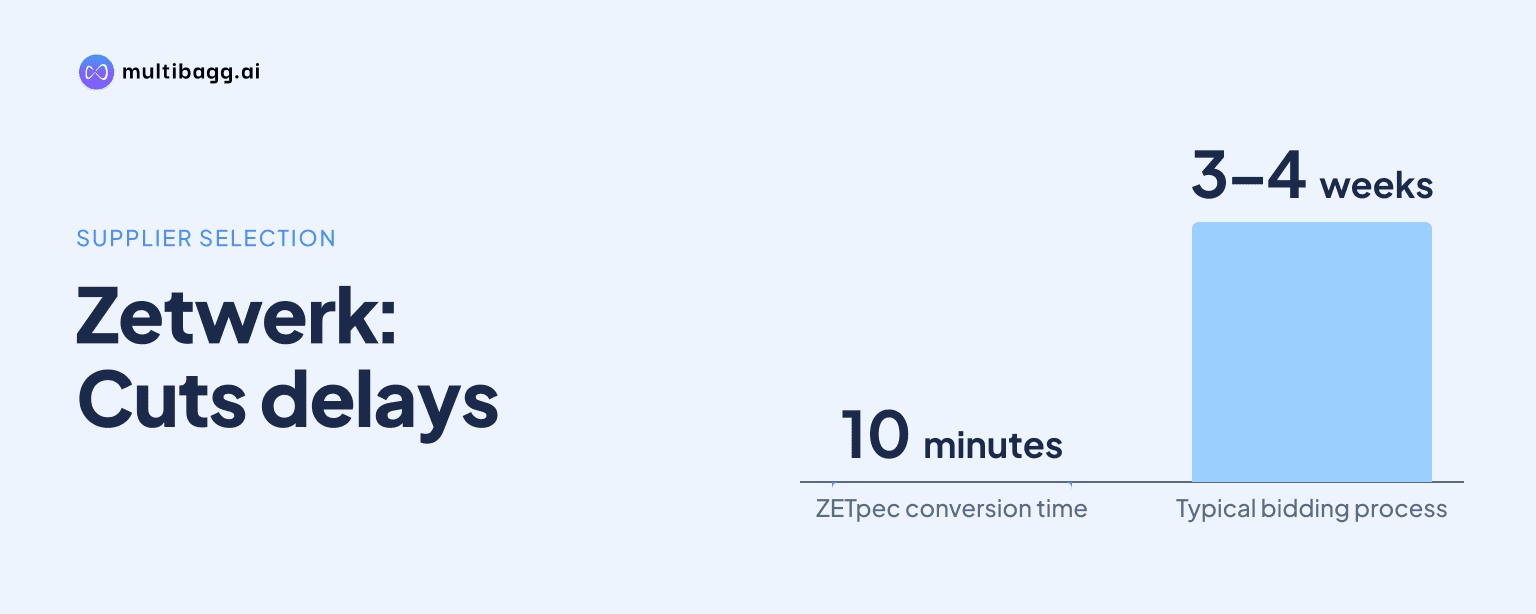
Zetwerk says its Zeus artificial intelligence platform has compressed supplier-selection decisions from days to minutes and hours, while ZETpec can turn a tender into a bill of materials in 10 minutes. Management said the tools draw on eight years of operating data and support workflows from customer requests for quotation through delivery.
Know Zetwerk Manufacturing Businesses inside out
Results, valuation, peers and who's buying, in one view.
How does Zetwerk OS manage an order from inquiry to delivery?
Zetwerk OS manages an order from a customer request for quotation, or RFQ, through quotation, manufacturing, quality checks, shipping and receipt by the customer. Management said it has built and deployed in-house software over the last seven to eight years for RFQ pricing, marketplace supplier selection, project management, quality, order-to-cash and procure-to-pay processes.
The system is intended to make production planning more consistent across products with different manufacturing cycles. Management used a wind-turbine component as an example, where the business must decide whether a part will take 30 days or 60 days to manufacture by combining physics-based drawing analysis with data from prior orders.
Zetwerk’s digital workflow covers both its captive and marketplace manufacturing models. In H1, captive factories accounted for 60% of manufacturing fulfilment and the marketplace model contributed 40%; management said the mix would skew more towards the marketplace in H2 as revenue from that model is recognised.
How is Zetwerk using AI to process tenders and RFQs?
Zetwerk is using ZETpec to shorten tender analysis, with management saying the tool converts a tender into a bill of materials in 10 minutes rather than the usual three to four weeks for the overall bidding process. ZETpec has been trained on thousands of private- and public-sector tenders that Zetwerk has bid on during the past eight years.
The company linked faster tender processing to the scale of order pursuit. Zetwerk won Rs 7,800 crore of orders in H1, 50% more than a year earlier, and said its typical win rate is about 20%. Management estimated that winning this volume would require bids on roughly Rs 30,000 crore to Rs 40,000 crore of opportunities, a workload it said is difficult to handle without software.
For RFQs, Zetwerk said its earlier response cycle took seven to 10 days and management’s goal is to respond within 24 hours. The 24-hour target is an aspiration rather than a reported current average, and the company did not disclose what share of its RFQs now receive an AI-assisted response.
How does Zeus select suppliers and manage quality requirements?
Zeus selects suppliers by analysing technical drawings, identifying the required manufacturing process and comparing the historical performance of suitable vendors. In an example involving aluminium die casting, management said Zeus can narrow hundreds of potential suppliers in Coimbatore to three or four vendors previously used by Zetwerk, compressing the decision from days to minutes and hours.
The supplier recommendation can use on-time delivery data alongside the drawing analysis. Management illustrated this by comparing a vendor with 80% on-time delivery against one with 50%, with the system directing the order to the better-performing supplier. Zetwerk did not provide a company-wide supplier delivery average, a count of suppliers assessed by Zeus or accuracy data for its recommendations.
Zetwerk also described an AI quality agent that reads each customer’s quality assurance plan and generates a standard operating procedure, or SOP, for shop-floor staff. The employee can follow the order-specific SOP while Zetwerk tracks compliance, connecting customer requirements to manufacturing quality controls.
Management said business users can now create internal tools through agentic software in minutes. Previously, a business request could require two to four weeks for engineering work and iteration, while final software could take three months; Zetwerk did not disclose how many tools have been built through the newer process.
Got a follow-up? Ask IRIS
What operating scale supports Zetwerk’s AI programme?
Zetwerk says its AI programme is based on a large internal operating footprint rather than a standalone software product. The company has 3,500 employees, including nearly 800 in design and engineering, or almost 20% of headcount. Management said these engineers assess whether a supplier can produce a component for a new sector despite having served another sector historically.
The workflow spans energy, precision and capital-goods manufacturing. Energy generated 64% of manufacturing revenue in H1, compared with almost 22% for precision and 14% for capital goods. The company also said 76% of revenue came from recurring build-to-print components, while 24% came from original design manufacturing, or ODM, where Zetwerk designs and manufactures the product.
The commercial setting for faster workflows is an order backlog of Rs 14,500 crore, described by management as an all-time high and almost 70% above the comparable prior period. International markets made up 46% of backlog and ODM represented 33%; management said backlog typically converts into revenue over about two years.
Zetwerk’s digital tools also extend to logistics visibility. Management showed an example of tracking a shipment from Mundra to the United States in real time as it travelled around Africa during the Middle East crisis, providing status visibility even where the route created an unforeseen delay.
What will Zetwerk focus on next for AI and execution?
Zetwerk’s next stated priority is to embed AI throughout the business while increasing capacity through its own network, captive factories and third-party suppliers. Management described the Rs 14,500 crore backlog as evidence of demand but also of supply constraints, making supplier assessment and execution monitoring important to converting orders into revenue.
Management also plans to use customer relationships to broaden categories including battery energy storage systems, or BESS, wire and cable, space and robotics. Zetwerk won its first BESS order in H1, while management described space and robotics as longer-term category-building efforts that may or may not succeed.
The company’s broader objective is to raise full-year gross margin towards 25%. Management said it expects to be closer to 21% in the current full year and suggested improvement of 100 to 200 basis points annually could put the 25% objective closer to FY29. Zetwerk did not quantify the portion of potential margin change attributable to AI.
Conclusion
Zetwerk presents its AI tools as operating infrastructure across a manufacturing network, from tender preparation and RFQ pricing to supplier selection, quality compliance and shipment tracking. The reported 10-minute tender-to-bill-of-material process and the stated reduction in supplier decisions from days to minutes sit within a business that used captive factories for 60% of H1 fulfilment and marketplace suppliers for 40%.
The next measures to watch are progress toward management’s 24-hour RFQ-response target, the H2 shift toward marketplace fulfilment and conversion of the Rs 14,500 crore backlog. Management also plans to embed AI filters across operations and pursue BESS, space and robotics, while adoption rates, productivity savings and recommendation accuracy for Zeus and ZETpec remain undisclosed.