










Zetwerk backlog reaches Rs 14,500 crore as precision grows
Key highlights
- Zetwerk’s Q2 FY27 order backlog was Rs 14,500 crore, up 67% year on year.
- Precision orders grew almost 80% year on year, with aerospace, defence and space contributing to growth.
- International work represented 46% of the backlog and 41% of H1 FY27 manufacturing revenue.
- Zetwerk won Rs 7,800 crore of orders in H1 FY27, 50% more than a year earlier.
powered by IRIS
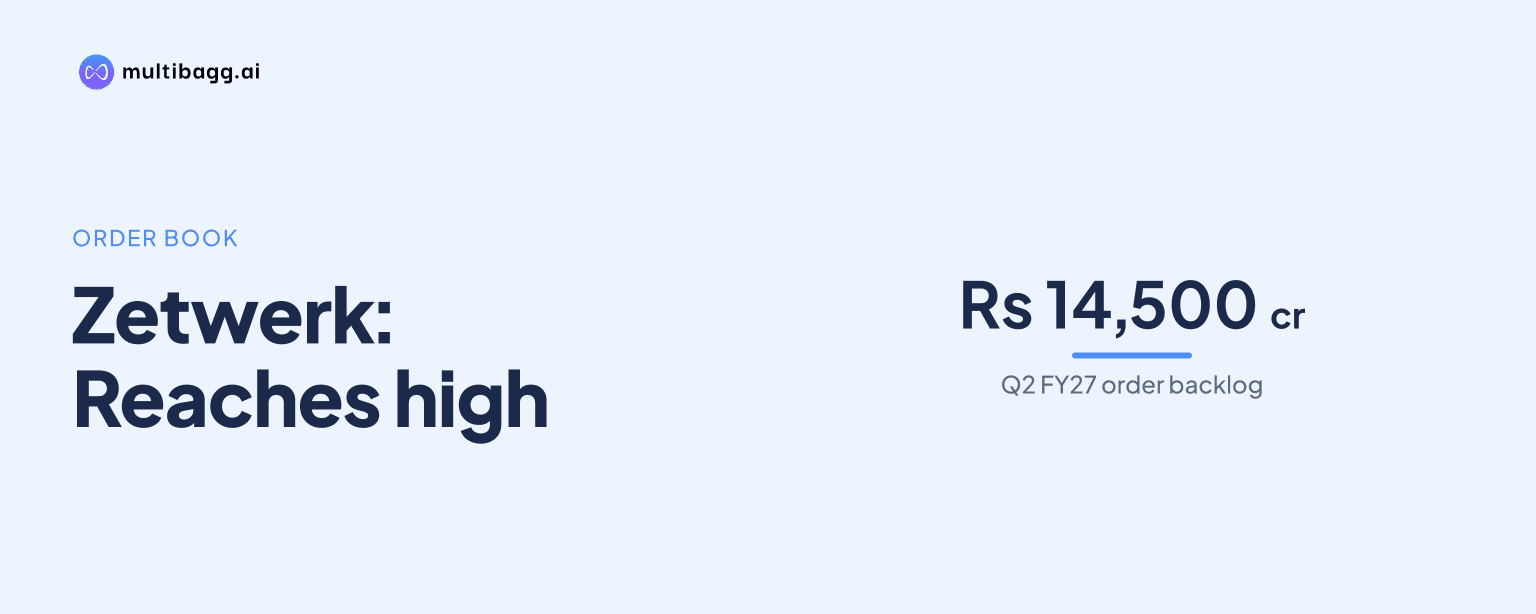
Zetwerk’s Q2 FY27 order backlog reached Rs 14,500 crore, up 67% year on year, as precision orders grew almost 80% and international work accounted for 46% of the book. Management said the all-time-high backlog provides roughly three years of revenue coverage, while orders typically convert into revenue over about two years.
Know Zetwerk Manufacturing Businesses inside out
Results, valuation, peers and who's buying, in one view.
What drove Zetwerk’s Rs 14,500 crore order backlog?
Zetwerk’s backlog growth was led by precision orders, while energy remained its largest manufacturing-revenue category. Energy accounted for 64% of manufacturing revenue in H1 FY27, precision contributed nearly 22%, and capital goods supplied the remaining 14%. Management said precision orders increased by almost 80% year on year, with aerospace, defence and space work contributing much of that growth.
Zetwerk won Rs 7,800 crore of orders in H1 FY27, 50% more than in the prior-year period. The awards included transformers for US customers, defence electronics for an Indian defence public-sector undertaking, cables, process-plant machinery, printed circuit board assemblies, or PCBAs, and transformer components. Management said capacity is the constraint on fulfilment and cited US power-transformer lead times of about three to five years, compared with its stated two-year delivery timeframe.
How much of Zetwerk’s backlog is international?
International work made up 46% of Zetwerk’s Q2 FY27 order backlog and 41% of manufacturing revenue in H1 FY27. The H1 revenue share was up from 30% in the prior year, showing that overseas business has increased both in current sales and in the future order book. Management identified US transformer demand and overseas energy customers as contributors to that change.
Management reported H1 FY27 manufacturing gross margin of 32% for international work, compared with 19% for India. In the prior year, the comparable margins were 28% internationally and 15% in India. Zetwerk’s first US transformer installation, in North Carolina, was completed in H1 FY27, and management said international exposure is one part of its mix, market and model approach to raising gross margin.
Why could precision and own-design orders change Zetwerk’s mix?
Precision orders could increase the share of aerospace, defence and space work in Zetwerk’s revenue mix. Precision represented nearly 22% of H1 FY27 manufacturing revenue, while aerospace and defence represented about 10% to 15% of the total order book. Management described aerospace, defence and space as higher-margin categories, but did not quantify the margin of each category.
Original design manufacturing, or ODM, accounted for 33% of Zetwerk’s order backlog. In H1 FY27, 24% of revenue came from products Zetwerk designed and manufactured, while 76% came from recurring build-to-print components designed by customers. Management said ODM carries a higher margin than regular business; manufacturing gross margin reached 25.5% in Q2 FY27, versus 23% in Q1 FY27 and 22% a year earlier.
Got a follow-up? Ask IRIS
What revenue visibility does Zetwerk’s backlog provide?
Zetwerk said its current backlog and new orders together provide roughly three years of revenue coverage. Management calculates this measure by dividing the current backlog plus orders won by current-year revenue, while saying a typical order backlog converts into revenue over approximately two years. The measure indicates contracted work, but the source does not disclose the timing or profitability of individual orders.
Zetwerk reported H1 FY27 revenue growth of 33% year on year and adjusted earnings before interest, tax, depreciation and amortisation, or adjusted EBITDA, growth of 70%. Q2 FY27 revenue rose 12% sequentially, while adjusted EBITDA, excluding non-cash employee stock option plan expense, was Rs 171 crore, 66% above Q1 FY27. Management expects H2 to exceed H1, noting that H1 represented 40% of both revenue and adjusted EBITDA in FY26.
How is Zetwerk planning to execute the growing order book?
Zetwerk plans to use captive factories and marketplace partners to fulfil its backlog. Captive factories accounted for 60% of H1 FY27 manufacturing fulfilment and marketplace partners for 40%, although management expects the mix to tilt more toward the marketplace model in H2. H1 gross margin was 25% for captive manufacturing and 24% for marketplace fulfilment, compared with FY26 margins of 23% and 17%, respectively.
The ecosystem segment supports manufacturing by supplying materials including aluminium, steel, zinc and copper. It generated nearly Rs 2,000 crore of revenue in Q2 FY27 but operates at a 2% to 3% gross margin and about a 1% EBITDA margin, according to management, because it does not take inventory positions or speculate on commodity prices. Manufacturing contributed about Rs 211 crore of segment EBITDA in H1 FY27, compared with Rs 20 crore from ecosystem.
Conclusion
Zetwerk’s order book has grown alongside a shift toward precision, international and ODM work, all of which management links to gross-margin expansion. Manufacturing gross margin increased to 25.5% in Q2 FY27 from 22% a year earlier, while the backlog adds contracted demand across energy, aerospace, defence, electronics and capital goods.
The next issue is execution through captive capacity and marketplace partners, particularly as management expects H2 FY27 to be larger than H1. Management has guided for FY27 revenue growth of 25% to 30% and adjusted EBITDA growth of 60% to 70%, and it has set an eventual goal of reaching close to 25% gross margin for a full year.