










ACME Solar Adds 66.68 MW at Bikaner Hybrid Project
Key highlights
- ACME Solar commissioned an additional 66.68 MW of solar capacity at Bikaner, Rajasthan.
- The Bikaner hybrid project’s operational capacity has reached 200.04 MW out of a total 300 MW.
- ACME Solar reported an 8,370 MW portfolio across solar, wind, storage, hybrid and FDRE projects.
- ACME Solar disclosed 5,380 MW of total under-construction contracted capacity.
powered by IRIS
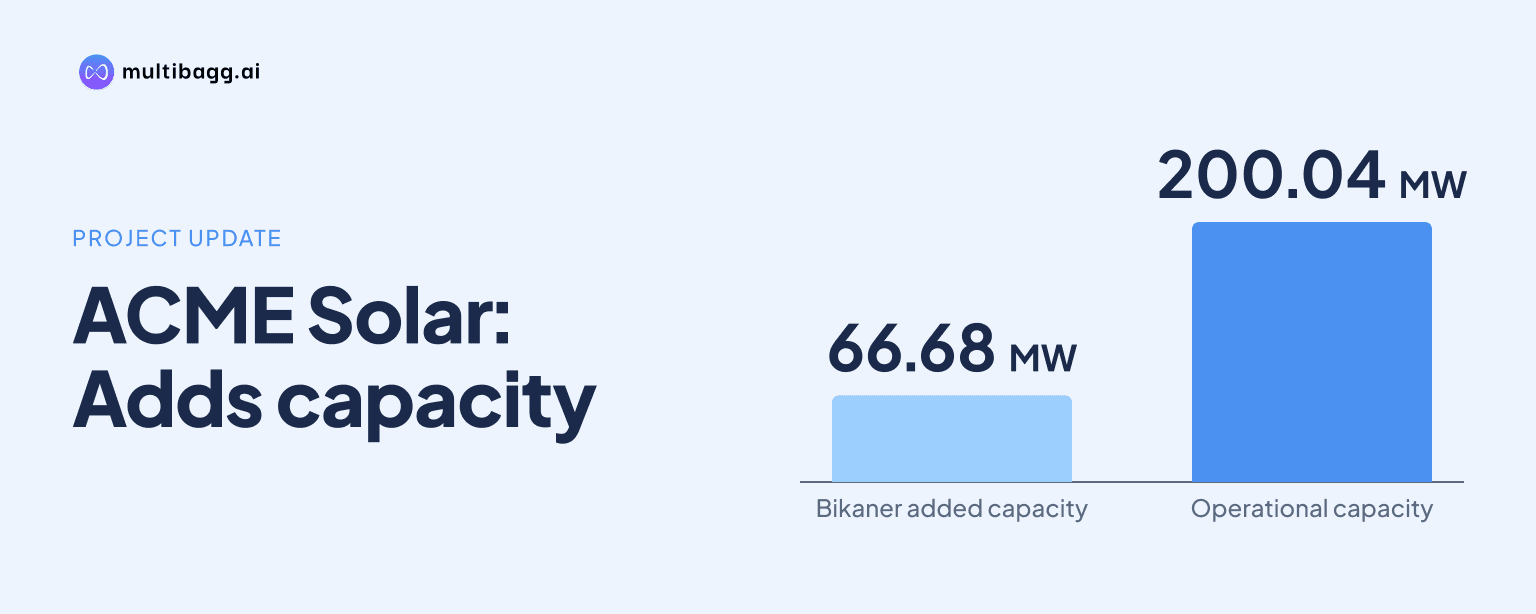
ACME Solar Holdings Limited added 66.68 MW of solar capacity at its Bikaner hybrid project in Rajasthan, lifting the project’s operational capacity to 200.04 MW. The commissioning adds to ACME Solar’s operating renewable base while the company continues to build a larger portfolio of hybrid and firm, dispatchable renewable energy projects.
Know ACME Solar Holdings inside out
Results, valuation, peers and who's buying, in one view.
What has ACME Solar commissioned in Bikaner?
ACME Solar commissioned an additional 66.68 MW of solar power capacity through its subsidiary, ACME Renewtech Private Limited, at the hybrid project in Bikaner. The latest addition takes the project’s total operational capacity to 200.04 MW.
The project is contracted with NTPC and has a total capacity of 300 MW. ACME Solar had previously disclosed the partial commissioning of 133 MW of solar capacity at the ACME Renewtech hybrid project. The new 66.68 MW addition increases the operational portion, although the source does not state a full commissioning date for the remaining project capacity.
Bikaner has become a significant renewable-energy location because of its solar resource and its role in Rajasthan’s wider clean-power buildout. For ACME Solar, the commissioning is an operational milestone within a project that combines its solar development activity with its growing focus on more dispatchable renewable-energy offerings.
Why does the 200.04 MW operating milestone matter?
The 200.04 MW milestone matters because it shows further execution at a 300 MW NTPC-contracted hybrid project. It raises the operating portion of the project to roughly two-thirds of its stated capacity, based on the disclosed figures.
The capacity addition comes as ACME Solar is tracking commissioning at the element level for its FDRE and hybrid assets. In its Q2 FY27 earnings-call commentary, management said that full commissioning of such plants depends on grid connectivity, referred to as G&A, and that timing could move by a quarter.
Management also stated that 1.9 GW was partially commissioned across sites, including solar at two locations and batteries at four locations. These assets were generating revenue under their PPAs except ACME Suryodha, according to the company’s commentary. Only 133 MW of grid-facing solar was operationalised during Q2 FY27.
How does Bikaner fit into ACME Solar’s project portfolio?
Bikaner fits into ACME Solar’s broader portfolio of solar, wind, storage, hybrid and FDRE projects. The company has reported an 8,370 MW portfolio across these technologies, with a growing share linked to firm and dispatchable supply requirements.
The company described itself as having a contracted FDRE pipeline of 4,031 MW, of which 2,980 MW, or 74%, had been converted into long-term PPAs with central government-backed off-takers. Separately, disclosures referenced 5,380 MW of total under-construction contracted capacity.
ACME Solar has continued to sign PPAs while developing its assets. It signed 430 MW of FDRE PPAs during Q2 FY27 and an additional 400 MW with NTPC, taking the PPA-assigned portfolio to 92% of the total contracted portfolio of 8,370 MW, according to the earnings-call highlights.
Got a follow-up? Ask IRIS
What is ACME Solar doing in firm and dispatchable renewable energy?
ACME Solar is expanding into FDRE projects that pair renewable generation with energy storage to provide power during specified periods, including evening and night-time peaks. This approach is relevant as renewable generation forms a larger share of India’s electricity mix and grid operators require supply that can meet contracted demand windows.
In October 2026, ACME Greentech Twenty Private Limited, a wholly owned subsidiary, signed a 300 MW and 1,200 MWh assured peak power purchase agreement with Solar Energy Corporation of India under FDRE Tranche IX. The tariff was Rs 6.00 per unit, and the project is intended to use solar generation and battery storage along with ACME’s existing night-time grid connectivity.
The company has also disclosed commissioning BESS components at Kelan and Neemri in Rajasthan. A September 2026 release referred to the commissioning of 66.68 MW of solar capacity and 300 MWh of BESS capacity in Rajasthan, demonstrating that solar generation and storage commissioning can occur in stages.
How does the capacity addition affect investors and the renewable sector?
For investors, the Bikaner commissioning provides a measurable update on construction progress at an NTPC-contracted project. Capacity becoming operational is relevant because PPAs govern the sale of power and because ACME Solar has said partially commissioned assets are generating revenue under their agreements, subject to the stated exception.
The update also needs to be read alongside the company’s execution disclosures. Management has identified grid connectivity as a factor in achieving full commissioning of FDRE and hybrid plants. Its FY27 target was about 1.5 GW of full commissioning, while partial commissioning could be higher at 2.53 GW, based on the figures cited in the earnings-call highlights.
For the renewable-energy sector, the project illustrates the shift from standalone solar development towards hybrid and storage-backed projects. The reported capacity addition does not alter the disclosed 300 MW project size, but it moves more of that contracted asset into operation.
Conclusion
ACME Solar’s additional 66.68 MW commissioning in Bikaner takes the operational capacity of its 300 MW NTPC-contracted hybrid project to 200.04 MW. The development adds operating solar capacity while supporting the company’s wider transition towards hybrid, storage and FDRE projects backed by long-term PPAs.
The next point to watch is progress towards full commissioning of the remaining Bikaner project capacity and the company’s FY27 target of about 1.5 GW of full commissioning. Grid connectivity remains a disclosed factor that can influence the timing of full project completion.