








Aster DM Quality Care Plans 4,230 Beds, Taking Capacity Above 15,000
MAX Plan at ₹4,999/yr

Find your next multibaggerBe a Pro Investor
Research stocks and track your picks on the go. Download the app.
Key highlights
- Aster DM Quality Care plans 4,230 additional beds from a base of 10,840 beds.
- The capacity pipeline is split 53% greenfield and 47% brownfield.
- The 454-bed Aster Trivandrum Hospital is included in the FY27 expansion pipeline.
- Aster DM Quality Care invested more than Rs 400 crore in capex in H1 FY27.
powered by IRIS
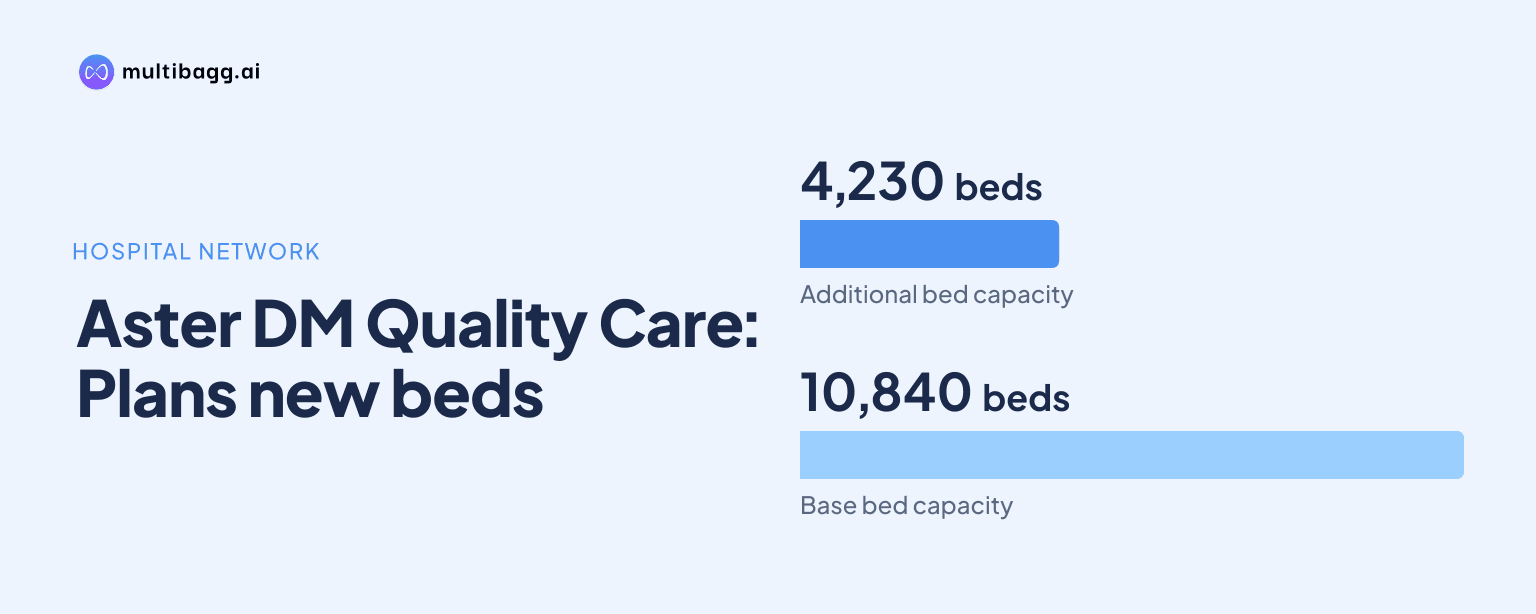
Aster DM Quality Care Limited plans to add 4,230 beds to its 10,840-bed capacity, taking the network above 15,000 beds, with 53% of additions greenfield and 47% brownfield. Management said the 454-bed Aster Trivandrum Hospital is in the FY27 pipeline and is progressing on its timelines.
Know Aster DM Quality Care inside out
Results, valuation, peers and who's buying, in one view.
How many beds is Aster DM Quality Care planning to add?
Aster DM Quality Care is planning 4,230 additional beds, which management said would lift capacity from 10,840 beds to more than 15,000. The expansion follows the first full quarter after the merger, when Q2 FY27 revenue rose 19% year-on-year to Rs 2,829 crore on a combined basis.
The 4,230-bed pipeline is about 39% of the existing 10,840-bed capacity. Management described the programme as combining capacity expansion with clinical-capability investment, including new specialist centres, doctors and medical technology, rather than adding beds alone.
The operational bed base had already expanded 4% year-on-year in Q2 FY27, primarily through additions at Kasaragod and Whitefield Block D. Occupied beds rose 8%, faster than the bed-base increase, and occupancy improved by 335 basis points to 68% during the quarter.
Aster DM Quality Care served 2.2 million patients in Q2 FY27, up 12% year-on-year. Management linked demand growth to more complex care in orthopaedics, gastroenterology, nephro-urology and oncology, areas where the network has added clinical staff, equipment and specialised services.
What is the greenfield and brownfield split in Aster DM Quality Care’s plan?
Aster DM Quality Care expects 53% of its 4,230 planned beds to be greenfield facilities and 47% to be brownfield additions at existing hospitals. Management said the mix would create new facilities while also deepening the network’s presence in established markets.
The 47% brownfield share means almost half the capacity programme is planned at operating hospital locations. Greenfield projects are new facilities, while brownfield projects expand existing assets, so the disclosed split combines market expansion with added capacity in the current network.
The first-half FY27 hospital-maturity data shows the importance of established sites. Mature hospitals represented 64% of operational beds, generated 73% of hospital revenue and contributed 83% of total operating earnings before interest, taxes, depreciation and amortisation, or EBITDA.
Emerging hospitals represented 10% of operational beds and 6% of revenue in H1 FY27, but patient volumes increased 53% and revenue grew 62% year-on-year. Management said Kasaragod and Nagercoil, two newly opened hospitals, largely drove that emerging-hospital growth.
Got a follow-up? Ask IRIS
Which hospital is included in Aster DM Quality Care’s FY27 expansion?
Aster DM Quality Care’s FY27 expansion includes the 454-bed Aster Trivandrum Hospital, which management said was progressing according to its timelines. The call did not disclose an opening date, project cost or the hospital-by-hospital allocation of the full 4,230-bed pipeline.
The 454-bed project is a disclosed component of the 4,230-bed capacity programme. Management did not specify how many of the remaining planned beds would be commissioned during FY27, so the available disclosure establishes a long-term capacity target rather than a complete annual opening schedule.
Aster DM Quality Care also onboarded more than 100 doctors in H1 FY27 and launched three named centres in Q2 FY27. They were the ARISE Robotic Spine Institute at Aster CMI, the CARE Cancer Institute in Raipur and the Foetal Medicine Centre of Excellence at Aster Medcity.
The company invested more than Rs 600 crore in medical technology over the preceding 18 months. In Q2 FY27, additions included one linear accelerator, or LINAC, one digital positron emission tomography-computed tomography scanner, three robots, two catheterisation laboratories and one magnetic resonance imaging system.
What has Aster DM Quality Care invested in its expansion programme?
Aster DM Quality Care invested more than Rs 1,200 crore in project, growth and refresh capital expenditure over the past 18 months, including more than Rs 400 crore in H1 FY27. Management said most first-half spending was directed to ongoing projects, with the balance allocated to medical equipment.
As of 30 September 2026, gross debt stood at Rs 3,959 crore, while cash, bank balances and current investments totalled Rs 2,240 crore. Net debt was therefore Rs 1,719 crore, and net debt to EBITDA was 0.87 times excluding lease liabilities and 1.72 times including them, both on a trailing-12-month basis.
Management said the balance sheet provides flexibility for planned investment while it focuses on capacity spending, integration benefits, debt and liquidity. The combined company reported Rs 16.6 crore of merger synergies in Q2 FY27, equal to an annualised run-rate of about Rs 65 crore against management’s estimated potential of about Rs 200 crore.
The expansion plan follows combined-basis H1 FY27 revenue growth of 20% to Rs 5,429 crore and operating EBITDA growth of 27% to Rs 1,255 crore. Operating EBITDA margin increased to 23.1% from 21.8% a year earlier, while normalised profit after tax after non-controlling interest rose 27% to Rs 457 crore.
Conclusion
Aster DM Quality Care has outlined a 4,230-bed programme that would take capacity above 15,000 beds from 10,840. The 53% greenfield and 47% brownfield allocation balances new facilities with expansion of established hospitals, while the H1 FY27 results show mature hospitals remained the main earnings contributor, generating 83% of operating EBITDA from 64% of operational beds.
The next points to watch are the FY27 progress of the 454-bed Aster Trivandrum Hospital and disclosures on the timing and location of the remaining pipeline. Management’s ability to invest more than Rs 400 crore of H1 FY27 capex in ongoing projects while working toward its estimated Rs 200 crore synergy potential will also shape execution of the capacity plan.

