








Aster DM Quality Care targets Rs 200 crore run rate in four quarters
MAX Plan at ₹4,999/yr

Find your next multibaggerBe a Pro Investor
Research stocks and track your picks on the go. Download the app.
Key highlights
- Aster realised Rs 16.6 crore of merger synergies in Q2 FY27, equivalent to a Rs 65 crore annualised run rate.
- Management said Aster can reach a Rs 200 crore annualised synergy run rate within three to four quarters.
- Q2 FY27 combined-basis revenue rose 19% to Rs 2,829 crore and operating EBITDA increased 25% to Rs 678 crore.
- Aster had 10,840 beds and a pipeline of 4,230 additional beds in Q2 FY27.
powered by IRIS
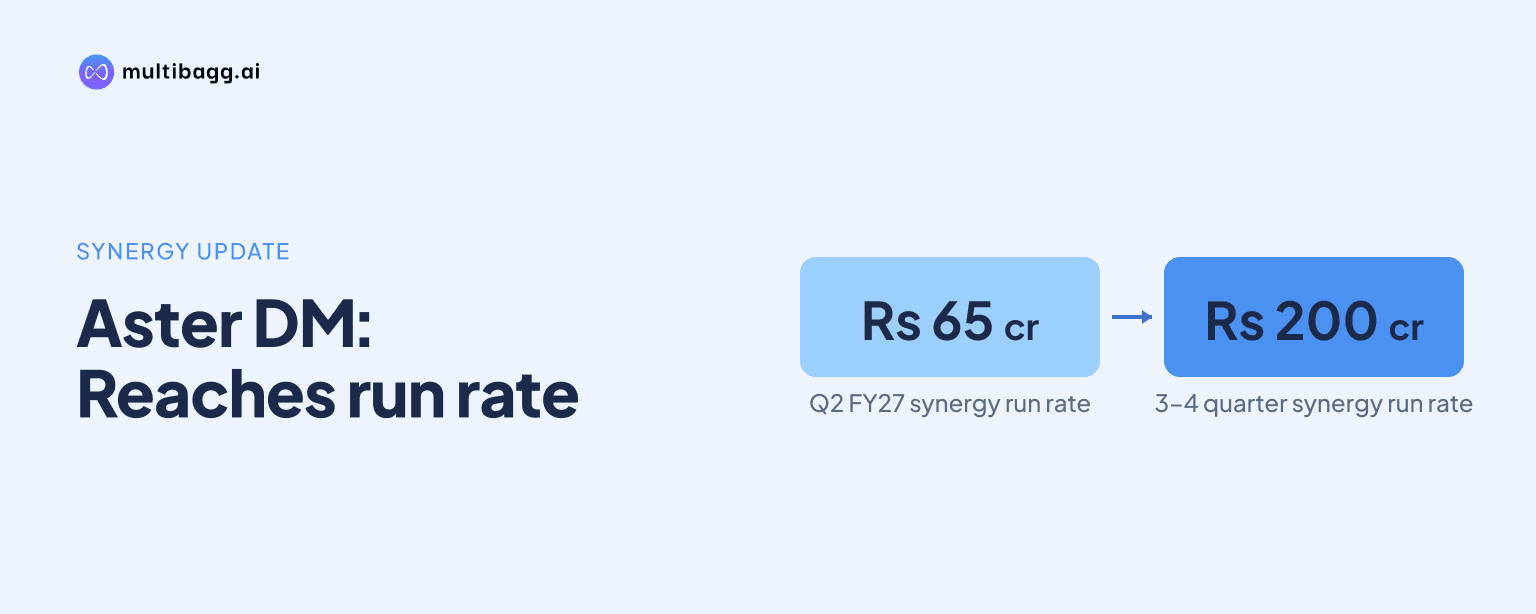
Aster DM Quality Care said in Q2 FY27 that it can reach a Rs 200 crore annualised merger-synergy run rate within the next three to four quarters, after realising Rs 16.6 crore in its first full combined quarter, equivalent to a Rs 65 crore annualised run rate. Management expects full realisation to take six or seven quarters.
Know Aster DM Quality Care inside out
Results, valuation, peers and who's buying, in one view.
What merger synergies did Aster deliver in Q2 FY27?
Aster realised Rs 16.6 crore of merger synergies in Q2 FY27, the first full quarter after the merger took effect on 1 July 2026. Management said that outcome represented an annualised run rate of about Rs 65 crore, against its full-potential estimate of about Rs 200 crore across integration levers.
The integration progress coincided with 19% combined-basis revenue growth to Rs 2,829 crore in Q2 FY27. Operating earnings before interest, tax, depreciation and amortisation, or EBITDA, rose 25% to Rs 678 crore, while the operating EBITDA margin increased by about 111 basis points to 24%.
Aster said its reported quarterly figures are not directly comparable year on year because the 30 September 2026 results include Quality Care only from 1 July 2026. The merger was accounted for under the pooling-of-interests method, and management used reviewed Aster DM Healthcare figures plus Quality Care pro forma figures to present combined-basis growth rates.
Can Aster reach a Rs 200 crore synergy run rate within four quarters?
Aster management said it expects to reach the Rs 200 crore annualised run-rate level by the fourth quarter from Q2 FY27. Responding to an analyst who referred to a three-year timetable, Varun Khanna said the benefit would be front-loaded and could be achieved faster, with the expected build occurring over the next three to four quarters.
Sunil Kumar M R said that reaching the run rate by the fourth quarter differs from fully realising the Rs 200 crore amount. He said the Q2 FY27 result of Rs 16.6 crore and its Rs 65 crore run rate gave management visibility on the next four quarters, while full realisation should occur by the sixth or seventh quarter.
The distinction matters because the Rs 200 crore figure is an annualised pace rather than the amount already captured in a single quarter. At the Q2 FY27 level, Aster had generated Rs 16.6 crore of synergies, and management did not provide quarterly targets for the remaining three or four quarters of the run-rate build.
Got a follow-up? Ask IRIS
What are Aster's main merger-synergy levers?
Aster said its integration programme uses a 10-point synergy wheel covering business key performance indicators, material costs, international medical tourism, quality and accreditation, food and beverage insourcing, information-technology integration, clinical programmes, talent sharing, indirect costs, renewable energy, and academics and nursing. Management did not disclose the rupee contribution expected from any individual lever within the Rs 200 crore objective.
Procurement is one identified mechanism, although management said the target should not be assessed through material costs alone. After sharing data following the merger, management found that 30% of articles were bought more cheaply by one entity than the other, creating an opportunity to standardise purchases at the lower price across the combined network.
Management also cited technology and insurance savings, while saying talent sharing can reduce the need to pay additional staff across hospitals. It said people-cost growth was significantly lower than patient-volume growth, but did not provide the rates, and added that procedure-level efficiency can reflect a mix of clinical, material, talent and indirect-cost changes.
How do Aster's operations and expansion plans support integration?
Aster's mature hospitals represented 64% of operational beds in the first half, but generated 73% of hospital revenue and 83% of total operating EBITDA. That segment recorded 18% revenue growth and 11% growth in total patient volume, supported by increasing clinical complexity.
Focus hospitals accounted for 15% of operational beds and 15% of revenue, reporting 7% patient-volume growth and 13% revenue growth. Emerging hospitals, which represented 10% of beds and 6% of revenue, increased patient volumes 53% and revenue 62%, led by the Kasaragod and Nagercoil hospitals.
The underperforming category increased revenue 24%, while operating EBITDA more than doubled, according to management. This category represented 11% of beds and about 5% of network revenue, compared with the mature category's 83% contribution to operating EBITDA.
Aster has invested more than Rs 1,200 crore in project, growth and refresh capital expenditure over the past 18 months, including more than Rs 400 crore in H1 FY27. It had 10,840 beds and a pipeline of 4,230 additional beds, of which 47% were brownfield and 53% greenfield; the 454-bed Aster Trivandrum Hospital was progressing as part of FY27 expansion.
Balance-sheet figures at 30 September 2026 showed gross debt of Rs 3,959 crore, cash, bank balances and current investments of Rs 2,240 crore, and net debt of Rs 1,719 crore. Net debt to trailing-12-month EBITDA was 0.87 times excluding lease liabilities and 1.72 times including them, while H1 FY27 combined-basis revenue rose 20% to Rs 5,429 crore.
Conclusion
Aster has established a Rs 65 crore annualised synergy run rate in its first full combined quarter, following Rs 16.6 crore of Q2 FY27 synergies. Its Rs 200 crore target rests on procurement rationalisation, clinical and staffing efficiencies, technology, insourcing and other network-wide actions, alongside revenue growth across mature, focus, emerging and underperforming hospitals.
The next measure to watch is management's stated goal of reaching the Rs 200 crore annualised pace within three to four quarters and fully realising that level by the sixth or seventh quarter. Execution of the 4,230-bed pipeline, including the 454-bed Aster Trivandrum Hospital in FY27, will also run alongside the integration programme and continued capital expenditure.

