








Aster targets 24%-25% full-year operating EBITDA margin
MAX Plan at ₹4,999/yr

Find your next multibaggerBe a Pro Investor
Research stocks and track your picks on the go. Download the app.
Key highlights
- Aster reported a 24% operating EBITDA margin in Q2 FY27, compared with 23.1% in H1 FY27.
- Management targets a 24%-25% full-year operating EBITDA margin within two to three years after the merger.
- Aster expects the complete synergy run-rate within four quarters and the full benefit in six to seven quarters.
- Aster cited three-to-nine-month break-even periods at Whitefield, Nagercoil and Kasaragod.
powered by IRIS
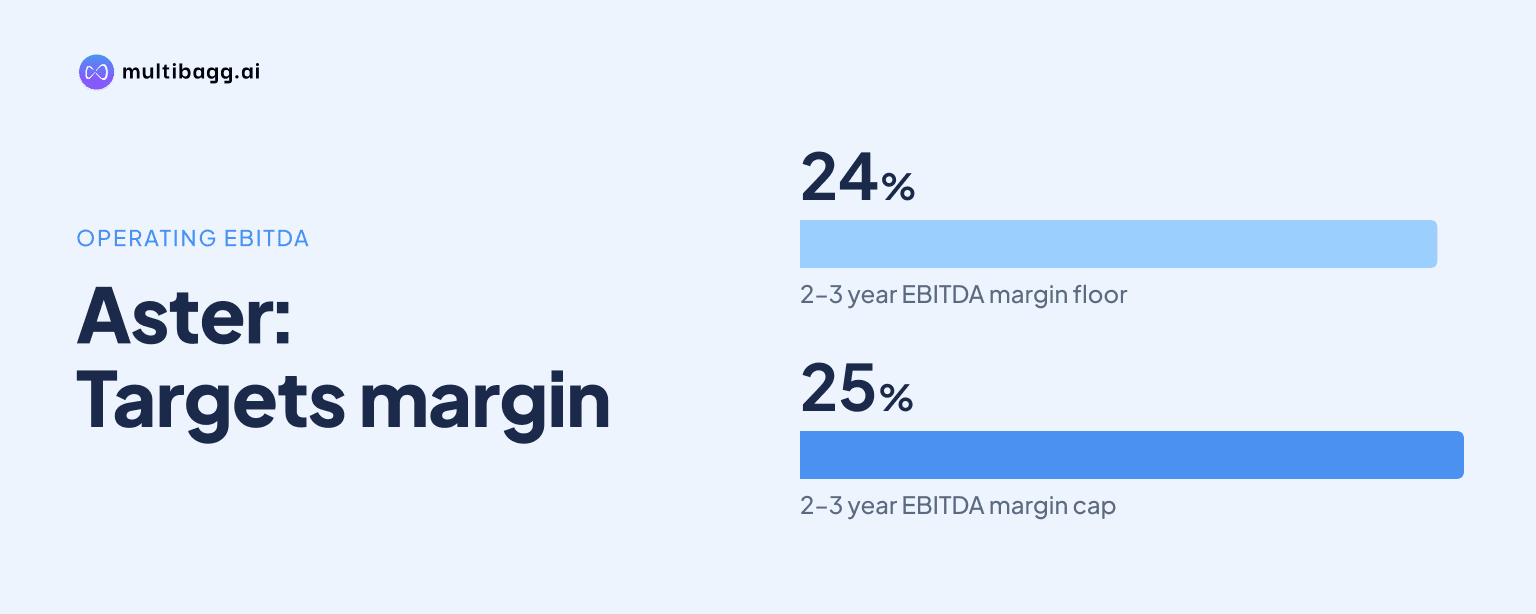
Aster DM Quality Care targets a 24%-25% full-year operating earnings before interest, tax, depreciation and amortisation (operating EBITDA) margin within two to three years after the merger, compared with 23.1% in H1 FY27 and 24% in Q2 FY27. Management said the Q2 result is not a new baseline because seasonal medical volumes supported the quarter and Q3 and Q4 include festive periods.
Know Aster DM Quality Care inside out
Results, valuation, peers and who's buying, in one view.
Why is Aster not treating its 24% Q2 FY27 margin as a baseline?
Aster said its Q2 FY27 operating EBITDA margin was 24%, but management said a single quarter should not be used as the basis for expectations. The H1 FY27 operating EBITDA margin was 23.1%, making the half-year result the broader reported comparison for a full-year margin target.
Management attributed part of the Q2 FY27 outcome to seasonal conditions. It said both CONGO and non-CONGO performed well, with CONGO growing more than 16% and non-CONGO more than 19%. Medical specialties also received support in some geographies where dengue cases doubled, according to management.
Aster said healthcare has seasonality and that Q3 and Q4 are more festive quarters, when margins may not match the Q2 FY27 level. The 0.9-percentage-point difference between the 24% Q2 margin and 23.1% H1 margin shows that the second quarter was above the first-half average.
What is Aster's full-year operating EBITDA margin target?
Aster's management target is a 24%-25% operating EBITDA margin for the full year within two to three years after the merger. Sunil Kumar M R confirmed that timeframe after an analyst asked whether the company expected to reach the range in two to three years.
The target is not guidance for the remaining quarters of FY27. Management said the two-to-three-year plan includes merger synergies, greenfield hospitals, 1,800 to more than 2,000 brownfield beds and acquisitions, rather than depending only on higher utilisation at current hospitals.
An analyst referred to a reported EBITDA margin of around 23.5% in Q2 FY27, alongside the 24% operating EBITDA margin. Management's response and the 24%-25% objective specifically referred to operating EBITDA, and the transcript did not provide a reconciliation between the reported and operating measures.
How will synergies and greenfield hospitals affect Aster's margins?
Aster expects to reach the complete synergy run-rate within four quarters, with the full benefit visible in six to seven quarters. Management did not disclose the synergy value in rupees or quantify its expected contribution to the 24%-25% margin objective.
An analyst asked whether about 1,200 greenfield beds due over the next 18 months could offset synergy gains through start-up losses and create a later margin J-curve. Management said it does not expect a profit-and-loss drag from these openings, whether synergies are available or not, because the projects are in operating clusters it knows well.
Aster cited three prior greenfield ramp-ups: Whitefield broke even in three months, Nagercoil in four months and Kasaragod in nine months. Management described the losses as negligible and said synergies would act as a backup, but the cited break-even periods do not establish that every future site will follow the same path.
Got a follow-up? Ask IRIS
Which hospitals are expected to provide the margin expansion?
Aster identified its mature hospital segment as a key contributor, with operating EBITDA margin of 30.2% in the discussion. An analyst said the segment had almost 40% incremental flow-through on an H1-to-H1 basis while revenue grew 20%, though management did not supply the underlying revenue or EBITDA figures for either half-year.
Management said larger mature hospitals can benefit from efficiency because costs do not increase in the same proportion as activity. It plans to add around 2,000 beds to this segment through brownfield expansion, and said these beds should become productive from day zero rather than carry the ramp-up period of a new hospital.
Aster also plans to build higher-complexity services at mature hospitals through investments in robots, the full range of CONGO-T and quaternary care. Management said these measures should increase average revenue per occupied bed and clinical complexity, while increasing average length of stay somewhat; it did not provide projected figures for either measure.
How is Aster measuring the combined hospital network?
Aster said it reviews all 38 hospitals as one network and no longer reports quarterly revenue, EBITDA or margins separately for Aster DM and Quality Care. Management said its cited 19% revenue growth and 25% EBITDA growth were both calculated on the combined basis.
The integrated approach also applies to monthly management information system reviews, where management said the two legacy brands are not reviewed separately. Of roughly 10,600 operational beds, Aster said about 80%-81% are census beds and about 20% are non-census beds, without providing revenue, occupancy or margin by those categories.
Management linked the combined structure to the expected synergy timetable, including regional leadership arrangements across hospitals in Kerala and Maharashtra. It did not quantify cost savings from the organisational changes, so progress toward the four-quarter synergy run-rate remains the disclosed operational milestone.
Conclusion
Aster's 24%-25% full-year operating EBITDA margin objective is a medium-term management target, not an indication that Q2 FY27's 24% margin will recur in every quarter. The reported comparison is 23.1% in H1 FY27 against 24% in Q2 FY27, while mature hospitals with a 30.2% operating EBITDA margin, brownfield additions and network integration form the stated route to improvement.
The next measures to watch are the complete synergy run-rate expected within four quarters and the full benefit anticipated in six to seven quarters. Management's execution on about 1,200 greenfield beds over 18 months, 1,800 to more than 2,000 brownfield beds, greenfield break-even times and any acquisitions will determine progress toward the two-to-three-year target.

