








Aster DM Quality Care Mature Hospitals Deliver 83% of EBITDA
MAX Plan at ₹4,999/yr

Find your next multibaggerBe a Pro Investor
Research stocks and track your picks on the go. Download the app.
Key highlights
- Mature hospitals represented 64% of operational beds and generated 83% of operating EBITDA in H1 FY27.
- Mature-hospital revenue rose 18% in H1 FY27, supported by 11% growth in total patient volume.
- Emerging-hospital revenue increased 62% and patient volume grew 53% in H1 FY27.
- Underperforming-hospital revenue grew 24% and operating EBITDA more than doubled in H1 FY27.
powered by IRIS
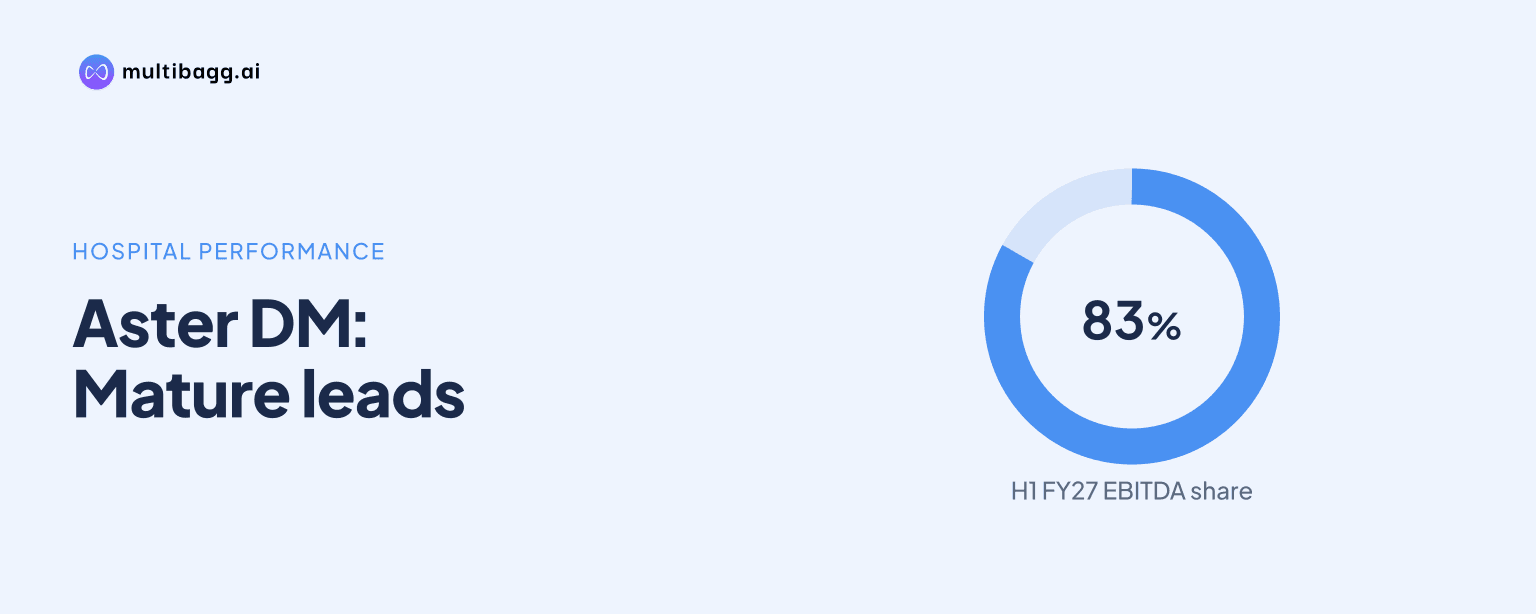
Aster DM Quality Care Limited’s mature hospitals generated 83% of total operating earnings before interest, tax, depreciation and amortisation (operating EBITDA) in the first half of fiscal year 2027 (H1 FY27), despite representing 64% of operational beds; their revenue grew 18%, backed by 11% higher patient volume.
Know Aster DM Quality Care inside out
Results, valuation, peers and who's buying, in one view.
How concentrated is Aster DM Quality Care’s hospital profitability?
Aster DM Quality Care’s mature hospitals were its principal disclosed earnings contributor in H1 FY27, producing 83% of operating EBITDA from 64% of operational beds and 73% of hospital revenue. The 19-percentage-point difference between the segment’s EBITDA share and bed share indicates that operating earnings were concentrated in established facilities.
The company’s disclosed mature, focus and emerging categories together represented 89% of operational beds and contributed 94% of revenue. Aster DM Quality Care did not disclose the bed share, revenue share or operating EBITDA contribution of its underperforming-hospital category.
Aster DM Quality Care reported combined-basis H1 FY27 revenue of Rs 5,429 crore, up 20% year on year, and operating EBITDA of Rs 1,255 crore, up 27%. Management said the merger took effect on 1 July 2026 under the pooling-of-interests method, so prior reported periods were not restated and the growth figures use combined reviewed and pro forma comparatives.
What drove mature-hospital revenue growth in H1 FY27?
Aster DM Quality Care said mature-hospital revenue increased 18% in H1 FY27 because total patient volume rose 11% and clinical complexity increased. Revenue growth was therefore 7 percentage points ahead of volume growth, although the company did not provide mature-hospital pricing, margin or absolute revenue figures.
Across the network, clinical investments supported more complex treatment in orthopaedics, gastroenterology, nephro-urology and oncology. Aster DM Quality Care added more than 100 doctors in H1 FY27, while, in the second quarter of fiscal year 2027 (Q2 FY27), robotic surgeries increased 39%, kidney transplants 31% and joint replacements 29%.
Network utilisation also improved in Q2 FY27: operational beds grew 4% year on year, while occupied beds grew 8%, lifting occupancy by 335 basis points to 68%. Revenue rose 19% to Rs 2,829 crore and operating EBITDA increased 25% to Rs 678 crore, producing a 24% operating EBITDA margin.
How are Aster DM Quality Care’s focus and emerging hospitals performing?
Aster DM Quality Care’s focus hospitals grew revenue 13% year on year in H1 FY27 after total patient volume increased 7%, which management attributed to investments in clinical capabilities. The category accounted for 15% of both operational beds and revenue, unlike mature hospitals, whose revenue share exceeded their bed share by 9 percentage points.
Emerging hospitals recorded the fastest disclosed growth, with patient volume up 53% and revenue up 62% in H1 FY27. These newly launched facilities represented 10% of operational beds but only 6% of revenue, and management identified Kasaragod and Nagercoil as the principal growth drivers.
At those locations, Aster MIMS Kasaragod performed the district’s first mechanical thrombectomy, while KIMSHEALTH Nagercoil launched a deceased-donor transplant programme and a comprehensive stroke unit. Aster DM Quality Care did not disclose individual revenue, operating EBITDA or margin figures for either hospital.
Got a follow-up? Ask IRIS
Are Aster DM Quality Care’s underperforming hospitals improving?
Aster DM Quality Care said revenue at underperforming hospitals rose 24% in H1 FY27 and operating EBITDA more than doubled, while total patient volume increased 7%. Management attributed the performance to higher occupancy, growth in inpatient volumes and better conversion of outpatients into inpatients.
The segment’s 24% revenue growth was more than three times its patient-volume growth of 7%. Aster DM Quality Care did not provide the segment’s starting operating EBITDA, absolute operating EBITDA, margin, bed base or share of group revenue, limiting a comparison of its profitability with mature hospitals.
The stated growth mechanisms differed across the portfolio in H1 FY27: mature hospitals benefited from clinical complexity, focus hospitals from capability investments, emerging hospitals from new-site ramp-up, and underperforming hospitals from utilisation and patient conversion. Emerging-hospital revenue growth of 62% was closest to its 53% volume growth, whereas mature-hospital revenue rose 18% on 11% volume growth.
What does the portfolio mix mean for Aster DM Quality Care’s expansion?
Aster DM Quality Care’s expansion plan will add capacity beyond the mature-hospital base that produced 83% of operating EBITDA in H1 FY27. The company had 10,840 beds and a pipeline of 4,230 additional beds, with management targeting capacity of more than 15,000 beds.
Management said 47% of planned beds are brownfield additions at existing hospitals and 53% are greenfield projects. The 454-bed Aster Trivandrum Hospital forms part of the fiscal year 2027 expansion plan and was progressing to its stated timeline, according to management.
The company invested more than Rs 1,200 crore in project, growth and refresh capital expenditure over the preceding 18 months, including more than Rs 600 crore in medical technology. In Q2 FY27, it added one linear accelerator, one digital positron emission tomography-computed tomography scanner, three robots, two catheterisation laboratories and one magnetic resonance imaging machine.
Conclusion
Aster DM Quality Care’s H1 FY27 segmentation shows that its established hospitals supplied a disproportionate share of earnings, with 64% of beds generating 73% of hospital revenue and 83% of operating EBITDA. At the same time, emerging hospitals grew revenue 62%, while underperforming hospitals increased revenue 24% and more than doubled operating EBITDA.
The next measure is the pace at which Aster DM Quality Care adds and ramps its 4,230-bed pipeline while maintaining performance at mature facilities. Management reported Rs 16.6 crore of Q2 FY27 synergies, or about a Rs 65 crore annualised run rate, against an estimated Rs 200 crore opportunity, and said it anticipated reaching that run-rate impact over the next three to four quarters.

