










Energy in Motion says 2,000 trucks can improve profitability
Key highlights
- Energy in Motion said a 2,000-vehicle annual run rate should be very positive for its business.
- Energy in Motion reported truck contribution margin of about 6%, versus an earlier range of about 8%.
- Energy in Motion said swapping-station utilisation is less than 30% and needs two to three more quarters to mature.
- Energy in Motion said its battery-inclusive truck package saves customers Rs 10 lakh annually after a Rs 25 lakh higher upfront cost.
powered by IRIS
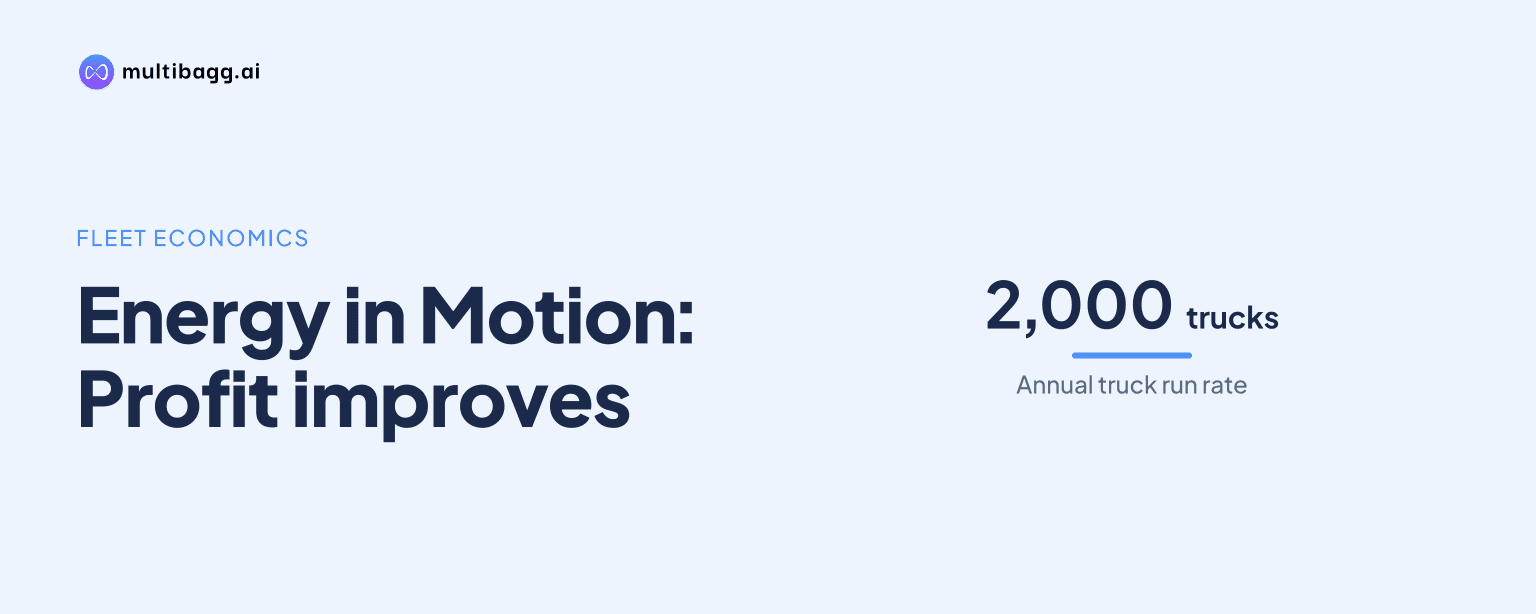
Energy in Motion said in its earnings call that a 2,000-vehicle annual run rate should be very positive for its electric-truck business, where truck contribution margin was about 6% and battery-swap-station utilisation was below 30%. Management said higher vehicle sales and greater network use must work together to improve profitability.
Know Ravindra Energy inside out
Results, valuation, peers and who's buying, in one view.
What sales scale does EIM say can improve profitability?
EIM said an annual run rate of 2,000 vehicles should be very positive for the business. Management did not call that volume a precise breakeven threshold, provide a target date for reaching it, or disclose a profit forecast for the electric-truck operation. It instead described the figure as a broad indicator of the scale required for a healthier business outcome.
The mechanism has two linked parts: truck volumes in the original equipment manufacturer, or OEM, operation and swaps per station in the charging network. Management said the two businesses are synergistic because network expansion can support vehicle sales, while more vehicles raise station use. It reported quarter-on-quarter improvement in utilisation and per-unit profitability, while saying the network needs another two to three quarters to mature.
Truck contribution margin of about 6% was lower than the earlier range of about 8%. Narendra Murkumbi said rupee weakness had a small effect on that decline. The change means EIM is pursuing higher sales and network throughput while its current per-truck contribution is lower than the earlier level.
Why does EIM need higher swap-station utilisation?
EIM said utilisation measured as swaps per station is currently less than 30%, and that filling the network with more trucks should produce a healthier bottom line for the network business. Management said it can already see quarter-on-quarter gains in both utilisation and per-unit profitability, but expects the operation to need two to three more quarters to mature.
A typical swapping station has 2.5 to 3 megavolt-amperes, or MVA, of outdoor consumption, according to management. It said one station can take 2 to 2.5 megawatts, or MW, of solar power during the day without battery energy storage, and as much as 4 MW when storage is considered. These power requirements connect the charging buildout with the group's renewable-energy strategy.
Management said adding 100 swap stations over the next 18 months could require 200 to 300 MW of solar capacity. It does not intend to build all this capacity itself: EIM may use open-access arrangements where state policies are favourable, partner with state-level operators, or develop projects where it considers ownership necessary.
Ravindra Energy is trading about 120 MW of electricity each month during the year, management said. It expects this activity to help source lower-cost electricity for the charging network, although it did not quantify any saving per station, truck or unit of energy sold.
Got a follow-up? Ask IRIS
What customer economics does EIM cite for electric trucks?
EIM said a customer buying its truck without a battery pays Rs 25 lakh more upfront than for a diesel truck. Management said its package that includes the battery saves Rs 10 lakh a year, producing a stated payback period of two and a half years. This comparison was management's explanation for why the product can offer lower operating costs despite a higher initial vehicle price.
Management said adoption is gradual because transporters have used diesel trucks for more than 50 years. It cited customers with fleets of more than 1,000 diesel trucks that started with two EIM vehicles, increased to five, and were negotiating for 20. These examples describe staged fleet conversion rather than an immediate replacement of diesel fleets.
About half of EIM sales are now repeat sales to customers already using its trucks or to customers who had used other electric-truck brands before shifting to EIM, management said. It did not disclose the total truck volume sold, the number of repeat customers or the value of orders under negotiation.
More than 10 banks are lending to customers buying EIM vehicles without batteries, management said. It also identified leasing companies, specialised green-finance leasing companies and large non-banking financial companies as active funding providers. Management said this financing pipeline has developed quickly given the recent adoption of electric heavy vehicles.
Which operating milestones could lift EIM volumes?
EIM expects to commission charging infrastructure on the Mumbai-Pune corridor by the end of November and subsequently move goods from JNPT to Pune using electric trucks. Management did not provide freight volumes, charging frequency or expected revenue from that corridor, but the route would create an internal use case for its charging infrastructure.
Management expects full-scale production at its factory from January, which it described as the following quarter. It also expects to start its battery plant in January, using CATL's latest heavy-vehicle battery-pack model after kits arrive from China later in the quarter. Management said the new packs have a significantly improved life compared with the current generation, without providing a cycle-life figure.
EIM said it will remain focused on heavy commercial trucks weighing 18 tonnes and above rather than move into smaller vehicles or buses. Its network is built around its own battery-swapping infrastructure but can charge medium- and heavy-duty vehicles from other operators, according to management.
How could solar-asset monetisation support EIM expansion?
Management said monetising solar assets with government and corporate PPAs is a top priority because it wants to direct capital and expertise towards a nationwide charging and battery network. It said it would prefer to complete monetisation sooner rather than later, but did not disclose a buyer, transaction value, timetable or committed use of proceeds.
The proposed merger is also part of the capital-allocation plan. Management said the scheme had been filed with stock exchanges, expected it to move to Securities and Exchange Board of India review by the end of that month, and identified September 2027 as a likely completion date, subject to approvals. It also referred to about Rs 900 crore of network post-merger, while saying it would return with the requested diluted-equity figure.
Conclusion
EIM's stated profitability path depends on a combination of a 2,000-vehicle annual sales run rate, greater use of a network operating below 30% utilisation, and further improvement in per-unit economics. The contribution margin of about 6%, down from about 8%, makes both truck volume and network volume central to management's explanation.
The next disclosed milestones are the end-November Mumbai-Pune corridor commissioning and the January targets for full-scale factory production and battery-plant start-up. Management also expects two to three more quarters of network maturation and said it has started disclosing energy sold, providing measures that can be tracked alongside truck volumes, utilisation and any solar-asset monetisation proposal.