










Ravindra Energy Limited Releases Q2 FY27 Call Recording
Key highlights
- Ravindra Energy Limited released its Q2 and H1 FY2026-27 earnings-call recording on November 5, 2026.
- The investor call covered results for the quarter and half year ended September 30, 2026.
- Management referred to MOUs for nearly 1,500 vehicles, with deliveries linked to charging-network commissioning.
- The supplied call summary said full-scale battery-plant production was scheduled to begin in January.
powered by IRIS
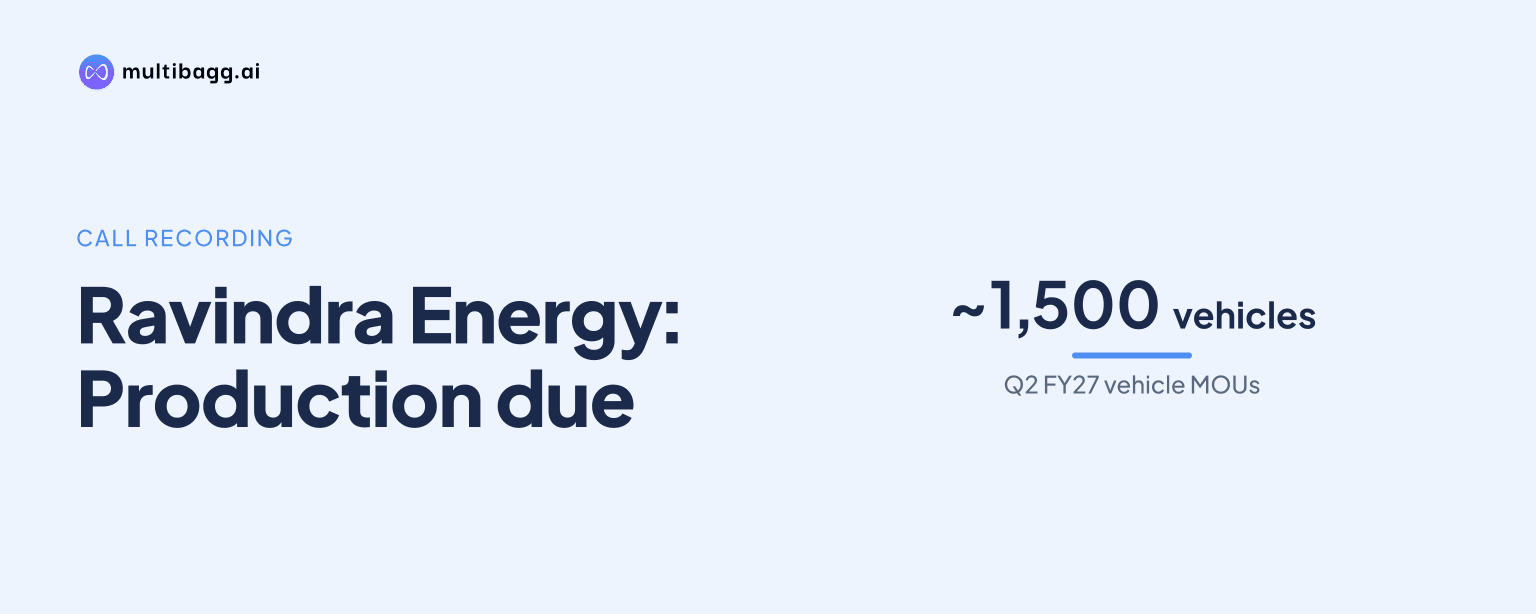
Ravindra Energy Limited released the recording of its November 5, 2026 investor call on Q2 and H1 FY2026-27 results for the period ended September 30, 2026, meeting its disclosure obligations under SEBI listing regulations. The filing makes management's results discussion available to investors after the company approved unaudited quarterly and half-yearly results.
Know Ravindra Energy inside out
Results, valuation, peers and who's buying, in one view.
What did Ravindra Energy Limited disclose on November 5, 2026?
Ravindra Energy Limited disclosed that the audio recording of its earnings call with investors had been made available on its website. The call covered the company's unaudited standalone and consolidated financial results for the quarter and half year ended September 30, 2026.
The disclosure was filed as an outcome of an analyst or investor meet under Regulation 30 of the SEBI (Listing Obligations and Disclosure Requirements) Regulations, 2015. The company also cited Regulation 46(2)(oa), which covers information required to be hosted on a listed entity's website.
The exchange announcement itself did not provide a financial-results table, management guidance, or a call transcript. It was limited to notifying investors that the audio recording of the discussion was accessible through Ravindra Energy Limited's website.
This distinction is relevant for investors reviewing the filing. The November 5 disclosure confirms the availability of the call recording, while the underlying quarterly and half-yearly financial statements remain the primary documents for reported accounting figures.
When was the Q2 and H1 FY27 investor call held?
Ravindra Energy Limited held the conference call at 9:30 AM IST on November 5, 2026, to discuss Q2 and H1 FY2026-27 results. The company had informed the exchanges of the planned call on November 2, 2026.
The call followed the Board meeting on November 4, 2026, at which Ravindra Energy Limited approved unaudited standalone and consolidated results for the quarter and half year ended September 30, 2026. The Board also considered a monitoring agency report from CARE Ratings on utilisation of funds from a previous rights issue.
Available event information named Chief Executive Officer Shantanu Lath, Vice Chairman Narendra Murkumbi, and Pankil Shah of Energy in Motion's finance function as participants. The scheduled interaction gave analysts and shareholders a forum to hear management's discussion after the results approval.
Ravindra Energy Limited had also released an investor presentation following an investor meet held on September 29, 2026. That earlier presentation and the November earnings call are separate investor-engagement disclosures, although both form part of the company's communication with stakeholders.
What operational points emerged from the earnings call discussion?
Ravindra Energy Limited's Q2 FY27 call discussion highlighted expansion and indigenisation plans in its electric-mobility business, according to the supplied call summary. Management indicated that memorandums of understanding covered almost 1,500 vehicles, with deliveries linked to commissioning of the charging network.
The same summary said full-scale production at the battery plant was scheduled to begin in January. The timing was presented as an operational milestone in the company's electric-mobility roadmap rather than as a quantified financial forecast.
A reported question-and-answer exchange attributed to Chief Executive Officer Shantanu Lath said that the specific order book would not be disclosed. However, he referred to MOUs for nearly 1,500 vehicles to be delivered as the network is commissioned. MOUs are indications of commercial intent and should not automatically be treated as recognised revenue or firm executed orders.
The supplied call summary also listed quarterly turnover of ₹31 crore from electricity generation, ₹26 crore from electricity trading, and ₹190 crore in revenue from service concession equipment in consolidated cases. These figures were reported in the call summary and are not contained in the Regulation 30 recording-availability announcement itself.
Got a follow-up? Ask IRIS
Why does the recording matter for Ravindra Energy Limited investors?
The recording matters because it gives investors direct access to management commentary around the September-quarter results and operational priorities. It also allows shareholders who could not attend the live call to review the discussion of electric mobility, charging-network commissioning and battery-plant plans.
For listed companies, recordings and transcripts where available improve access to the same information across analysts and retail investors. Ravindra Energy Limited's disclosure confirms the recording has been placed on its website, rather than limiting the discussion to participants on the live call.
The 1,500-vehicle MOU figure is a relevant operating indicator because management tied potential vehicle deliveries to charging-network commissioning. But the disclosed material does not specify a delivery value, customer-wise breakup, execution schedule, or the conversion of MOUs into binding orders.
Similarly, the reported January battery-production schedule is a timeline to monitor, not a statement of achieved output. Investors assessing the impact on financial performance would need to compare subsequent filings for production progress, charging-network rollout, order execution and reported revenue.
How does this disclosure affect the market and sector context?
The filing does not report a share-price movement, trading volume, revised earnings forecast, or a new capital-raising plan. Therefore, no direct market reaction can be established from the information supplied. Its immediate significance is disclosure-related: it expands availability of the management interaction held after the Q2 and H1 results.
Operationally, the call points to Ravindra Energy Limited's focus on electric-mobility infrastructure and domestic battery production. Network commissioning is central to the stated plan because management linked vehicle deliveries under the nearly 1,500-vehicle MOUs to the availability of charging infrastructure.
The Board's consideration of CARE Ratings' monitoring report also provides context on governance around utilisation of proceeds from a prior rights issue. The supplied material does not state the report's findings, the quantum of funds under review, or any change in the planned use of proceeds.
For the broader industry, the disclosure illustrates why charging deployment, battery production readiness and fleet commitments are closely connected in commercial electric mobility. The provided information does not establish an industry-wide demand trend or permit conclusions about competitors, but it identifies the execution factors Ravindra Energy Limited has placed before investors.
Conclusion
Ravindra Energy Limited's November 5 filing confirms that investors can access the recording of its Q2 and H1 FY2026-27 earnings call. The discussion, as summarised in the supplied material, focused on electric-mobility expansion, charging-network-linked vehicle deliveries and a planned January start for full-scale battery production, while the formal announcement itself primarily concerned disclosure of the recording.
The next disclosures to watch are updates on charging-network commissioning, the planned January battery-production start, and progress in converting the nearly 1,500 vehicle MOUs into deliveries. Investors can also review future quarterly results and any further disclosures relating to the CARE Ratings monitoring report on prior rights-issue fund utilisation.