










Energy in Motion targets January Pune truck production
Key highlights
- Energy in Motion rolled out its first India-assembled electric truck from Pune on October 30, 2026.
- EIM expects regular Pune production from January at about 200 vehicles a month.
- EIM sold 142 vehicles in Q2 FY27, compared with 58 vehicles in Q1 FY27.
- EIM plans to expand charging stations from 8 to 15 by December 2026 and 40 by March 2027.
powered by IRIS
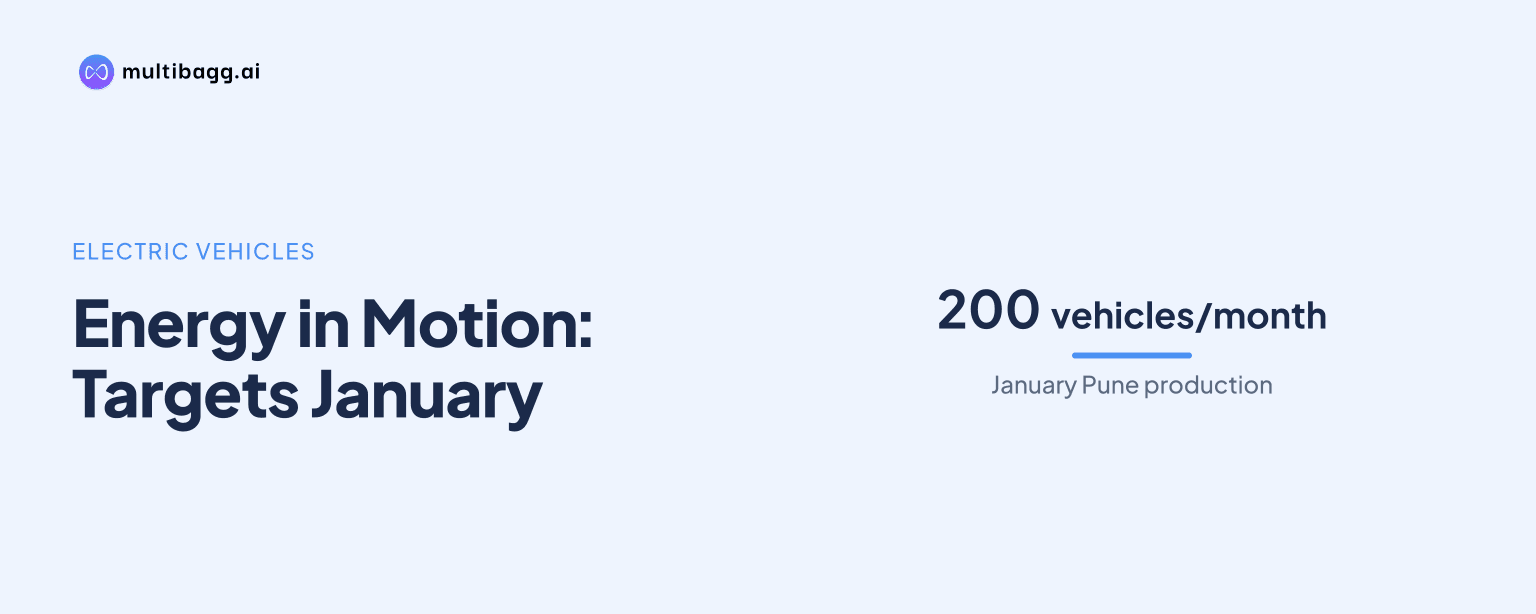
Energy in Motion expects regular production at its Pune truck-assembly facility from January after rolling out its first India-assembled electric truck on October 30, 2026. The facility is designed for 5,000 vehicles a year, while EIM plans a full-scale production run rate of about 200 vehicles a month from January.
Know Ravindra Energy inside out
Results, valuation, peers and who's buying, in one view.
What has EIM started assembling in Pune?
EIM has started assembling heavy electric trucks in Pune and rolled out its first India-assembled truck from the facility on October 30, 2026. Management said regular production should begin in January after the plant is set up and its systems have completed successful trials.
The assembly start follows higher vehicle sales in Q2 FY27, when EIM sold 142 vehicles, compared with 58 in Q1 FY27. Management said the increase reflected customer conversion, although the engagement-to-sale cycle is about six months and charging infrastructure construction can delay deliveries.
EIM said a significant part of Q2 FY27 sales came from repeat customers that had placed small trial orders in earlier quarters. Management also reported uptime above 99% for most customers, linking repeat purchases to operating performance rather than providing a disclosed order-book figure.
When will EIM begin regular Pune truck production?
EIM expects full-scale Pune production from January at a run rate of about 200 vehicles a month. Management said the facility is ready and is conducting trial production using completely knocked-down, or CKD, kits before the regular manufacturing run begins.
The truck plant has been designed for 5,000 vehicles a year, but management said it does not expect immediate full utilisation. At the indicated 200-vehicle monthly run rate, output would equal about 2,400 vehicles on an annualised basis, below the facility's design capacity of 5,000 vehicles.
Management did not disclose EIM's current order book or the proportion of capacity supported by firm customer commitments. It said, however, that second-half FY27 sales should be significantly stronger than first-half sales, supported by customer interest and charging infrastructure under construction.
EIM has signed memoranda of understanding, or MOUs, with large transporters covering almost 1,500 vehicles. Management said those vehicles will be delivered in phases as charging corridors are commissioned, meaning the MOUs are not presented as an immediately deliverable order book.
What does EIM's CATL battery-pack programme cover?
EIM has tied up with CATL to assemble truck battery packs in India, with a pack-assembly facility in the same Pune complex expected to be commissioned in the next quarter. Management described the arrangement as the first instance of a new original equipment manufacturer, or OEM, assembling CATL truck battery packs in India.
The battery facility has capacity similar to the 5,000-vehicle annual truck-assembly design, according to management. The disclosed programme concerns battery-pack assembly, not battery-cell manufacturing, and EIM did not provide a date for domestic cell sourcing.
EIM acknowledged that it, like other heavy electric-vehicle OEMs, has significant imported content in critical components. Management did not quantify the localised share of truck or battery-pack value, nor did it disclose the share represented by imported battery cells or motor-related components.
Management said its technology agreement permits indigenisation of a significant part of the vehicle, supported by a digitalisation and local-supplier-development programme in the Pune-to-Dharwad cluster. It added that localisation depends on both access to technology and sufficient production volumes, making the January ramp a relevant operating milestone.
Got a follow-up? Ask IRIS
How is EIM expanding charging for truck deliveries?
EIM plans to increase its charging-station network from eight sites to 15 by December 2026 and 40 by March 2027. Management is concentrating the expansion around the north-western corridor, including Delhi-Pune, Mundra-Ahmedabad and Kandla-Jaipur routes.
Management said the targeted corridor accounts for almost one-third of India's heavy-truck traffic. The network plan is directly linked to phased deliveries under the nearly 1,500-vehicle MOUs because transporters need commissioned charging routes before they can operate electric trucks at scale.
Network sales reached Rs 10.7 crore in Q2 FY27, compared with Rs 6.5 crore in Q1 FY27, an increase of almost 65% as stated by management. Two of EIM's eight stations were operating at more than 75% of daily capacity, and management said they were the country's largest single-location charging sites by electricity volume.
EIM is also expanding charging locations where demand does not yet justify a full-scale station, while independent charging stations are under construction. Management cited charging construction as one reason vehicle sales had not increased faster, despite its stated expectation of stronger sales in the second half.
How does EIM sell trucks, batteries and energy services?
EIM's average truck selling price is about Rs 60 lakh, and management said 95% of vehicle sales are without batteries. Instead, EIM supplies batteries through service arrangements linked to energy packages and minimum monthly electricity-consumption commitments.
Annual energy packages start at about Rs 14 lakh per vehicle for low-running road applications and rise to as much as Rs 33 lakh for higher-use applications. The contracts run for seven years, with pricing depending on operating conditions such as port work or long-distance highway use.
Vehicle sales were about Rs 130.8 crore in Q2 FY27, up from Rs 44 crore in Q1 FY27. Management said losses narrowed as volumes increased and set a target for EIM to turn positive in the next financial year, while continuing to invest in network and after-sales coverage.
EIM has incorporated EIM Megaplex as a step-down subsidiary to hold charging assets, renewable-energy assets supporting charging infrastructure and batteries supplied as a service. Management said the network company is operational and that its charging assets will sit within EIM Megaplex.
Conclusion
EIM's October 30 truck rollout, January production target and planned CATL battery-pack commissioning establish the sequence of its India manufacturing programme. Sales rose from 58 vehicles in Q1 FY27 to 142 in Q2 FY27, while the company is connecting vehicle assembly to battery services and charging-network deployment rather than relying on truck sales alone.
The next milestones are regular output at about 200 vehicles a month from January, network expansion from eight stations to 15 by December 2026 and 40 by March 2027, and phased deliveries against almost 1,500 vehicle MOUs. Management's target to turn EIM positive in the next financial year remains tied to higher volumes while network and after-sales investment continues.