










Energy in Motion targets 40 truck chargers by March 2027
Key highlights
- EIM plans to expand from 8 heavy-truck charging stations to 15 by December 2026 and 40 by March 2027.
- EIM sold 142 heavy electric vehicles in Q2 FY27, compared with 58 in Q1 FY27.
- EIM’s charging-network sales rose to Rs 10.7 crore in Q2 FY27 from Rs 6.5 crore in Q1 FY27.
- Two of EIM’s 8 charging stations were operating above 75% of daily capacity, according to management.
powered by IRIS
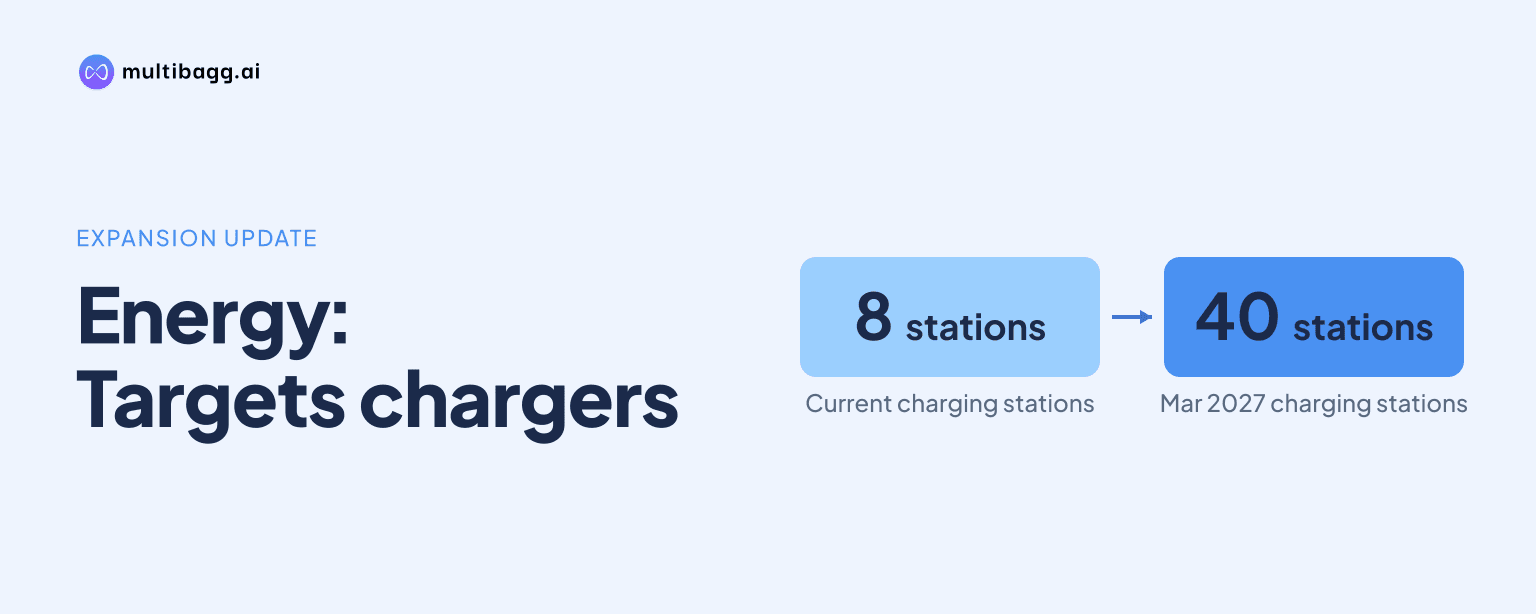
In the September 2026 quarter, Energy in Motion said it would expand its heavy-truck charging network from eight stations to 40 by March 2027, following a 15-station target for December 2026. Management is concentrating the rollout on northwest freight corridors that it said carry almost one-third of India’s heavy-truck traffic.
Know Ravindra Energy inside out
Results, valuation, peers and who's buying, in one view.
How fast will EIM expand its truck-charging network?
EIM expects to add seven stations by December 2026 and a further 25 by March 2027, taking its network from eight locations to 40. Management described a mix of full-scale independent charging stations under construction and smaller charging locations where current demand does not yet justify a full station.
The 40-station expansion is intended to address a sales constraint identified by management on the November 5, 2026 earnings call: electric-truck buyers need charging infrastructure to be commissioned before they can operate on intended routes. Management said the period from initial customer engagement to truck-sale conversion is about six months, and cited infrastructure construction as one reason sales did not rise faster in the September quarter.
EIM reported that charging-network sales increased almost 65% from the preceding quarter. Network sales reached Rs 10.7 crore in the September quarter, compared with Rs 6.5 crore in the prior quarter, while total vehicle sales rose to Rs 130.8 crore from Rs 44 crore. The comparable growth in charging activity and vehicle sales is relevant because EIM sells trucks alongside energy packages rather than batteries in most cases.
Where will EIM build the new charging stations?
EIM plans to place most of its 40-station expansion on the northwest corridor, including Delhi-Pune, Mundra-Ahmedabad, Kandla-Jaipur and other routes. Management said this geography represents almost one-third of India’s heavy-truck traffic and is the country’s most industrialised corridor, making it the initial focus for both charging utilisation and electric-truck volumes.
The 40-station route concentration differs from a broad nationwide public-charging strategy. EIM is building infrastructure around industrial freight flows, with the stated aim of accelerating truck sales and charging-business revenue in the same corridors. Management also said memorandums of understanding with large transporters cover nearly 1,500 vehicles, to be delivered in phases as the relevant network sections are commissioned.
The existing network has already produced concentrated utilisation at two of its eight stations. Management said those two sites operate at more than 75% of capacity daily and, by electricity volume, are already the country’s largest or heaviest single-location charging sites. That claim is management’s assessment, while the transcript does not disclose the electricity volume, station capacity or utilisation at the other six locations.
Got a follow-up? Ask IRIS
What is driving EIM’s electric-truck demand?
EIM sold 142 heavy electric vehicles in the September quarter, up from 58 in the June quarter, and management said a significant portion of the latest sales were repeat orders. Customers that had placed smaller trial orders in earlier quarters were buying second and third batches, while management reported uptime above 99% for most customers.
Management attributed the sales outlook partly to operating economics, saying customers can achieve 5% to 20% savings in cost per tonne per kilometre with EIM’s support and energy packages. It also said electric trucks are price-competitive in many applications on that operating-cost basis, although the call did not provide a customer-by-customer cost comparison or diesel-price assumptions.
The company’s truck structure separates the vehicle purchase from the battery. Management said the average truck selling price is around Rs 60 lakh and that 95% of sales exclude the battery. Instead, customers take seven-year energy packages based on minimum monthly electricity consumption, with annual charges starting at around Rs 14 lakh for lower-running road applications and reaching Rs 33 lakh for higher-running uses.
For the 95% of sales that exclude batteries, EIM management said it does not expect significant annual maintenance contract revenue because its after-sales objective is to minimise breakdowns. Batteries remain on EIM’s balance sheet under its battery-as-a-service model, with the company responsible for battery tracking, maintenance and lifecycle management. This makes charging infrastructure and energy delivery central to the commercial model rather than an ancillary service after a truck sale.
How will EIM support the charging rollout and truck production?
EIM has created EIM Megaplex as a step-down subsidiary to hold charging assets, renewable-energy assets needed to support charging infrastructure, and batteries supplied as a service. Management said the network company is operational, establishing a separate vehicle for the assets associated with the planned 40-station charging buildout.
The company said it has paid-up equity of Rs 400 crore and an additional Rs 100 crore of shareholder funds. Management said EIM is continuing to invest in network expansion and after-sales service because these functions must precede sales growth, even though the business reported a loss that narrowed as volumes increased. Its stated target is to turn positive in the next financial year.
On manufacturing, EIM inaugurated a Pune truck-assembly facility and rolled out its first India-assembled truck from the site on October 30. Management expects regular production from January after plant systems are tested, with the facility designed for 5,000 vehicles a year and an initial production run rate of about 200 vehicles a month. A battery-pack assembly facility in the same complex is expected to be commissioned in the next quarter.
EIM also announced an arrangement with CATL to assemble truck battery packs in India. Management said imported content remains significant across the heavy-electric-vehicle industry, particularly battery cells and certain electric-motor components, but described the Pune-to-Dharwad cluster and the 5,000-vehicle facility as part of an indigenisation programme. It said localisation depends on both technology access and higher industry volumes.
Conclusion
EIM’s plan to move from eight charging stations to 40 by March 2027 links network investment directly to its heavy-truck sales model. September-quarter vehicle sales of 142, versus 58 in the preceding quarter, and charging-network sales of Rs 10.7 crore, versus Rs 6.5 crore, show that both parts of the model expanded together, while the northwest freight-corridor strategy concentrates capital where management expects industrial demand.
The next milestones are 15 stations by December 2026, the start of regular Pune production from January, and the commissioning of the battery-pack facility in the next quarter. Readers can also watch whether phased deliveries under nearly 1,500 vehicle memorandums of understanding occur as corridor charging is commissioned, and whether management meets its target of turning EIM positive in the next financial year.