










Ravindra Energy Sees 200-300 MW Solar Need From Swaps
Key highlights
- Ravindra Energy said 100 additional swapping stations over 18 months could require 200-300 MW of solar capacity.
- A typical Ravindra Energy swapping station has outdoor consumption of 2.5-3 MVA and can absorb 2-2.5 MW of daytime solar without storage.
- Ravindra Energy said it is trading about 120 MW of electricity each month in the current year.
- Ravindra Energy reported EIM network utilisation below 30% and truck contribution margin of about 6%.
powered by IRIS
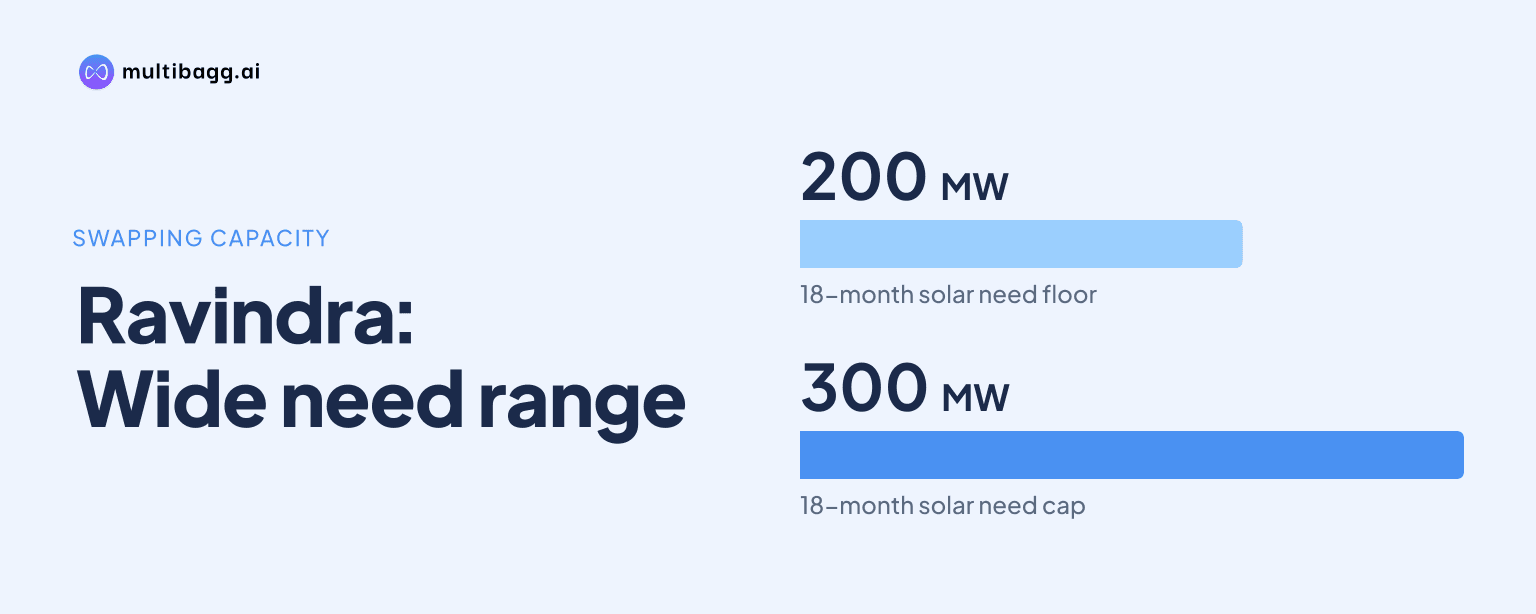
Ravindra Energy said 100 additional battery-swapping stations over the next 18 months could create demand for 200-300 MW of solar capacity. Management based the estimate on each station’s electricity requirement and said supply may come from self-built projects, state-level developers or open-access power rather than from assets wholly owned by Ravindra Energy.
Know Ravindra Energy inside out
Results, valuation, peers and who's buying, in one view.
How much solar capacity could Ravindra Energy need for swapping stations?
Ravindra Energy estimates that adding 100 swapping stations in 18 months could require 200-300 MW of solar-capacity additions. Management described this as an extrapolation of its planned network expansion, not as a committed order book or a confirmed construction target for solar projects.
A typical swapping station has outdoor electricity consumption of 2.5-3 MVA, or megavolt-amperes, management said. Without battery energy storage, a station can absorb 2-2.5 MW, or megawatts, of solar power during the day; when considering the broader solar requirement, management said capacity reserved for one station could reach about 4 MW.
The stated 200-300 MW range indicates that solar capacity will not be allocated uniformly at the maximum 4 MW level across all 100 stations. Management said the outcome will depend on station locations, state policies and whether a nearby solar project can be built, particularly at urban sites.
Will Ravindra Energy build all the solar capacity itself?
No, Ravindra Energy said it does not expect all renewable projects supporting the charging network to sit on its balance sheet. Management said it may use open access, in which electricity is supplied through the grid from a remote generator, in states with favourable policies or where urban stations cannot accommodate near-site generation.
Ravindra Energy said it would develop projects itself at locations where dedicated supply is required. At other sites, it may contract with state-level developers that management considers more efficient in particular markets, allowing the network to obtain renewable electricity without Ravindra Energy owning every generating asset.
Management said energy strategy would follow the charging-network buildout by a few months. It also said Ravindra Energy is trading about 120 MW of electricity each month in the current year, a capability management believes could help source lower-cost power for the battery-swapping network.
How does Ravindra Energy’s existing solar portfolio fit this plan?
Ravindra Energy’s existing renewable portfolio is largely committed under long-term power purchase agreements, or PPAs, and is therefore not presented as immediately available to supply the planned charging network. Management is evaluating monetisation of operating and under-construction solar assets instead of diverting their contracted output.
Management said equity released through asset monetisation could help expand the EIM electric-mobility network without raising external capital. It added that Ravindra Energy does not intend to bid for new government solar tenders, with prospective new projects instead focused on the renewable-energy needs of the charging network.
The solar business retains separate operating targets. Management said it aims to add about 200 MW of engineering, procurement and construction, or EPC, capacity in the full year, compared with about 100 MW added last year, and indicated potential full-year EPC revenue of about Rs 600 crore, of which Rs 200 crore had been booked in H1.
Management also expects electricity sales of about Rs 141-150 crore for the full year, against Rs 89 crore in the prior financial year. That projected increase concerns the existing power business and is separate from the 200-300 MW opportunity associated with 100 future swapping stations.
Got a follow-up? Ask IRIS
What links solar demand to Ravindra Energy’s truck network?
Ravindra Energy said truck deliveries and swapping-station utilisation are the two connected drivers of the integration plan. Management reported network utilisation of less than 30% and said more electric trucks using each station should improve the network’s per-unit profitability over the next two or three quarters.
The company has signed memorandums of understanding with large transporters covering almost 1,500 vehicles, with deliveries intended in phases as corridors are commissioned. Management cautioned that these memorandums do not represent next-quarter sales, although it expects them to convert into sales over one or two years.
Management said the electric-mobility business would be very positive at an annual run rate of 2,000 vehicles. Its truck contribution margin was about 6%, down from the earlier 8% range, with management attributing a small part of the decline to rupee weakness.
Ravindra Energy said a truck purchased without its battery costs Rs 25 lakh more upfront than a diesel truck. Management said its truck-and-battery subscription package can save an operator Rs 10 lakh a year, implying a payback period of two and a half years under its stated calculation.
When could Ravindra Energy provide clearer evidence of integration?
Ravindra Energy expects to start full-scale production at its Talegaon facility from January, initially at a run rate of about 200 vehicles a month. The facility has been designed for annual capacity of 5,000 vehicles, though management said it does not expect to fill that capacity immediately.
Management also expects to commission charging infrastructure on the Mumbai-Pune corridor by the end of November. After that commissioning, it plans to move goods from JNPT to Pune using electric trucks, providing an early operational use case for the corridor network.
Ravindra Energy said it has begun disclosing energy sold from the current quarter and plans quarterly business updates for the next couple of quarters. Management said it may later move to monthly or other regular operating disclosures, which could show whether energy sales and station utilisation rise alongside vehicle deliveries.
Conclusion
Ravindra Energy has defined a potential renewable-energy requirement for its electric-truck expansion: 100 additional battery-swapping stations over 18 months could support 200-300 MW of solar-capacity additions. The plan combines truck sales, station utilisation and electricity procurement, but it does not require the company to own every solar project serving the network.
The next disclosed milestones are the expected end-November commissioning of the Mumbai-Pune charging corridor and full-scale Talegaon production from January. Investors can also watch for solar-asset monetisation progress, changes in utilisation from below 30%, energy-sold disclosures and the proposed merger timeline, which management expects could conclude around September 2027 subject to approvals.