










Ravindra Energy weighs solar monetisation for EV growth
Key highlights
- Ravindra Energy is evaluating monetisation of operating and under-construction solar assets to expand its charging network without external capital.
- Management said 100 additional swapping stations over 18 months could require 200-300 MW of solar capacity.
- Ravindra Energy expects about Rs 600 crore of full-year EPC revenue, with Rs 200 crore booked in H1.
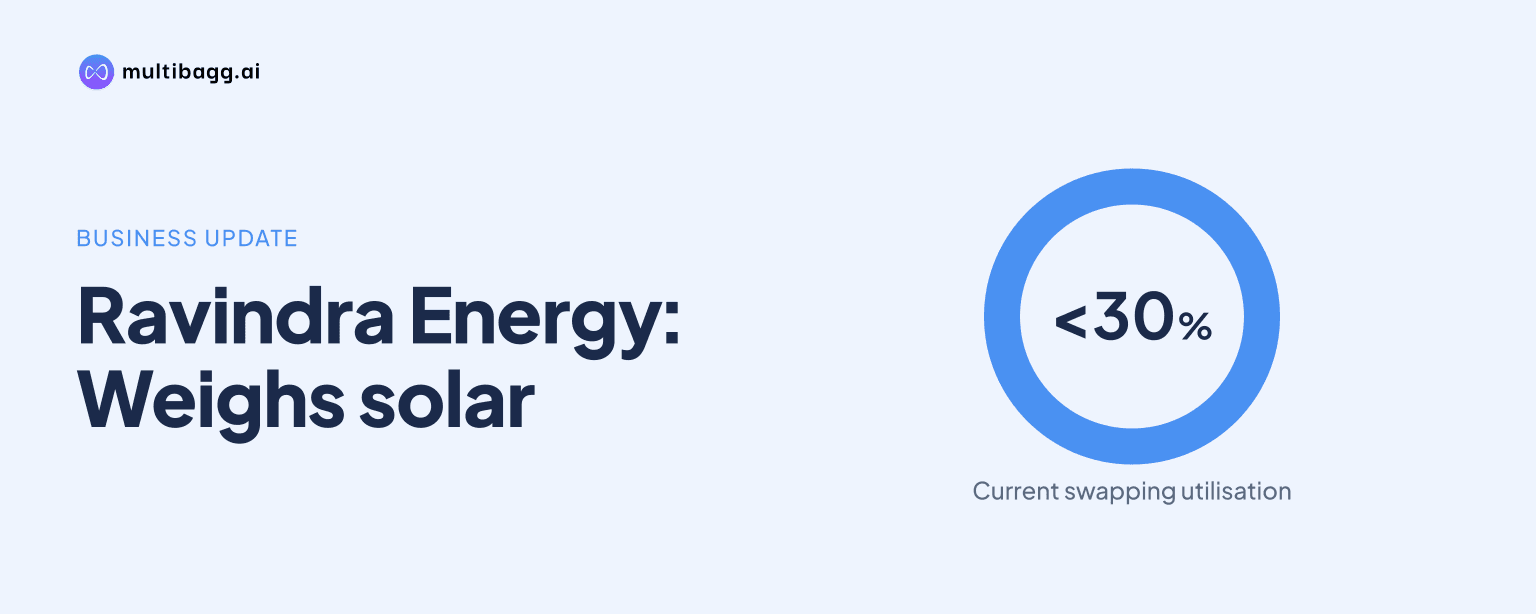
- Swapping-station utilisation is below 30%, while contribution margin was about 6% versus an earlier 8% range.
powered by IRIS
Ravindra Energy is evaluating monetisation of operating and under-construction solar assets to fund expansion of its electric-truck charging and battery-swapping network without external capital. Management linked the strategy to a potential 100 additional swapping stations over 18 months, which could require 200-300 megawatts (MW) of solar capacity.
Know Ravindra Energy inside out
Results, valuation, peers and who's buying, in one view.
Will Ravindra Energy sell its solar portfolio?
Ravindra Energy has not announced a solar-asset sale, but it is evaluating strategic options that include monetisation of operating and under-construction projects. Management said the existing solar portfolio is tied to long-term power-purchase agreements (PPAs), meaning those assets are not readily available to directly supply the charging network.
Management said it sees a market for monetising the existing projects and that the resulting equity could support network expansion without external capital. It did not disclose a portfolio valuation, expected proceeds, buyer discussions, a transaction timetable or the specific projects that could be included.
Ravindra Energy also said it does not intend to bid for new government solar tenders. Following the proposed merger, management intends to assess whether its in-house project-development capability can build renewable capacity needed for charging sites, rather than pursue tender-led capacity growth.
How would monetisation support Ravindra Energy's charging network?
Ravindra Energy said released equity could grow the charging and battery-swapping network “manifold” from its current scale without raising external capital. The call did not provide a network capital-expenditure budget or a count of existing swapping stations, so the possible funding requirement cannot be calculated from management's comments.
The model depends on recurring battery-service revenue because about 95% of electric heavy-truck sales exclude the battery. Ravindra Energy said its average truck price is about Rs 60 lakh, while customers take seven-year energy packages starting at Rs 14 lakh a year for lower-running road applications and rising to Rs 33 lakh a year per vehicle.
Management said truck sales and station use reinforce each other, with current swapping-station utilisation below 30%. It reported a contribution margin of about 6%, compared with an earlier range of 8%, and said rupee weakness had a small effect because heavy electric vehicles still have significant imported content.
How much solar capacity could Ravindra Energy need?
Ravindra Energy said a typical swapping station has outdoor consumption of 2.5-3 megavolt-amperes (MVA) and can absorb 2-2.5 MW of solar power during daytime without battery energy storage. Management said total solar demand could be about 4 MW per station when extrapolated beyond daytime consumption.
For an additional 100 swapping stations over the next 18 months, management estimated that 200-300 MW of solar capacity may be required. The estimate remains contingent on the network rollout because management said the renewable strategy would follow the charging-network buildout by a few months.
Ravindra Energy does not plan to build all of this supply on its own balance sheet. Management said it may use open-access power in states with suitable policies and work with state-level suppliers, particularly where urban sites cannot support nearby projects; it would build its own projects where needed.
The company also said it is trading about 120 MW of electricity each month in the current year. Management said the trading book could help source lower-cost power for the charging network, although it did not disclose trading margins, procurement costs or how much power may be directed to stations.
Got a follow-up? Ask IRIS
What is Ravindra Energy's solar-business outlook?
Ravindra Energy expects to execute about 200 MW of engineering, procurement and construction (EPC) work for the full year, compared with about 100 MW of capacity added last year. Management said the higher EPC workload could produce about Rs 600 crore of full-year revenue, of which Rs 200 crore had been booked in the first half (H1).
For electricity generation, management expects full-year electricity sales of Rs 141 crore to Rs 150 crore, compared with Rs 89 crore in the last financial year. This outlook concerns the solar business's electricity-sales activity and does not quantify the revenue impact of any potential asset monetisation.
Management's 200 MW EPC expectation does not signal a return to government tender bidding. Instead, Ravindra Energy said new renewable projects are likely to be considered for the charging network, while contracted operating assets remain candidates for possible monetisation.
What will determine whether Ravindra Energy's network scales?
Ravindra Energy said it has signed memorandums of understanding (MOUs) with large transporters covering almost 1,500 vehicles. Management cautioned that these MOUs do not become immediate sales, because deliveries will occur in stages as charging corridors are commissioned over the next one or two years.
The vehicle facility was designed for 5,000 vehicles a year, and management said full-scale production would begin in January at a run rate of about 200 vehicles a month. It added that an annual run rate of 2,000 vehicles would be very positive for the business, alongside higher station utilisation.
Management said losses in the charging-network business narrowed in the second quarter from the first quarter and are expected to narrow significantly in the third and fourth quarters. It identified higher vehicle volumes and greater use of stations currently below 30% utilisation as the main operating drivers, without giving a specific profit forecast.
Import dependence is another factor in the plan. Ravindra Energy said battery cells and certain electric-motor components will remain dependent on imports for some time, even as it pursues localisation through the Talegaon facility and expects volumes to support greater domestic sourcing.
Conclusion
Ravindra Energy is considering a capital reallocation from contracted solar assets toward an electric-truck charging network that could add 100 swapping stations and require 200-300 MW of renewable supply. The strategy would retain renewable energy as a central input, but management may rely on a mix of self-built projects, open-access supply and state-level partners rather than own every solar asset.
Next, investors can watch whether management identifies assets, proceeds or timing for the potential monetisation, and whether corridor commissioning converts almost 1,500 vehicle MOUs into deliveries. The proposed merger remains another scheduled milestone, with management indicating a likely completion around September 2027, subject to regulatory and tribunal approvals.