










Exicom turns EBITDA positive after ₹34.5 crore quarterly swing
Key highlights
- Exicom reported ₹1.8 crore of consolidated EBITDA in Q2 FY27 versus a ₹32.7 crore loss in Q2 FY26.
- Consolidated EV revenue increased 91.3% year on year to ₹214 crore in Q2 FY27.
- Consolidated revenue rose 37.8% year on year to ₹388 crore in Q2 FY27.
- Inventory declined by about ₹20 crore to ₹236.6 crore as Hyderabad operations normalised.
powered by IRIS
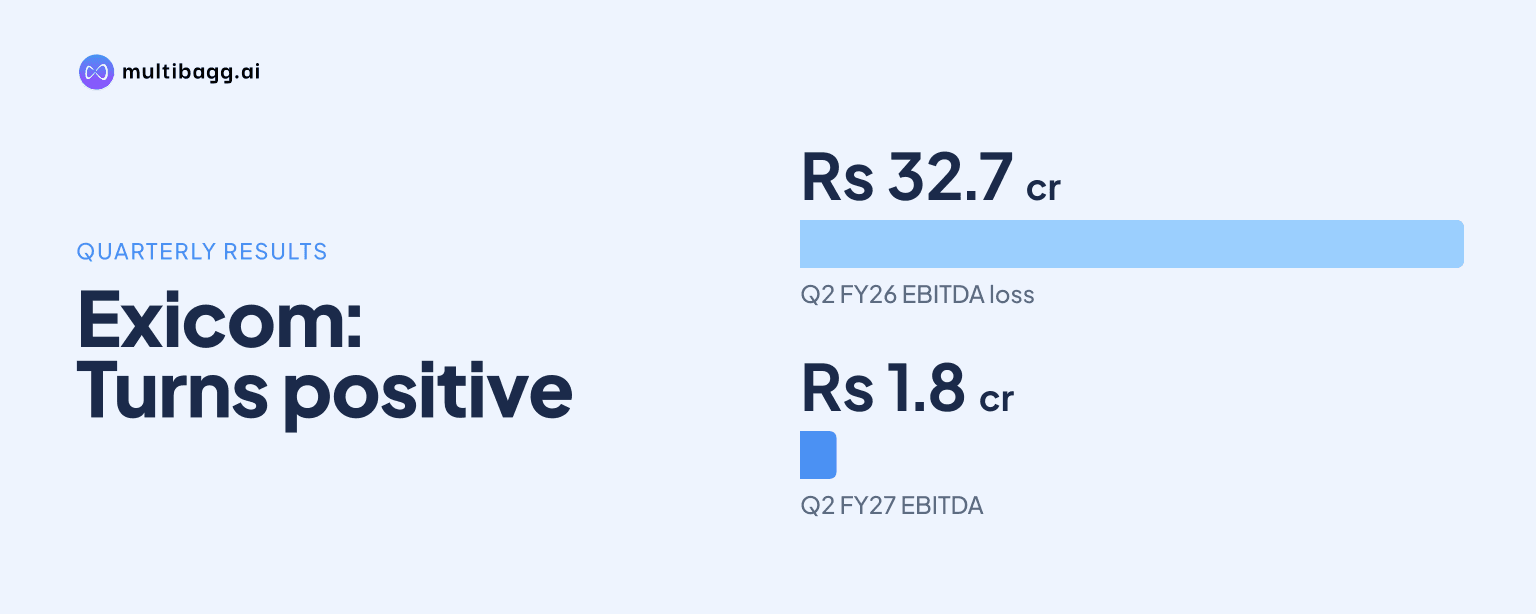
Exicom reported consolidated earnings before interest, tax, depreciation and amortisation (EBITDA) of ₹1.8 crore in Q2 FY27, reversing a ₹32.7 crore loss a year earlier through a ₹34.5 crore swing. Consolidated EV revenue rose 91.3% to ₹214 crore, while the Gurgaon-to-Hyderabad production transition substantially normalised.
Know Exicom Tele-Systems inside out
Results, valuation, peers and who's buying, in one view.
Why did Exicom’s consolidated EBITDA turn positive?
Exicom’s consolidated EBITDA turned positive because higher revenue, improved gross margins and operating leverage at both its stand-alone operations and Tritium offset prior operating losses. Consolidated revenue increased 37.8% year on year to ₹388 crore in Q2 FY27 from ₹282 crore in Q2 FY26, while EBITDA moved from a ₹32.7 crore loss to a ₹1.8 crore profit.
The main growth contribution came from EV revenue rather than Critical Power. Consolidated EV revenue reached ₹214 crore, up 91.3% year on year and 38.9% from Q1 FY27, whereas Critical Power revenue was ₹175 crore, compared with ₹170 crore a year earlier and ₹177 crore in Q1 FY27. Management attributed the ₹34.5 crore EBITDA swing to revenue growth, gross-margin improvement and better operating leverage.
How did Exicom’s EV charging business perform in Q2 FY27?
Exicom’s electric vehicle supply equipment (EVSE) business recorded its highest quarterly stand-alone revenue, according to management. Stand-alone EVSE revenue rose 58.7% year on year to ₹106 crore in Q2 FY27, exceeding ₹100 crore in a quarter for the first time, and was 74.6% higher than in Q1 FY27.
The stand-alone result also showed improved operating profitability before Tritium’s consolidated costs. Revenue rose 21.3% to ₹277 crore from ₹228 crore, while EBITDA increased 68.8% to ₹25.6 crore from ₹15.2 crore. EBITDA margin rose to 9.2% from 6.6%, and stand-alone profit after tax increased 31.8% to ₹7.8 crore.
Critical Power delivered slower growth than EVSE. Stand-alone Critical Power revenue rose 5.8% year on year to ₹171 crore in Q2 FY27, compared with ₹106 crore from EVSE. For H1 FY27, stand-alone revenue totalled ₹513.8 crore against ₹379 crore in H1 FY26, placing the Q2 result within a larger first-half increase.
What changed after Exicom moved production to Hyderabad?
Exicom said the Gurgaon-to-Hyderabad manufacturing transition was substantially complete in Q2 FY27, enabling production volumes to rise and fixed-cost intensity to decline. Management said operations were normalising, inventory was being absorbed and operating leverage was beginning to show in quarterly margins after the transfer of production.
Consolidating operations reduced the dual inventory previously maintained in Gurgaon and Hyderabad. Inventory declined to ₹236.6 crore from ₹256.8 crore, or by about ₹20 crore, while net working capital of ₹414 crore was lower than the March level. Exicom said released working capital helped reduce stand-alone borrowings to ₹345.6 crore from ₹361.1 crore in March FY26.
The Hyderabad facility also increased depreciation charged below EBITDA. Exicom recorded ₹10.8 crore of depreciation for the plant in Q2 FY27, its first full-quarter charge after deploying more than ₹200 crore of capital expenditure in March FY26. The charge explains why higher factory utilisation supported EBITDA without producing an equivalent increase in consolidated profit after tax.
Got a follow-up? Ask IRIS
Why did Exicom remain loss-making after tax?
Exicom remained loss-making after tax because Hyderabad depreciation and Tritium amortisation continued to exceed the consolidated EBITDA improvement. Consolidated profit after tax was a ₹57.8 crore loss in Q2 FY27, narrower than the ₹68.8 crore loss in Q2 FY26 and the ₹73.6 crore loss in Q1 FY27.
The difference between ₹1.8 crore of positive consolidated EBITDA and the ₹57.8 crore net loss reflects costs below the EBITDA line, management said. The stand-alone business recorded ₹7.8 crore of profit after tax in Q2 FY27, but the group result included continuing Tritium amortisation and the ₹10.8 crore Hyderabad depreciation charge.
Consolidated revenue grew faster than the reported bottom line in the first half. Revenue reached ₹719 crore in H1 FY27, compared with ₹487 crore in H1 FY26, while the company continued to consolidate Tritium-related costs and charges from the newly commissioned Hyderabad plant. The disclosed data shows an EBITDA turnaround, not yet a consolidated profit-after-tax turnaround.
What does the Tritium divestment plan mean for Exicom?
Exicom’s proposed Tritium divestment is intended to reduce the further funding required for working capital and engineering investment before that business reaches EBITDA breakeven. Management said Tritium’s revenue rose almost 133% in the first nine months of FY27 and that it accounted for almost 27% of consolidated revenue in H1 FY27, but said the business still needed more capital during its ramp-up.
The Board-approved proposal was based on a non-binding term sheet, with a target to close in December 2026 that management said could extend into the following quarter. Exicom has not disclosed final proceeds because customary transaction adjustments are still under calculation. Management expects some write-down but cited potential revenue from supplying power modules and selling EV-charging technology in global markets.
Exicom said it would continue to manufacture liquid-cooled power modules at Hyderabad for Tritium and retain rights to the TRI-FLEX charging product in certain geographies. Management said the manufacturing arrangement, including exclusivity and volumes, remained under negotiation. Exicom’s overall order book was about ₹1,645 crore as of 30 September, representing roughly 15 months of revenue visibility.
Conclusion
Exicom’s Q2 FY27 operating result marks a shift from a ₹32.7 crore consolidated EBITDA loss to a ₹1.8 crore profit, supported by 91.3% growth in consolidated EV revenue and a substantially completed Hyderabad transition. Critical Power remained broadly stable at ₹175 crore, while the EV business supplied the larger change in revenue and operating leverage.
The next material events are the planned Tritium transaction, targeted for December 2026 but potentially extending into the next quarter, and Exicom’s FY28 guidance, which management said it would provide before the end of FY27 with Q4 results. Management also said both business segments should grow next year, while its ₹1,645 crore order book as of 30 September provides visibility for about 15 months.