










Exicom Tele-Systems Limited Revenue Rises 38% in Q2 FY27
Key highlights
- Exicom reported Q2 FY27 consolidated revenue of ₹388.35 crore, up 37.84% year-on-year.
- The consolidated net loss narrowed to ₹56.78 crore from ₹68.81 crore in Q2 FY26.
- Standalone EV charging revenue rose 258.7% year-on-year to ₹106 crore, its first quarter above ₹100 crore.
- Standalone revenue was ₹277 crore, up 21.3% year-on-year and 17% quarter-on-quarter.
powered by IRIS
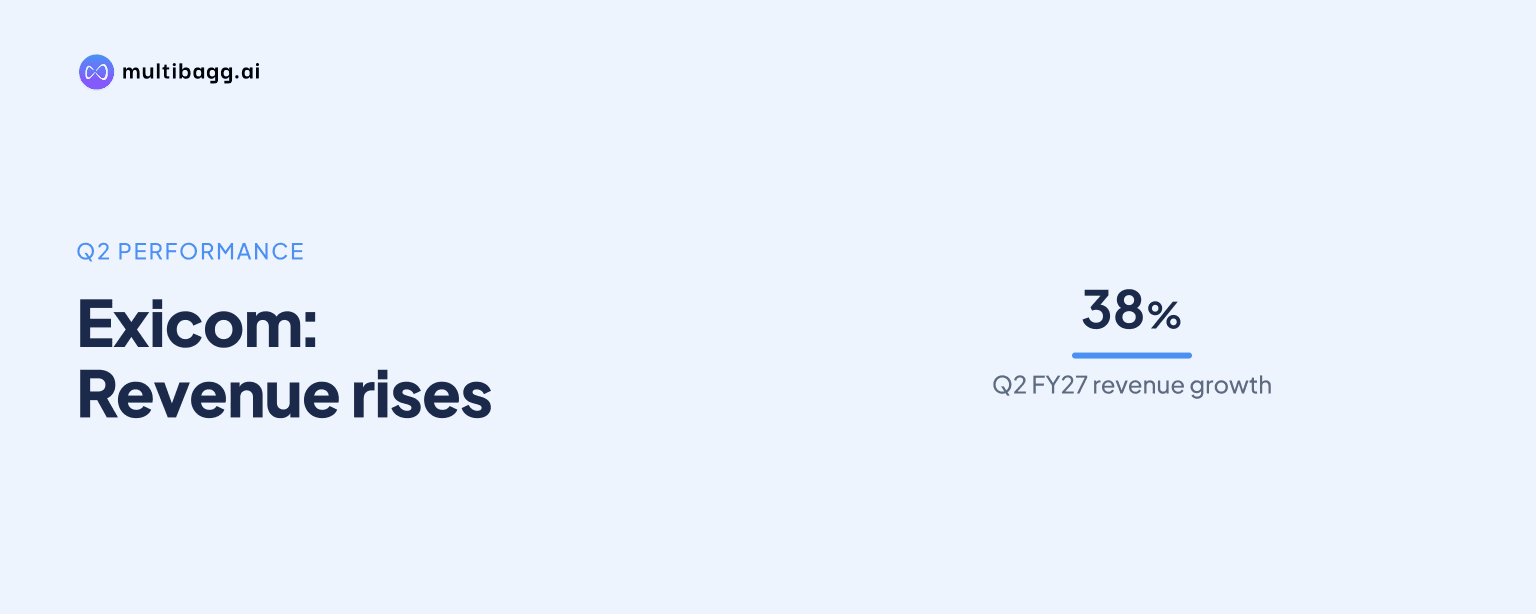
Exicom Tele-Systems Limited reported consolidated revenue of ₹388.35 crore in Q2 FY27, a 37.84% year-on-year increase, while its consolidated net loss narrowed to ₹56.78 crore from ₹68.81 crore a year earlier. The July-September quarter showed stronger revenue across the business and a return to positive consolidated operating profit.
Know Exicom Tele-Systems inside out
Results, valuation, peers and who's buying, in one view.
What did Exicom report in Q2 FY27?
Exicom reported consolidated revenue of ₹388.35 crore for Q2 FY27, compared with ₹281.73 crore in Q2 FY26 and ₹331.07 crore in the preceding quarter. This represented growth of 37.84% year-on-year and 17.30% sequentially. The company released its Q2 FY27 results on November 4, 2026, and discussed the performance with investors and analysts on November 12, 2026.
The company’s consolidated operating profit was ₹1.76 crore, against an operating loss of ₹32.70 crore in the corresponding quarter of the previous year. Its reported quarterly summary also showed operating profit of ₹1.18 crore compared with a loss of ₹21.90 crore in Q1 FY27. The figures indicate that higher revenue helped Exicom move back into positive operating territory on a consolidated basis.
Which businesses drove Exicom's quarterly revenue growth?
Exicom’s standalone revenue was ₹277 crore in Q2 FY27, up 21.3% year-on-year from ₹228 crore and 17% quarter-on-quarter from ₹237 crore. Management identified the electric-vehicle charging business as a major contributor to the quarterly performance.
Standalone EV charging revenue reached ₹106 crore, marking the first time the segment crossed ₹100 crore in a quarter. This was up 258.7% year-on-year from ₹67 crore in Q2 FY26 and rose 74.6% sequentially. The growth in this business supported the increase in standalone revenue during the quarter.
The company also reported standalone EBITDA of about ₹25.6 crore, up 68.8% year-on-year. On a consolidated basis, EBITDA was ₹1.8 crore, described as positive after earlier losses. The difference between standalone and consolidated operating metrics is relevant because the consolidated accounts include the wider group’s businesses and costs.
Why did Exicom approve the Tritium subsidiary divestment?
Exicom’s board approved the divestment of its Tritium global DC fast-charging subsidiary to strengthen the balance sheet and direct capital toward core markets. Management said that the home market in India and export initiatives were growing faster than expected and required investment.
The company said it chose to focus its capital on markets where it expected higher returns for a given level of risk. The divestment decision was therefore presented as a capital-allocation measure rather than a response to weak commercial traction. Exicom stated during the earnings call that it intended to prioritise opportunities in India and other higher-priority EV charging markets.
As part of the arrangement described in the earnings-call summary, Exicom is to retain a perpetual licence for Tritium’s TRI-FLEX technology outside the Americas. The provided material does not disclose a transaction value, closing date, buyer, or the expected accounting impact of the divestment.
Got a follow-up? Ask IRIS
How did the quarter affect Exicom's losses and financial position?
Exicom remained loss-making at the net-profit level despite the revenue growth and positive operating profit. Consolidated net loss narrowed to ₹56.78 crore from ₹68.81 crore in Q2 FY26 and from ₹73.58 crore in Q1 FY27. Profit before tax improved sequentially to a loss of ₹54.31 crore from a loss of ₹72.04 crore.
PBDT was a loss of ₹11.32 crore, compared with a loss of ₹33.18 crore in the previous quarter. These movements show an improvement in quarterly operating and pre-tax measures, but they do not remove the net loss reported for the period.
For investors, the key development is the combination of stronger revenue, a positive consolidated operating result, and the proposed subsidiary divestment. The results also underline that revenue growth has not yet translated into consolidated net profitability. The company’s stated emphasis on balance-sheet strengthening makes the eventual terms and execution of the divestment relevant to its financial position.
What does Exicom's performance indicate for the EV charging sector?
Exicom’s quarterly figures reflect rising activity in its EV charging operations, with standalone segment revenue growing faster than the company’s overall standalone revenue. The segment’s ₹106 crore quarterly revenue was nearly double the ₹67 crore reported a year earlier, based on the figures provided by the company.
The company’s decision to concentrate capital on India and selected international opportunities also points to the investment requirements associated with expanding charging operations. Management has linked the decision to faster-than-expected growth in domestic and export businesses, while the disclosed financial results show that group-level profitability remains under pressure.
The Q2 FY27 performance should therefore be assessed through both operating and financial measures. Revenue expanded materially and operating performance improved, but Exicom reported a consolidated net loss and has not disclosed financial terms for the Tritium divestment. These factors will remain important when evaluating subsequent quarterly disclosures.
Conclusion
Exicom delivered higher Q2 FY27 revenue, led by strong growth in its EV charging business, and returned to a positive consolidated operating profit. However, the company continued to report a consolidated net loss of ₹56.78 crore, even though the loss was lower than both the year-earlier and preceding quarters.
The next major item to watch is the progress of the Tritium subsidiary divestment, including any disclosed transaction terms and its impact on Exicom’s balance sheet. Investors will also monitor whether the company can sustain EV charging revenue growth and convert the improved operating performance into a reduction in consolidated losses.