










Exicom targets 30% export sales in both units within 3 years
Key highlights
- Exicom targets exports at 30% of sales in each business unit within three years.
- Management estimates exports will represent 10% of sales in both business units during FY27.
- EV Charging revenue increased 58.7% year on year to Rs 106 crore in Q2 FY27.
- Critical Power exports were almost Rs 100 crore in FY26, with 30% to 40% annual growth targeted for two years.
powered by IRIS
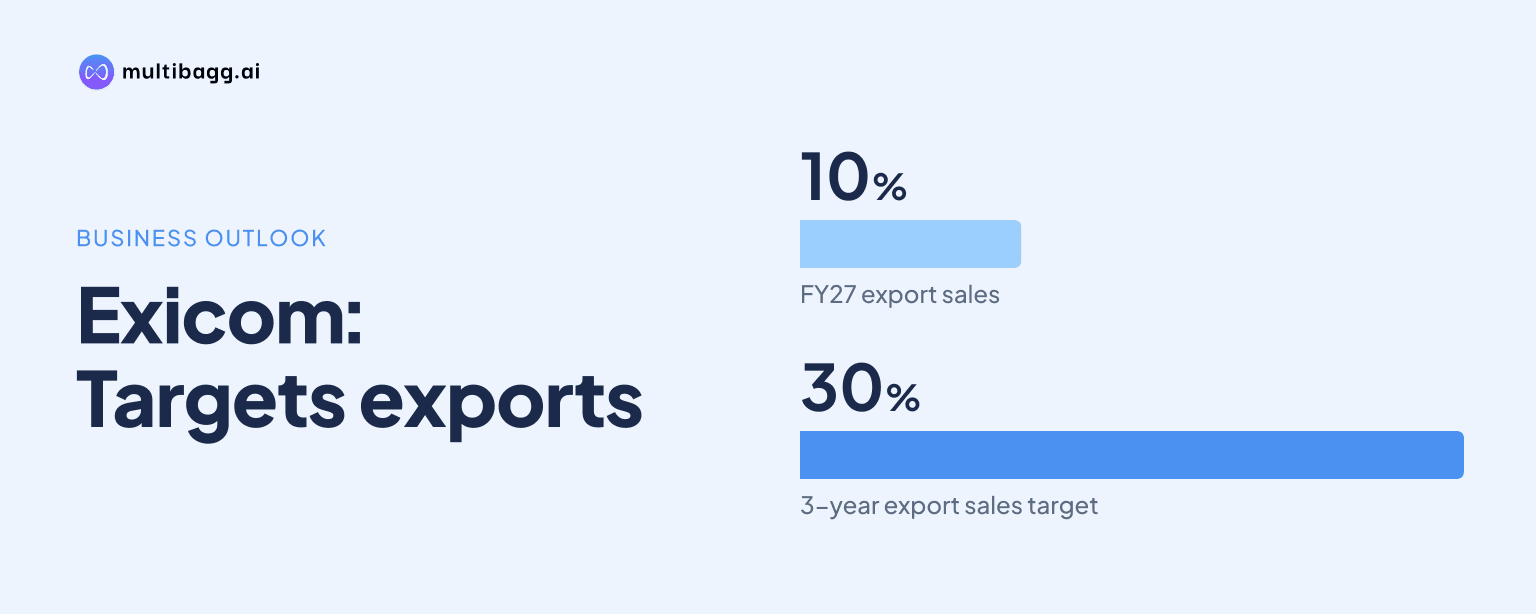
Exicom Tele-Systems Limited is targeting exports to provide 30% of sales in both its EV Charging and Critical Power units within three years, versus management’s FY27 estimate of 10% for each. The plan rests on certified export products, repeat EV charger orders and Critical Power exports of almost Rs 100 crore in FY26.
Know Exicom Tele-Systems inside out
Results, valuation, peers and who's buying, in one view.
How will Exicom reach 30% export sales in each unit?
Exicom plans to pursue the 30% target through separate export programmes in EV Charging and Critical Power, rather than through one combined overseas business. Management said exports were estimated at 10% of sales in each unit in FY27, substantially above the previous year, although it did not quantify the earlier combined export mix.
The strategy began in FY26 with EV Charging business development in five countries and initial charger sales. Exicom said it has redesigned its charger portfolio and the related ecosystem for export markets, while Critical Power products can be customised for customer requirements in its priority overseas regions.
The company’s disclosed figures require some monitoring because management also described EV Charging export mix as 5% on its FY27 presentation slide. It said that EV percentage should be higher by the end of FY27, but did not reconcile the 5% reference with its estimate that exports would represent 10% of sales in both units during the year.
What is behind Exicom’s EV Charging export plan?
Exicom’s EV Charging export plan is supported by certifications covering Europe, the United States, Canada, Southeast Asia and the Middle East. Management cited CE certification for Europe, UL certification for the United States and Canada, and regional certifications in smaller Southeast Asian and Middle Eastern markets.
The FY26 market-development effort has generated repeat charger orders in the current year and added customers and geographies, according to management. Exicom expects FY28 to be its first fully scaled commercial year for export charger shipments and said it expects export revenue to be at least three times its FY27 level.
Domestic EV Charging growth provides a larger production base for that expansion. Revenue in the segment rose 58.7% year on year to Rs 106 crore in Q2 FY27 from Rs 67 crore in Q2 FY26, while H1 FY27 revenue increased to Rs 167 crore from Rs 120 crore in H1 FY26. Management said AC, or alternating-current, and DC, or direct-current, charger volumes were almost 90% higher in Q2 FY27 or H1 FY27 than the comparable Q2 FY26 level.
Exicom also has domestic customer relationships across passenger vehicles and public charging. It works with seven of India’s top 10 passenger-vehicle original equipment manufacturers and 17 of the top 20 charging-point operators, management said. The company added that its share of business varies by customer, ranging from full supply in some cases to lower shares in others.
Got a follow-up? Ask IRIS
What supports Exicom’s Critical Power export growth?
Exicom aims to build Critical Power exports from almost Rs 100 crore of revenue in FY26, with management targeting annual growth of 30% to 40% for the following two years. Its stated priority markets are Africa, the Middle East and Southeast Asia, while its existing credentials are in Africa and Southeast Asia.
The export opportunity sits alongside telecom investment in India linked to fifth-generation, or 5G, networks. Management said India’s 5G subscriber base had increased from 25 crore to nearly 45 crore by the beginning of FY27. It estimated annual demand for 60,000 to 80,000 power-conversion systems over the next three years and demand for almost 8 lakh lithium-ion batteries across telecom operators and tower companies.
Exicom supplies power systems, batteries and hybrid systems able to operate with grid electricity, solar power or generator sets. Management said it serves at least one of the two leading telecom operators with a high share of power-system business and at least one of the three leading tower companies with a very high share. It identified global product certification and customisation as key mechanisms for converting overseas opportunities.
Government-linked domestic projects offer a separate source of Critical Power visibility. BharatNet Phase 3 carries Rs 235 crore of FY27 revenue visibility and Rs 478 crore in FY28, with the balance expected in FY29, although management said part of FY28 execution could shift into FY29. These projects may also generate Rs 40 crore to Rs 50 crore of service revenue over 10 years beginning in FY29.
What will determine whether Exicom achieves the export target?
Exicom will need to turn initial overseas wins into recurring shipments while domestic revenue continues to grow. Stand-alone revenue rose 21.3% year on year to Rs 277 crore in Q2 FY27 from Rs 228 crore, with EV Charging at Rs 106 crore and Critical Power at Rs 171 crore. Faster domestic growth would increase the overseas revenue needed for exports to become 30% of total sales.
The company has an open confirmed order book and advanced pipeline of almost Rs 1,650 crore, providing management with visibility over the next 15 months. Advanced pipeline represents about 20% of that amount, while Exicom booked about Rs 377 crore of orders in H1 FY27 and reported a build-to-book ratio of 0.73.
Costs and the proposed Tritium transaction are additional factors in the company’s operating context. Management said higher commodity, semiconductor and foreign-exchange costs partly offset operating leverage in Q2 FY27, when stand-alone earnings before interest, tax, depreciation and amortisation rose to Rs 25.6 crore from Rs 15.2 crore a year earlier. It is also targeting December 2026, potentially extending into the following quarter, to close a proposed 100% sale of Tritium following receipt of a non-binding term sheet.
Conclusion
Exicom’s export objective would shift both business units toward a larger overseas contribution, from management’s FY27 estimate of 10% to 30% within three years. EV Charging has certifications and repeat orders from its FY26 programme, while Critical Power starts from almost Rs 100 crore of FY26 exports and management’s stated 30% to 40% annual growth ambition for the next two years.
The next disclosures to watch are EV Charging export mix by the end of FY27, the planned threefold increase in EV export revenue in FY28, and progress against the Critical Power growth plan. Management also identified BharatNet Phase 3 execution, including the Rs 478 crore FY28 visibility, and the expected timing of the Tritium transaction as unresolved or scheduled developments.