










Exicom seeks Tritium sale while retaining module supply rights
Key highlights
- Exicom has a non-binding term sheet to sell 100% of Tritium Group while retaining module manufacturing and certain Tri-Flex rights.
- Tritium contributed about 27% of Exicom’s consolidated revenue in H1 FY ’27 and recorded about 133% revenue growth in the first nine months of 2027.
- Q2 FY ’27 consolidated EBITDA was Rs 1.8 crore, compared with a loss of Rs 32.7 crore in Q2 FY ’26.
- Stand-alone EV-charging revenue rose 58.7% year on year to Rs 106 crore in Q2 FY ’27.
powered by IRIS
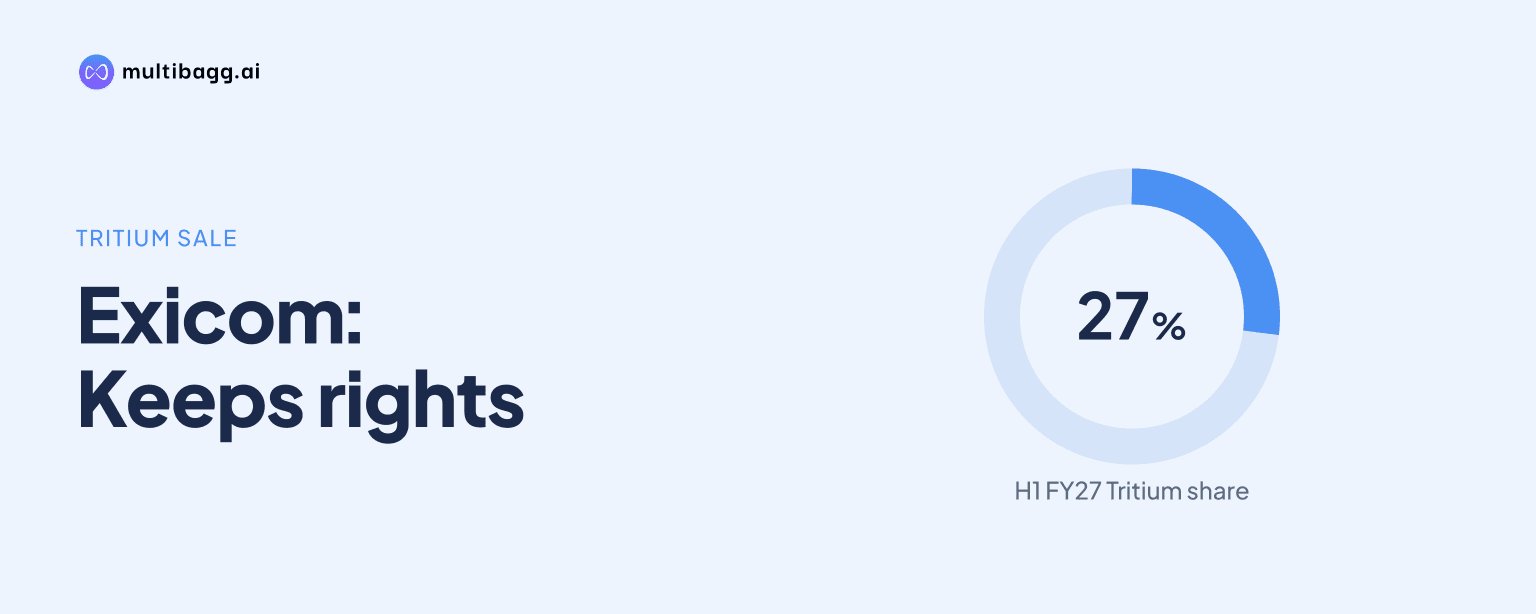
Exicom has received a non-binding term sheet to sell 100% of Tritium Group while retaining liquid-cooled power-module manufacturing and Tri-Flex rights in certain geographies; Tritium contributed about 27% of Exicom’s consolidated revenue in H1 FY ’27. Management targets closing in December 2026, subject to definitive agreements and customary adjustments.
Know Exicom Tele-Systems inside out
Results, valuation, peers and who's buying, in one view.
What is Exicom proposing to sell?
Exicom is proposing to sell 100% of Tritium Group under a non-binding term sheet, with the Board having recently decided to pursue a divestment. Management said the proposal remains subject to several steps before it becomes a definitive agreement and ultimately closes. Its stated closing target is December 2026, although management said completion could spill into the following quarter.
The disclosed valuation is on a cash-free, debt-free basis, which does not establish the cash ultimately received by Exicom. In the question-and-answer session, management said it was working through customary adjustments, including Tritium’s debt, leases and minority interests. Management said it would update investors once the amount reaching Exicom has been finalised.
Management also expects some write-down of Exicom’s investment in Tritium, but did not quantify that accounting impact in the call. It said the prospective write-down should be considered alongside future opportunities to supply power modules and commercialise retained EV-charging technology. The eventual proceeds, any write-down and the transaction closing are therefore unresolved matters rather than completed outcomes.
Why is Exicom selling Tritium despite its revenue growth?
Exicom is pursuing the sale because management said Tritium requires further working-capital and engineering investment before reaching earnings before interest, tax, depreciation and amortisation, or EBITDA, breakeven. Tritium accounted for about 27% of Exicom’s consolidated revenue in H1 FY ’27, but management said its continuing losses would remain consolidated in Exicom’s profit and loss account during the ramp-up phase.
Tritium’s operating progress was substantial despite that funding requirement. Management said revenue rose about 133% in the first nine months of 2027, while its order backlog and bookings reached their highest levels to date. It also said Tritium had anchor customers for newly launched products and had moved beyond EV chargers into power infrastructure, including a product aimed at emerging data centres in the US.
The group’s Q2 FY ’27 numbers show why management separated improved operating performance from the need for capital. Consolidated revenue rose 37.8% year on year to Rs 388 crore from Rs 282 crore, and consolidated EBITDA turned positive at Rs 1.8 crore from a loss of Rs 32.7 crore. However, consolidated net loss was Rs 57.8 crore, although narrower than Rs 68.8 crore a year earlier, with management citing depreciation at the Hyderabad plant and Tritium amortisation.
Got a follow-up? Ask IRIS
What would Exicom retain after a Tritium sale?
Exicom would retain the manufacture of liquid-cooled power modules for Tritium and rights to the Tri-Flex flagship EV-charging product in certain geographies. Management said it had established a production line at its Hyderabad facility for these modules, which represent a substantial part of Tritium’s system cost. This structure would preserve a manufacturing relationship even if Tritium’s ownership changes.
The module-supply terms remain under negotiation. Management did not commit to an exclusive arrangement, a minimum volume or a final contract duration, noting that companies commonly diversify their supply risk through more than one supplier. It nevertheless described the potential revenue as substantial and said Exicom has visibility on Tritium’s expected volumes for the next three years while it remains within the group.
The Tri-Flex rights could also support Exicom’s own export programme. Management said Exicom could use its manufactured modules when selling Tri-Flex in overseas markets, while retaining access to technology developed by Tritium for direct-current fast charging. It added that Tri-Flex still requires localisation and commercialisation work for Exicom’s requirements, meaning no specific revenue from those rights was disclosed.
How does the sale fit Exicom’s balance sheet and export plans?
Exicom said a successfully completed sale could move it from a net-debt position to a net-cash position, although that depends on final proceeds and transaction adjustments. As of 30 September, it reported an order book of about Rs 1,645 crore and said order visibility was good for the next 15 months. Stand-alone borrowings were Rs 345.6 crore, down from Rs 361.1 crore in March FY ’26, while net debt was Rs 326.8 crore.
The retained Tri-Flex rights align with Exicom’s stated intention to expand EV-charging exports. Management said it aspires for exports to account for 30% of EV-charging revenue over the next three years and expects FY ’28 to be the first fully scaled commercial year for charger shipments to export markets. It also said FY ’28 export revenue is expected to be at least three times FY ’27 revenue, while export mix at the end of FY ’27 was expected to be above 5%.
Exicom’s stand-alone EV-charging business is also growing independently of Tritium. Revenue from that segment reached Rs 106 crore in Q2 FY ’27, up 58.7% from Rs 67 crore in Q2 FY ’26, while H1 revenue rose to Rs 167 crore from Rs 120 crore. Management said AC and DC charger volumes in Q2 FY ’27 were nearly 90% higher than a year earlier, contributing to operating leverage as production volumes increased.
Conclusion
The proposed transaction would not be a complete withdrawal by Exicom from Tritium’s products or charging technology. Exicom is seeking to sell ownership of a subsidiary that still needs funding before EBITDA breakeven, while retaining module production and certain Tri-Flex rights that could generate manufacturing revenue and support overseas EV-charging sales.
The next disclosures to watch are a definitive sale agreement, final proceeds after debt, lease and minority-interest adjustments, and the amount of any investment write-down. Management has targeted December 2026 for completion but allows for slippage into the next quarter, while module volumes, the final scope of Tri-Flex geography rights and FY ’28 export shipments remain subject to execution and negotiation.