










The Great Eastern Shipping Co. Ltd. reaches USD 593m net cash
Key highlights
- GESCO reported normalized net cash of USD 593 million in 2Q27, versus peak net debt of USD 361 million in FY19.
- GESCO had USD 119 million of standalone debt outstanding at September 2026.
- GESCO's repayment schedule shows USD 30 million due by March 2027, USD 23 million by March 2028 and USD 66 million by March 2029.
- GESCO reported FY27 year-to-date dividends of Rs 28.8 per share, including Rs 14.4 per share declared for 2Q27.
powered by IRIS
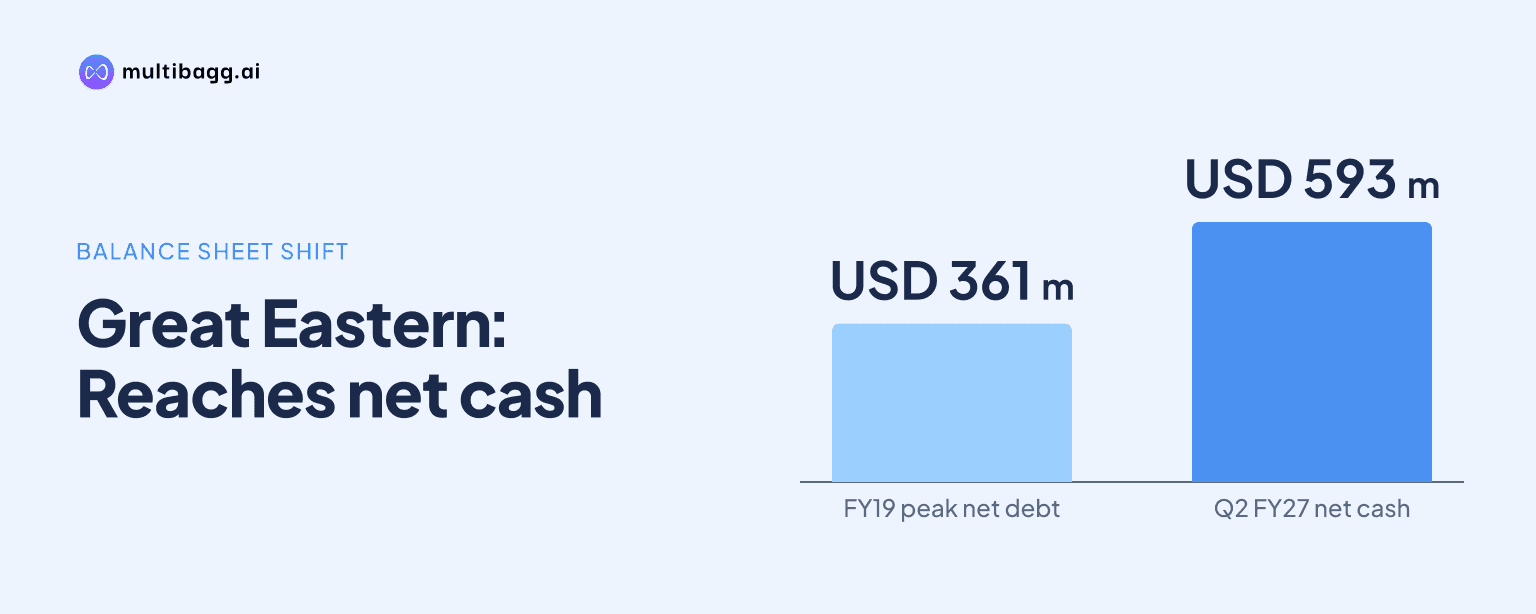
The Great Eastern Shipping Co. Ltd. reported normalized net cash of USD 593 million in 2Q27, reversing from peak net debt of USD 361 million in FY19, while USD 119 million of standalone debt remained at September 2026. GESCO identifies fleet renewal, dividend payouts and a buyback as its disclosed capital-allocation uses.
Know Great Eastern Shipping Company inside out
Results, valuation, peers and who's buying, in one view.
How did GESCO move from net debt to net cash?
GESCO moved from USD 361 million of net debt in FY19 to USD 593 million of normalized net cash in 2Q27, a USD 954 million swing in its net balance-sheet position. Net debt-to-equity was 0.49 in FY19, while the 2Q27 figure was negative 0.37, indicating that cash exceeded debt under the presentation's measure.
The company labels the earlier period as a net-debt expansion phase and the subsequent period as a net-debt reduction phase. Management also says GESCO has been in a net-cash position for the past four years, although the presentation provides point labels only for FY19 and 2Q27 rather than annual net-debt figures for every intervening year.
Cash profitability and asset movements contributed to the balance-sheet change disclosed elsewhere in the presentation. Between September 2021 and September 2026, standalone net asset value, or NAV, per share rose from Rs 570 to Rs 1,787, including Rs 1,012 per share of cash profit, Rs 374 per share from fleet change and a Rs 169 per share dividend reduction.
On a consolidated basis, NAV per share rose from Rs 619 in September 2021 to Rs 2,224 in September 2026. The bridge attributes Rs 1,222 per share to cash profit, Rs 551 per share to fleet change and Rs 169 per share to dividends, showing larger cash-profit and fleet-change contributions than on the standalone measure.
How much debt does GESCO still have?
GESCO had USD 119 million of standalone loans outstanding in September 2026, with the repayment schedule allocating USD 30 million to March 2027, USD 23 million to March 2028 and USD 66 million to March 2029. Those three scheduled repayments total USD 119 million, matching the September 2026 loan balance.
The schedule indicates that debt falls to USD 90 million by March 2027 and USD 66 million by March 2028 before reaching zero in March 2029. Separately, the capital-allocation slide says the remaining USD 119 million debt matures by November 2028; the presentation does not explain the difference between that statement and the March 2029 endpoint in the repayment chart.
The remaining borrowings are small relative to the stated USD 593 million normalized standalone net-cash position, but the cash figure is explicitly described as normalized. The source does not define the adjustments behind normalized net cash, so it does not establish the exact reported cash and gross-debt amounts underlying that USD 593 million figure.
Got a follow-up? Ask IRIS
How is GESCO allocating its cash?
GESCO says fleet renewal at the right prices is its primary objective, with dividends and a buyback also forming part of capital allocation. Its stated fleet approach is to sell older vessels and purchase relatively younger ships with similar tonnage, maintaining market presence rather than expanding the fleet.
Management says it is cautious about buying vessels at elevated asset prices and is prepared to wait for better value. That approach applies while GESCO has predominantly spot-market exposure across tankers and dry bulk, with 3Q27 coverage of about 58% for crude tankers, 60% for product tankers, 100% for liquefied petroleum gas, or LPG, and 61% for dry bulk.
For offshore operations, GESCO says 3Q27 days are about 94% covered for vessels and 72% covered for rigs. One rig remains to be repriced in FY27, which is the specific outstanding operating item management identifies alongside the fleet-renewal plan.
Management also says a buyback has been launched at a discount to NAV, without specifying its size, price, timing or completion status in the supplied material. At 2Q27, consolidated NAV was Rs 2,224 per share and standalone NAV was Rs 1,787 per share; the presentation used a 6 November 2026 closing share price of Rs 1,429 per share and showed a share-price-to-consolidated-NAV ratio of 0.64.
What has GESCO returned through dividends?
GESCO had made 19 consecutive quarterly dividend payouts and reported FY27 year-to-date dividends of Rs 28.8 per share. The presentation says that amount includes a Rs 14.4-per-share dividend declared for 2Q27, which management characterises as about 21% of standalone earnings per share.
The FY27 year-to-date payout of Rs 28.8 per share is below the Rs 35.1 per share paid in FY26, but it already equals the Rs 28.8 per share paid for FY23. The dividend history also shows Rs 36.3 per share in FY24 and Rs 29.7 per share in FY25, compared with Rs 9.9 per share in FY22.
The rise in payouts since FY22 occurred alongside an increase in standalone NAV per share from Rs 618 in FY22 to Rs 1,787 in 2Q27. Consolidated NAV per share increased from Rs 692 to Rs 2,224 over the same points, and management reports five-year NAV compound annual growth rates of 26% standalone and 29% consolidated, driven largely by cash profits.
Conclusion
GESCO's disclosed capital position combines USD 593 million of normalized net cash in 2Q27 with USD 119 million of standalone debt at September 2026, following a reversal from USD 361 million of net debt in FY19. Management's stated use of that financial capacity is not fleet expansion: it is replacement of older ships with relatively younger vessels when values are suitable, continued dividends and a buyback launched below NAV.
The next items to watch are the scheduled USD 30 million, USD 23 million and USD 66 million debt repayments through March 2029, as well as clarification of management's separate statement that debt matures by November 2028. Investors can also track the repricing of the remaining rig in FY27, 3Q27 spot-market coverage and whether fleet-renewal transactions occur at the prices management considers appropriate.