










Great Eastern Shipping: Capesize earnings rose 80% in H1 FY27
Key highlights
- Great Eastern Shipping reported Baltic Capesize earnings of US$38,927 per day in H1 FY27, up 80% from US$21,674 per day.
- Guinean bauxite exports rose about 35% year on year in Q2 FY27, alongside Simandou iron-ore export ramp-up.
- Coal trade fell 4% year on year and grain trade declined about 6% year on year in Q2 FY27.
- The bulk-carrier fleet grew 3% year on year in Q2 FY27, while bulk-carrier asset prices rose 5% to 10% quarter on quarter.
powered by IRIS
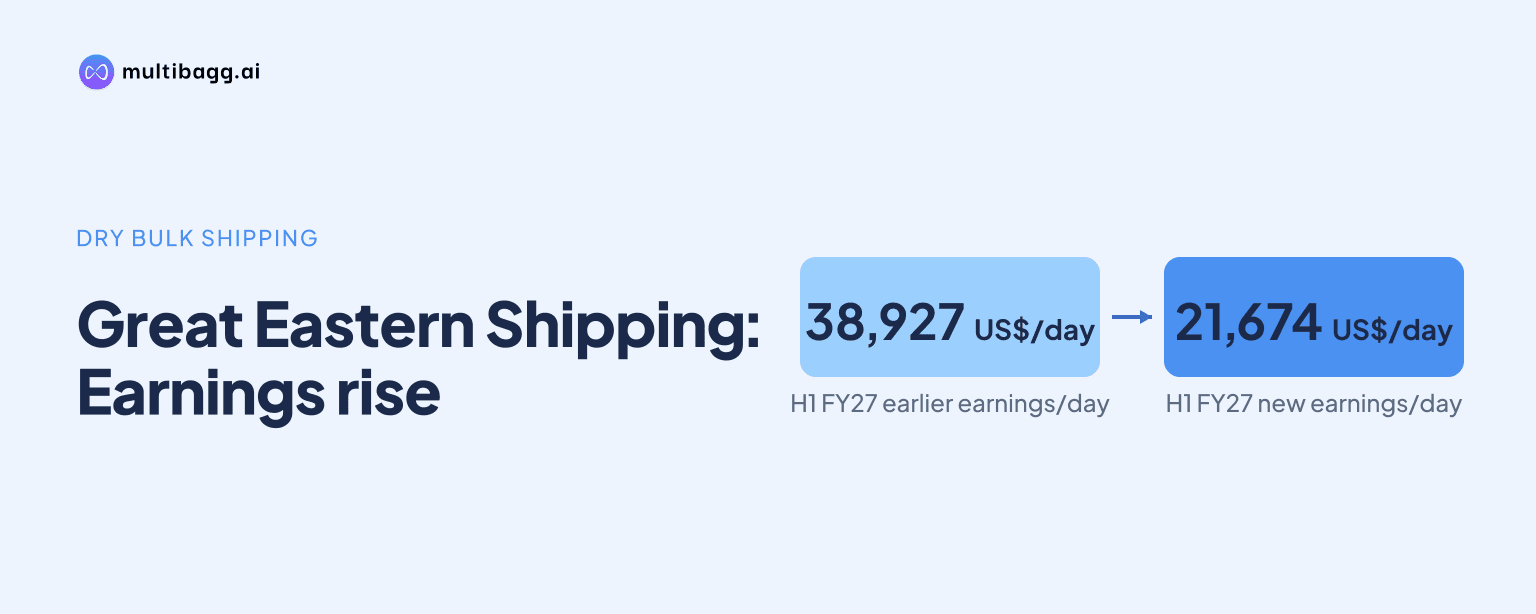
The Great Eastern Shipping Co. Ltd. reported average Baltic Capesize earnings of US$38,927 per day in the first half of financial year 2027 (H1 FY27), up 80% from US$21,674 in H1 FY26, with Simandou iron-ore exports and roughly 35% growth in Guinean bauxite exports during Q2 FY27 supporting the market.
Know Great Eastern Shipping Company inside out
Results, valuation, peers and who's buying, in one view.
What drove Great Eastern Shipping's Capesize earnings in Q2 FY27?
Great Eastern Shipping said Capesize demand in the second quarter of financial year 2027 (Q2 FY27) was supported by a ramp-up in iron-ore exports from the Simandou project in Guinea and by strong Guinean bauxite exports. Guinean bauxite exports rose by about 35% year on year during Q2 FY27, providing a stated demand driver for the larger dry-bulk vessel class.
Capesize earnings rose 67% year on year in Q2 FY27, compared with 27% growth for both Kamsarmax and Supramax earnings. The reported gap shows that Capesize rates increased faster than the two other vessel categories cited in the quarterly market commentary.
Great Eastern Shipping did not disclose cargo tonnage from Simandou, vessel utilisation or its own fleet exposure to Capesize vessels. The data therefore describe the industry freight market in Q2 FY27 rather than a quantified impact on Great Eastern Shipping's dry-bulk operations.
How much did Great Eastern Shipping's Capesize earnings rise in H1 FY27?
Great Eastern Shipping reported that the Baltic Capesize benchmark averaged US$38,927 per day in H1 FY27, an 80% increase from US$21,674 per day in H1 FY26. The increase was US$17,253 per day between the two first-half periods.
The Supramax benchmark averaged US$18,277 per day in H1 FY27, up 45% from US$12,607 per day in H1 FY26. Its H1 FY27 average was US$20,650 per day below the Capesize average, showing a material difference in both rate level and year-on-year growth.
The H1 FY27 Capesize gain of 80% was higher than the 67% year-on-year increase stated for Q2 FY27 alone. Great Eastern Shipping did not provide an H1 FY27 Kamsarmax benchmark, although it said Kamsarmax earnings rose 27% year on year in Q2 FY27.
Which dry-bulk cargo trades weakened in Q2 FY27?
Coal trade fell 4% year on year in Q2 FY27 after rising about 8% year on year in the preceding quarter. This was a 12-percentage-point shift in the quarterly growth rate, contrasting with the roughly 35% increase in Guinean bauxite exports.
Great Eastern Shipping attributed restrained Chinese coal-import demand to higher renewable and hydro-powered electricity generation in Q2 FY27. It said Indian coal-import demand also remained weak because of higher prices and continued inventory drawdown.
Grain trade declined by about 6% year on year in Q2 FY27 as intensifying attacks hampered Russian and Ukrainian grain flows from the Black Sea region. The 4% coal-trade decline and 6% grain-trade decline show that Capesize strength occurred alongside weakness in two other dry-bulk cargo streams.
Great Eastern Shipping explicitly linked iron ore and bauxite to Capesize support, while it did not assign the weaker coal and grain flows to a particular vessel class. The presentation consequently supports a cargo-specific explanation for Capesize outperformance rather than a uniform improvement across dry-bulk trades.
Got a follow-up? Ask IRIS
How did dry-bulk supply and asset prices change in Q2 FY27?
The bulk-carrier fleet grew 3% year on year during Q2 FY27, while bulk-carrier asset prices rose between 5% and 10% quarter on quarter. Great Eastern Shipping said the price movement varied by vessel type and age profile, rather than reporting one price increase for every bulk carrier.
Great Eastern Shipping put the dry-bulk orderbook-to-fleet ratio at about 16% in Q2 FY27. Its calendar-year 2026 orderbook chart showed bulkers at 15.8% of fleet, consistent with the rounded quarterly figure.
The 15.8% calendar-2026 bulker orderbook ratio was below the 28.3% ratio for crude tankers and the 22.0% ratio for product tankers shown in the same chart. Great Eastern Shipping did not disclose delivery schedules or scrapping volumes for dry-bulk vessels, so the presentation does not quantify when the stated orderbook may enter the fleet.
How do Great Eastern Shipping's financial results provide context?
Great Eastern Shipping reported standalone time-charter equivalent revenue of Rs 2,601 crore in H1 FY27 and consolidated time-charter equivalent revenue of Rs 3,385 crore. Time-charter equivalent is operating revenue after direct operating or voyage expenses, and these reported figures cover the company rather than dry bulk alone.
Standalone time-charter equivalent revenue was Rs 1,190 crore in Q2 FY27, compared with Rs 749 crore in Q2 FY26. Consolidated time-charter equivalent revenue was Rs 1,598 crore in Q2 FY27, compared with Rs 1,063 crore in Q2 FY26.
The H1 FY27 financial statement also included Rs 433 crore of profit on sales of ships and other assets. Standalone net profit was Rs 2,184 crore and consolidated net profit was Rs 2,578 crore, so the disclosed profit figures cannot be attributed solely to the US$38,927-per-day Capesize benchmark.
Conclusion
Great Eastern Shipping's presentation shows a dry-bulk market in which Capesize earnings led the reported first-half gains, rising 80% in H1 FY27 against a 45% increase for Supramax earnings. Simandou iron-ore exports and 35% growth in Guinean bauxite exports supported the Capesize segment, while coal and grain trades declined during Q2 FY27.
The next disclosed issues to watch are whether the Simandou ramp-up and Guinean bauxite growth continue, and whether renewable and hydro generation in China, Indian inventory drawdown, and Black Sea disruptions continue to restrain coal and grain flows. On supply, the bulk-carrier fleet had grown 3% year on year in Q2 FY27 and the dry-bulk orderbook stood at about 16% of fleet, without delivery timing disclosed in the presentation.