










Great Eastern Shipping Shows LPG Has Largest Delivery Pipeline
Key highlights
- LPG carriers of 65,000 cbm and above had a 38.8% orderbook-to-fleet ratio in calendar 2026.
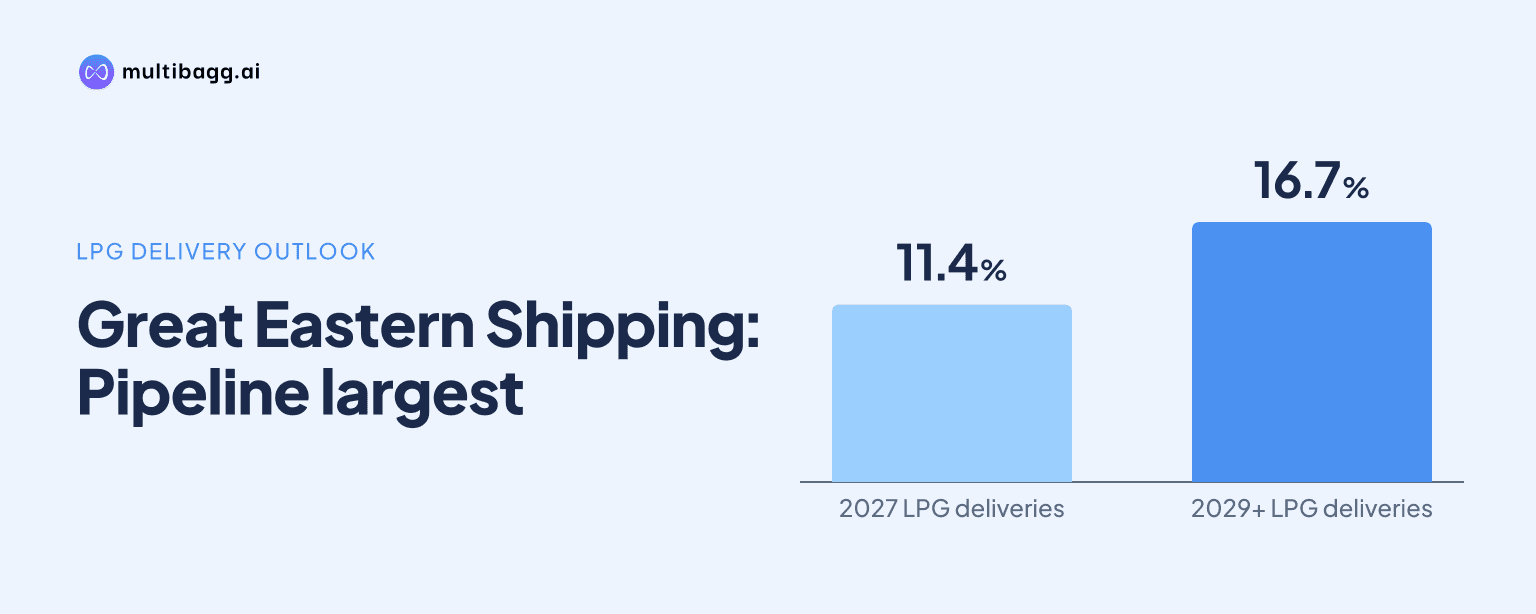
- LPG deliveries are allocated at 11.4% of fleet in 2027 and 16.7% in calendar 2029 and beyond.
- VLGC average earnings were USD 140,439 per day in H1 FY27, up 153% from H1 FY26.
- Crude, product and dry-bulk scrapping was 0.52%, 0.43% and 0.26% of beginning fleet in CY 2026 year to date.
powered by IRIS
The Great Eastern Shipping Co. Ltd. reports that LPG carriers of 65,000 cubic metres (cbm) and above had an orderbook equal to 38.8% of fleet in calendar 2026, higher than crude tankers at 28.3%, product tankers at 22.0% and bulk carriers at 15.8%.
Know Great Eastern Shipping Company inside out
Results, valuation, peers and who's buying, in one view.
Why does Great Eastern Shipping show a larger LPG delivery pipeline?
Great Eastern Shipping shows a larger LPG delivery pipeline because the 38.8% orderbook-to-fleet ratio for LPG carriers of 65,000 cbm and above exceeds the ratio in each of the three other reported shipping categories in calendar 2026. LPG is 10.5 percentage points above crude tankers, 16.8 points above product tankers and 23.0 points above bulk carriers.
An orderbook-to-fleet ratio compares contracted vessels with the existing fleet, rather than identifying ships already delivered. Great Eastern Shipping’s comparison places crude at 28.3%, product at 22.0% and bulk at 15.8%, making LPG the category with the largest disclosed prospective fleet addition relative to current capacity.
The LPG supply data appears alongside elevated freight conditions in H1 FY27. Very large gas carrier, or VLGC, average earnings were USD 140,439 per day, up 153% from USD 55,542 per day in H1 FY26, while VLGC fleet supply grew 8% year on year in Q2 FY27 and asset values increased 18% quarter on quarter.
When are Great Eastern Shipping’s reported deliveries scheduled?
Great Eastern Shipping’s disclosed orderbook schedule places the largest LPG delivery bucket in calendar 2029 and beyond, at 16.7% of fleet. The earlier LPG allocations are 2.4% in calendar 2026, 11.4% in 2027 and 9.7% in calendar 2028, indicating that most of the stated pipeline is scheduled after 2026.
Crude deliveries are also weighted towards later years, rising from 1.0% of fleet in calendar 2026 to 11.6% in calendar 2029 and beyond. Product tankers have 7.4% scheduled in both 2027 and 2028 before 6.6% in 2029 and beyond, while dry bulk ranges from 1.3% in 2026 to 4.8% in both 2027 and 2029 and beyond.
The LPG schedule totals 40.2% across the four delivery buckets, whereas the historical orderbook table identifies a 38.8% ratio for LPG carriers of 65,000 cbm and above. Great Eastern Shipping does not explain the difference in scope between the two LPG measures, nor does it disclose cancellation rates, construction delays or delivery slippage.
Got a follow-up? Ask IRIS
How do tanker and bulk pipelines compare with freight conditions?
Great Eastern Shipping shows that crude, product and dry-bulk orderbooks are lower than LPG’s, while earnings across these segments increased in H1 FY27. Average Suezmax earnings reached USD 180,689 per day, up 289% from USD 46,509 per day in H1 FY26, and medium-range, or MR, product tanker earnings rose 64% to USD 31,550 per day.
Crude tanker fleet supply grew about 2% year on year in Q2 FY27, compared with 6% for product tankers. Great Eastern Shipping said inefficient ship-to-ship operations in the Arabian Gulf, higher West-to-East flows and Yanbu cargo rerouting kept the crude fleet stretched, while the long-range 2, or LR2, fleet contracted 30% year on year as vessels moved into dirty trades.
Dry bulk had the lowest calendar 2026 orderbook ratio at 15.8%, while fleet supply increased 3% year on year in Q2 FY27. Average Capesize earnings rose 80% to USD 38,927 per day in H1 FY27, and Supramax earnings increased 45% to USD 18,277 per day, compared with USD 21,674 and USD 12,607 respectively in H1 FY26.
The dry-bulk demand indicators were mixed during Q2 FY27. Guinean bauxite exports increased about 35% year on year and supported Capesize earnings, but coal trade fell 4% year on year after an approximately 8% increase in the preceding quarter, while grain trade declined about 6% as attacks disrupted Black Sea flows.
Is scrapping offsetting Great Eastern Shipping’s reported supply pipeline?
Great Eastern Shipping reports limited scrapping in crude, product and dry bulk during calendar 2026 year to date, and it provides no comparable LPG scrapping series. Crude scrapping represented 0.52% of beginning world fleet, product scrapping 0.43% and dry-bulk scrapping 0.26%, against orderbook ratios of 28.3%, 22.0% and 15.8% respectively.
Crude scrapping increased from 0.48% in calendar 2025 to 0.52% in calendar 2026 year to date, after 0.14% in 2024. In contrast, product scrapping fell from 0.85% to 0.43%, and dry-bulk scrapping declined from 0.51% to 0.26%, so the data does not show a common acceleration in vessel removals.
The asset-value charts show labelled values of 302 for five-year-old Suezmax tankers, 193 for MR tankers, 157 for Capesize bulk carriers and 167 for VLGCs at their latest displayed points. Great Eastern Shipping does not define these chart values as currency amounts or percentage returns, but the charts extend to October 2026 across the four categories.
Conclusion
The disclosed data identifies LPG as the largest future-supply category relative to fleet size, with a 38.8% orderbook-to-fleet ratio for carriers of 65,000 cbm and above, compared with 28.3% for crude, 22.0% for product and 15.8% for bulk. Freight earnings were nevertheless higher in H1 FY27, including USD 140,439 per day for VLGCs and USD 180,689 per day for Suezmax tankers, with trade disruptions and longer voyages contributing to vessel demand.
The next disclosed supply milestones are LPG allocations of 11.4% of fleet in 2027, 9.7% in 2028 and 16.7% in calendar 2029 and beyond. Great Eastern Shipping does not disclose whether the 40.2% scheduled LPG total and the 38.8% historical LPG orderbook ratio use identical scopes, while the future effect will also depend on delivery timing and scrapping, which was 0.26% to 0.52% of beginning fleet in the three reported sectors during calendar 2026 year to date.