










Great Eastern adds tonnage as Q2 crude TCY reaches USD 73,322 daily
Key highlights
- Great Eastern had 42 shipping vessels with 3,381,290 deadweight tonnes as of 6 November 2026.
- Great Eastern added three vessels through 3Q27 to date and committed to a 157,000-deadweight-tonne newbuild Suezmax.
- Great Eastern's Q2 FY27 crude-carrier TCY was USD 73,322 per day, up 145% year on year.
- Great Eastern reported Q3 FY27 coverage of 58% in crude, 60% in product, 100% in LPG and 61% in dry bulk.
powered by IRIS
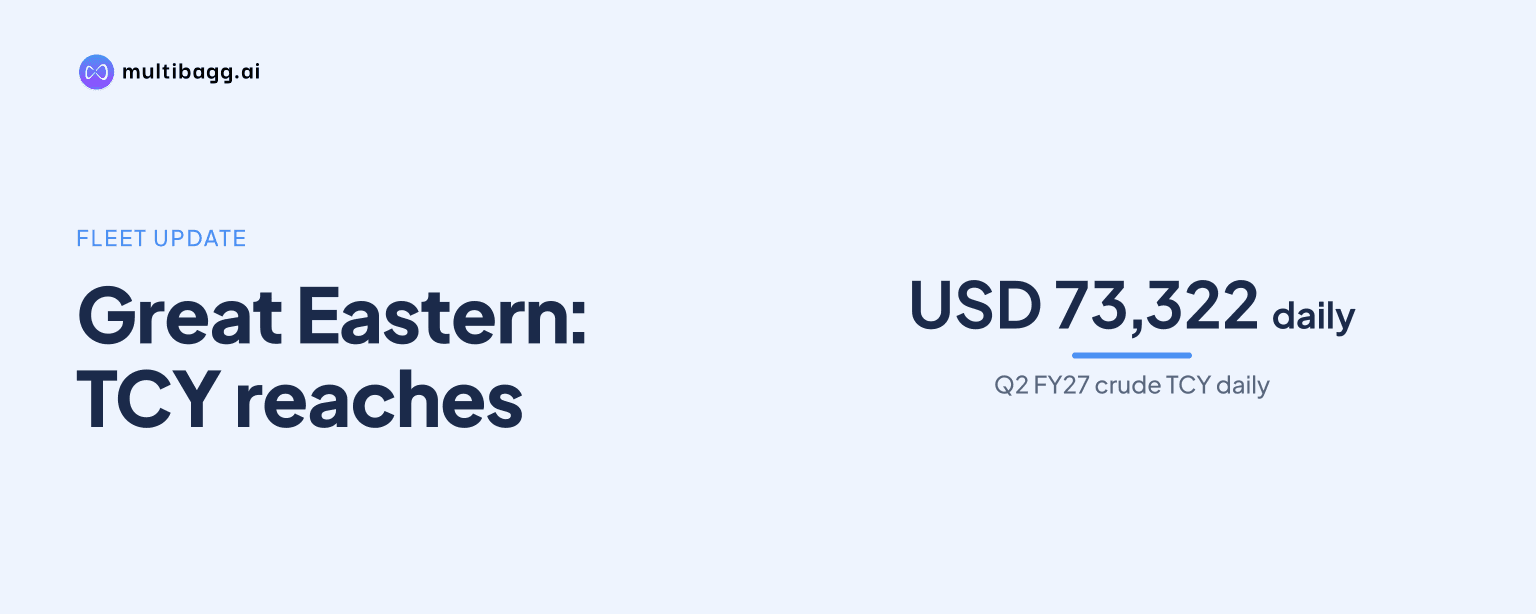
The Great Eastern Shipping Co. Ltd. added three vessels through 3Q27 to date and committed to a 157,000-deadweight-tonne Suezmax, while Q2 FY27 crude-carrier average time-charter equivalent yield reached USD 73,322 a day. Great Eastern had 42 shipping vessels with 3,381,290 deadweight tonnes as of 6 November 2026.
Know Great Eastern Shipping Company inside out
Results, valuation, peers and who's buying, in one view.
What vessels has Great Eastern added, sold and committed to buy?
Great Eastern added the 2015-built Jag Laxman, a Long Range 2, or LR2, product carrier with 109,990 deadweight tonnes, during 2Q27. In the same quarter, it sold the 2009-built LR2 Jag Lokesh, which had 105,900 deadweight tonnes. The disclosed purchase and sale involved vessels of the same category, with Jag Laxman built six years later and carrying 4,090 more deadweight tonnes than Jag Lokesh.
Great Eastern added two vessels in 3Q27 to date: Jag Amit, a 2015-built Kamsarmax dry-bulk carrier with 81,886 deadweight tonnes, and Jag Vikrant, a 2015-built very large gas carrier, or VLGC, with capacity of 82,000 cubic metres. The presentation reports Jag Vikrant's capacity in cubic metres rather than deadweight tonnes, so it is not directly comparable with the LR2 and Kamsarmax figures.
Great Eastern also reported two purchases committed and pending delivery: a 2019-built Kamsarmax with 81,609 deadweight tonnes and a newbuild Suezmax crude carrier with 157,000 deadweight tonnes. The presentation does not disclose delivery dates, purchase prices, financing arrangements or charter plans for either pending vessel.
How is Great Eastern's shipping fleet split by segment?
Great Eastern's shipping fleet consisted of 42 vessels, 3,381,290 deadweight tonnes and an average age of 14.44 years on 6 November 2026. Dry bulk was the largest segment by capacity, with 16 vessels and 1,435,636 deadweight tonnes, followed by 16 product carriers with 1,010,158 deadweight tonnes.
Crude carriers numbered five and had 691,049 deadweight tonnes, while gas carriers also numbered five with 244,447 deadweight tonnes. The planned 157,000-deadweight-tonne Suezmax would add to the disclosed crude-carrier base, although the presentation does not state when it will join the fleet.
Great Eastern's dry-bulk fleet had the lowest average age among shipping segments at 12.04 years, compared with 16.49 years for gas carriers. Separately, the offshore fleet included four jack-up rigs and 19 offshore support vessels, including nine anchor handling tug cum supply vessels and four platform supply vessels, as of 6 November 2026.
Got a follow-up? Ask IRIS
How did Great Eastern's shipping rates change in Q2 FY27?
Great Eastern reported higher average time-charter equivalent yields, or TCYs, year on year in each of its four shipping categories in Q2 FY27, although crude and product carrier yields declined from Q1 FY27. Crude-carrier TCY was USD 73,322 a day, up 145% from USD 29,974 in Q2 FY26 but down 21% from USD 93,026 in Q1 FY27.
Product-carrier TCY was USD 32,114 a day in Q2 FY27, 28% above USD 25,110 a year earlier and 29% below USD 45,471 in Q1 FY27. LPG, or liquefied petroleum gas, carrier TCY rose 11% quarter on quarter to USD 46,208 a day, while dry-bulk TCY increased 8% to USD 24,308 a day.
Shipping revenue days increased to 3,737 in Q2 FY27 from 3,678 in Q2 FY26. Owned-tonnage revenue days rose by 59 to 3,553, while inchartered-tonnage days were unchanged at 184; total owned tonnage increased to 3.24 million deadweight tonnes from 3.13 million.
How much of Great Eastern's Q3 FY27 operating days are covered?
Great Eastern reported Q3 FY27 operating-day coverage of 58% for crude carriers, 60% for product carriers, 100% for LPG carriers and 61% for dry bulk. LPG was the only disclosed shipping segment with full coverage, while 42% of crude-carrier days, 40% of product-carrier days and 39% of dry-bulk days were outside the reported coverage.
The presentation does not identify whether the days outside coverage are intended for spot employment or disclose rates for covered operating days. The partial-coverage categories include crude carriers, which earned an average TCY of USD 73,322 a day in Q2 FY27, and dry bulk, which earned USD 24,308 a day.
Great Eastern's offshore operating-day coverage for Q3 FY27 was 72% for jack-up rigs, 89% for anchor handling tug cum supply vessels, 91% for multipurpose platform supply and support vessels, and 100% for platform supply vessel and remotely operated vehicle support vessel operations. Offshore revenue days rose to 1,923 in Q2 FY27 from 1,891 in Q2 FY26, as offshore logistics days increased to 1,650 from 1,617 and drilling-services days stayed near flat at 273 versus 274.
Conclusion
Great Eastern's disclosed fleet activity adds exposure to product tankers, dry bulk, gas carriers and crude transportation through three vessels already added and two pending purchases. Operating conditions were mixed sequentially in Q2 FY27, with crude and product TCYs below Q1 FY27 levels, but all four reported shipping categories recorded higher yields than in Q2 FY26, led by a 145% increase in crude-carrier TCY.
The next disclosed matters to watch are delivery of the 81,609-deadweight-tonne Kamsarmax and the 157,000-deadweight-tonne newbuild Suezmax, for which Great Eastern gave no dates. Q3 FY27 execution will also depend on operating-day coverage, particularly the 58% disclosed for crude carriers and 61% for dry bulk, alongside subsequent changes in segment TCYs.