










Great Eastern VLGC earnings rose 153% in H1 FY27 despite trade fall
Key highlights
- Great Eastern reported average VLGC earnings of USD 140,439 per day in H1 FY27, up 153% from USD 55,542 per day in H1 FY26.
- Overall LPG trade volumes fell 14% year on year in Q2 FY27 as Middle East Gulf exports halved.
- About 75% of exports through Hormuz used ship-to-ship transfers in Q2 FY27.
- The VLGC fleet grew 8% year on year in Q2 FY27, while the VLGC orderbook-to-fleet ratio was 39%.
powered by IRIS
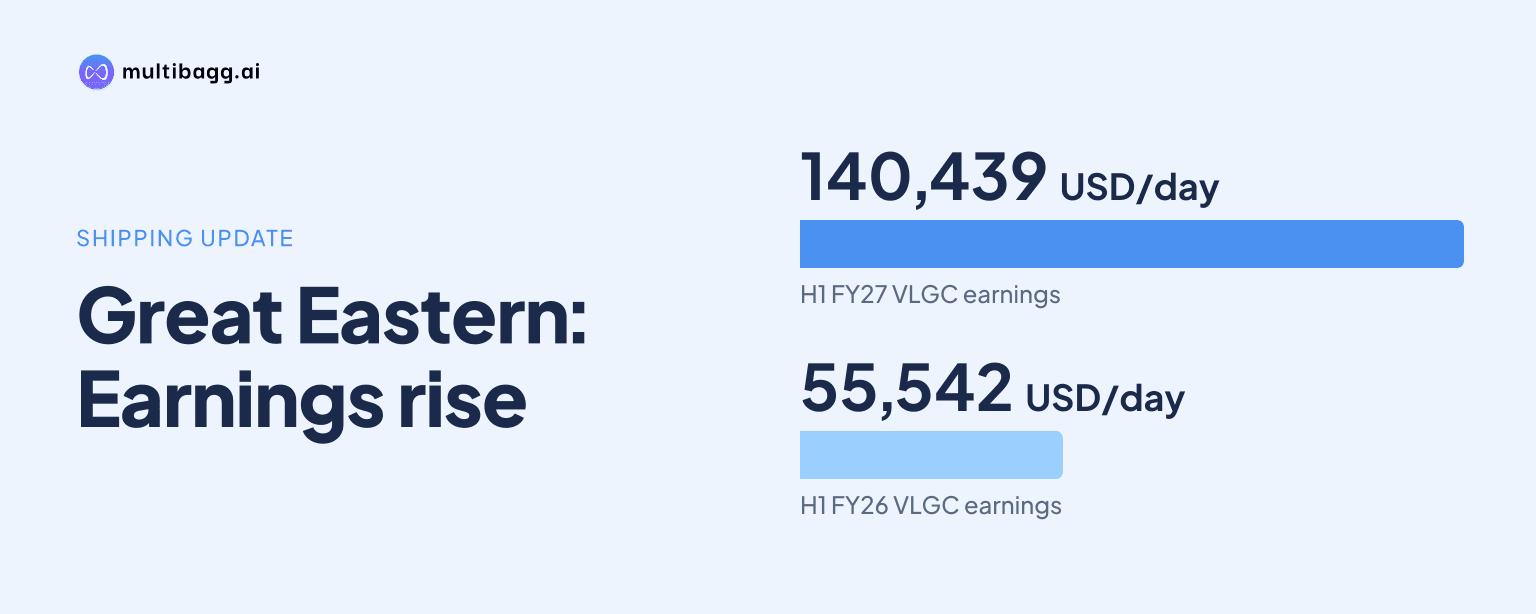
The Great Eastern Shipping Co. Ltd. said average Very Large Gas Carrier (VLGC) earnings reached USD 140,439 per day in H1 FY27, up 153% from USD 55,542 per day in H1 FY26, despite a 14% year-on-year decline in overall liquefied petroleum gas (LPG) trade during Q2 FY27.
Know Great Eastern Shipping Company inside out
Results, valuation, peers and who's buying, in one view.
Why did Great Eastern VLGC earnings rise while LPG trade declined?
Great Eastern’s VLGC earnings rose because ship availability was constrained by inefficient Middle East Gulf export operations and longer voyages, even as aggregate LPG trade fell. Average VLGC earnings increased by USD 84,897 per day between H1 FY26 and H1 FY27, while spot earnings in Q2 FY27 alone rose 135% year on year.
The presentation identifies the Strait of Hormuz as a central mechanism. Middle East Gulf exports halved year on year in Q2 FY27, contributing to the 14% fall in overall LPG trade, but ship-to-ship transfers accounted for about 75% of exports through Hormuz. Great Eastern said these transfers created artificial inefficiencies that supported the market.
This was a different outcome from a volume-led freight cycle, in which lower cargo volumes would normally leave more vessels available. In Q2 FY27, the reduced efficiency of cargo handling and voyages absorbed vessel time despite lower Middle East Gulf exports. Great Eastern did not disclose the number of additional days required for transfers or the resulting increase in tonne-miles.
How did US LPG exports support Great Eastern’s VLGC market?
US LPG exports supported Great Eastern’s VLGC market by rising 10% year on year in Q2 FY27, providing cargo demand while Middle East Gulf exports halved. Great Eastern attributed the resilient US exports to robust production and declining domestic consumption.
India was a notable destination for this trade. US LPG exports to India more than tripled year on year in Q2 FY27, according to Great Eastern, although the presentation did not disclose export tonnage. The increase occurred during a quarter in which overall LPG trade volumes contracted 14% year on year.
Great Eastern also said strong Asian demand and high US inventories supported the US to Far East arbitrage. Normalised US terminal fees allowed freight to capture a wider share of that arbitrage, meaning that terminal charges left more of the regional pricing gap available to freight. The presentation does not quantify terminal-fee changes or the value of the arbitrage.
Got a follow-up? Ask IRIS
How did Hormuz transfers and Cape routing affect VLGC demand?
Hormuz ship-to-ship transfers and Cape of Good Hope routing increased the vessel time required to move LPG cargoes in Q2 FY27. Great Eastern said high Panama Canal fees pushed more ships through the Cape of Good Hope, a longer route that increased tonne-miles, or cargo volume multiplied by distance travelled.
The Hormuz disruption was separate from the Cape routing effect. About 75% of exports through Hormuz used ship-to-ship transfers in Q2 FY27, while Middle East Gulf exports halved year on year. Great Eastern said the transfers caused artificial inefficiencies, reducing the effective availability of the VLGC fleet.
Together, these conditions help explain why Q2 FY27 VLGC spot earnings rose 135% year on year while US exports increased 10% and total trade declined 14%. This is an interpretation of the mechanisms presented by Great Eastern, not a measure of the precise contribution from each route or transfer activity.
What supply and asset-value factors does Great Eastern disclose for VLGCs?
Great Eastern disclosed that the VLGC fleet grew 8% year on year in Q2 FY27, even as spot earnings rose 135% year on year. The company also put the VLGC orderbook-to-fleet ratio at 39%, indicating that the disclosed future delivery pipeline was large relative to the operating fleet.
The 39% VLGC ratio was above the corresponding ratios of 28% for crude tankers, 22% for product tankers and about 16% for bulk carriers. A separate 2026 historical orderbook table put LPG carriers of 65,000 cubic metres and above at 38.8% of fleet, compared with 28.3% for crude tankers, 22.0% for product tankers and 15.8% for bulkers.
VLGC asset values rose 18% quarter on quarter in Q2 FY27, according to Great Eastern. The company’s five-year-old LPG asset-value chart showed a labeled VLGC value of 167 in October 2026, but it did not provide a currency vessel price or specify whether the value represented newbuild or second-hand transactions.
The disclosed global LPG orderbook distribution was 2.4% of fleet in calendar 2026, 11.4% in 2027, 9.7% in calendar 2028 and 16.7% in calendar 2029 and beyond. Those figures describe the timing of the orderbook rather than a forecast for freight rates or asset values.
Conclusion
Great Eastern’s H1 FY27 VLGC earnings increase was associated with operational constraints rather than a rise in total LPG trade. Average earnings climbed 153% to USD 140,439 per day as Hormuz ship-to-ship transfers, Cape of Good Hope routing and higher US exports increased cargo movement requirements while overall LPG trade declined 14% in Q2 FY27.
The next disclosed factors to watch are whether the roughly 75% ship-to-ship share of Hormuz exports persists, whether US exports maintain their 10% year-on-year Q2 FY27 growth, and the delivery profile of the LPG orderbook. Great Eastern’s schedule places 11.4% of fleet capacity in calendar 2027, 9.7% in calendar 2028 and 16.7% in calendar 2029 and beyond.