










The Great Eastern Shipping Co. Ltd. has 8 vessels, 1 rig in H2 FY27
Key highlights
- GIL has eight vessels and one rig scheduled for repricing in H2 FY27.
- GIL states that its oilfield-services fleet comprises four rigs and 19 OSVs.
- The offshore industry orderbook is 12 rigs and 97 vessels, equal to 2.5% and 2.9% of current fleets.
- The presentation lists 31% of rigs and 27% of vessels above its stated age thresholds.
powered by IRIS
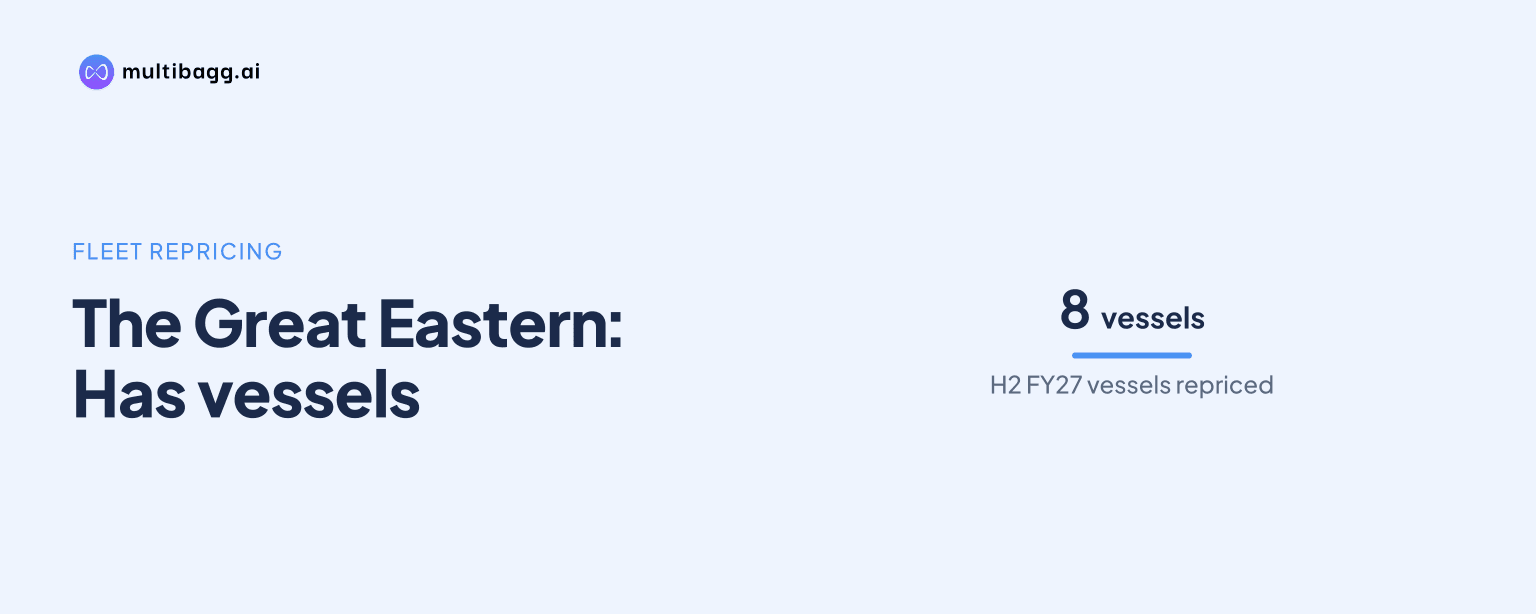
The Great Eastern Shipping Co. Ltd. (GIL) has eight offshore vessels and one rig scheduled for repricing in H2 FY27, the largest vessel count in any disclosed half-year. The presentation places this schedule against an offshore industry orderbook of 12 rigs and 97 vessels, equal to 2.5% and 2.9% of their respective current fleets.
Know Great Eastern Shipping Company inside out
Results, valuation, peers and who's buying, in one view.
What is GIL's H2 FY27 offshore repricing exposure?
GIL's H2 FY27 repricing exposure is eight vessels and one rig. The schedule shows the highest vessel count of any period from H2 FY27 through H2 FY30, while the one rig is the first of four rig repricing entries in the disclosed calendar. The presentation does not disclose the rates, contract terms or counterparties associated with these assets.
The H2 FY27 concentration is followed by two vessel repricings in H1 FY28 and seven in H2 FY28. The table therefore contains 17 vessel repricing entries across the first three disclosed half-years, from H2 FY27 to H2 FY28. The remaining two vessel entries occur in H1 FY29, with no vessel repricings listed from H2 FY29 to H2 FY30.
How does GIL's schedule compare with its offshore fleet?
GIL states that its oilfield-services fleet comprises four rigs and 19 offshore support vessels, or OSVs. Its repricing table contains 19 vessel entries from H2 FY27 through H1 FY29 and four rig entries from H2 FY27 through H2 FY30. The matching totals indicate that the table covers the stated fleet counts, although GIL does not identify the individual assets.
The timing differs between the two asset types. All 19 vessel repricing entries occur by H1 FY29, beginning with eight in H2 FY27 and ending with two in H1 FY29. Rig repricing is spread over a longer period, with one rig in H2 FY27, one in H1 FY30 and two in H2 FY30; no rig repricing is listed between H1 FY28 and H2 FY29.
GIL's company overview separately lists a shipping fleet of 42 vessels, comprising 26 tankers and 16 dry-bulk carriers. The offshore repricing schedule therefore concerns the four rigs and 19 OSVs rather than the 42-vessel shipping fleet. The presentation does not provide asset-level revenue, earnings or utilisation for the rigs and OSVs due for repricing.
How limited is the offshore industry newbuild pipeline?
The offshore industry newbuild pipeline shown by GIL is 12 rigs and 97 vessels, compared with current fleets of 489 rigs and 3,345 vessels. The presentation calculates the orderbook-to-current-fleet ratio at 2.5% for rigs and 2.9% for vessels. These figures describe assets on order, rather than a stated timetable for delivery or entry into service.
Industry data show 364 rigs and 2,327 vessels under contract. Vessels outnumber rigs in the current fleet by 3,345 to 489 and in the orderbook by 97 to 12. However, the vessel orderbook ratio is only 0.4 percentage points above the rig ratio, at 2.9% compared with 2.5%.
Got a follow-up? Ask IRIS
What do the industry age and cold-stack figures show?
GIL's industry data show that 31% of rigs and 27% of vessels are above the presentation's stated age thresholds. The table describes the measure as the number of vessels or rigs more than 20 or 30 years old, respectively, expressed as a percentage of fleet. It does not identify individual units or specify the ages of GIL's four rigs and 19 OSVs.
The same industry table lists 57 rigs and 404 vessels as cold stacked for more than three years. These are separate counts from the 12-rig and 97-vessel orderbooks, and the presentation does not say whether any cold-stacked assets will return to service, be retired or remain inactive. It also does not link the cold-stacked counts to GIL's contract repricing calendar.
GIL also presents a jack-up utilisation chart extending through September 2026. Its note says the September 2026 data include all rigs on contract, including rigs placed on standby because of the war in the Middle East. That disclosure means the chart's contracted-rig measure includes standby rigs as well as rigs that may be operating.
When are GIL's remaining offshore assets scheduled for repricing?
GIL lists no vessel repricings after H1 FY29, while the three remaining rig repricings fall in FY30. One rig is scheduled for H1 FY30 and two rigs for H2 FY30. This differs from the vessel schedule, which is concentrated in H2 FY27, H1 FY28, H2 FY28 and H1 FY29.
The zero entries define the gap in the schedule: H2 FY29 has zero vessels and zero rigs, H1 FY30 has zero vessels and one rig, and H2 FY30 has zero vessels and two rigs. The disclosed calendar is therefore vessel-free from H2 FY29 and includes rigs only during FY30. GIL provides no repricing periods beyond H2 FY30.
Conclusion
GIL's disclosed offshore repricing calendar is weighted first toward vessels, with eight vessels and one rig due in H2 FY27 and seven more vessels listed for H2 FY28. The company presents this against industry orderbooks equal to 2.5% of the rig fleet and 2.9% of the vessel fleet, while 31% of rigs and 27% of vessels exceed the stated age thresholds.
The next disclosed points to watch are two vessel repricing entries in H1 FY28, seven in H2 FY28 and two in H1 FY29, followed by three rig repricing entries across FY30. The presentation leaves contract pricing, duration, asset-level utilisation and counterparties unresolved, even though those details would determine the financial effect of each repricing event.