










GIC Re begins climate catastrophe reserves for future volatility
Key highlights
- GIC Re has started building catastrophe reserves for climate change to manage future volatility.
- GIC Re reported a 418% solvency ratio in H1 FY26-27, versus 421% in FY25-26.
- GIC Re’s incurred claims ratio was 86.2% in H1 FY26-27, compared with 85.4% in FY25-26.
- GIC Re reported Rs 53,402 crore of net worth excluding FVC in H1 FY26-27.
powered by IRIS
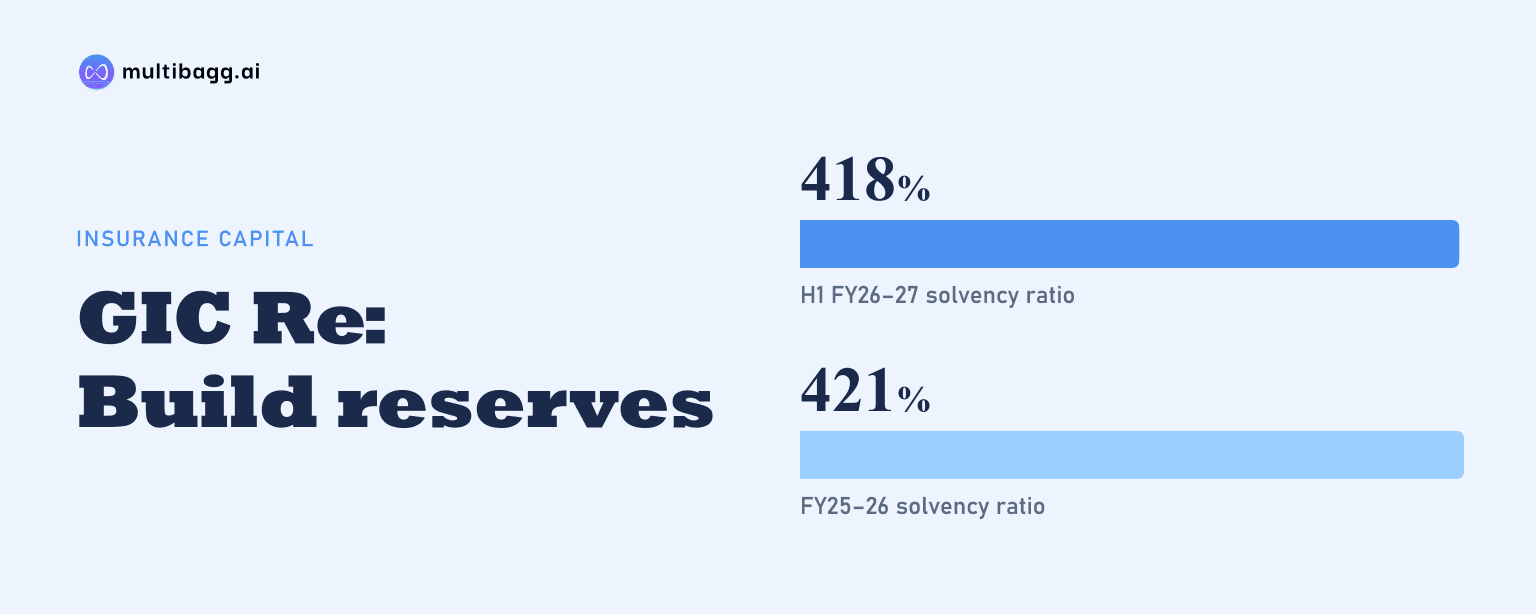
GIC Re has started building catastrophe reserves for climate change to manage future volatility, while reporting a 418% solvency ratio in H1 FY26-27, compared with 421% in FY25-26. The reserve initiative sits within a strategy that also targets underwriting profitability through contract selection, exposure modelling and loss-ratio improvement.
Know General Insurance Corporation of India inside out
Results, valuation, peers and who's buying, in one view.
Why is GIC Re building catastrophe reserves for climate change?
GIC Re says it has begun building catastrophe reserves for climate change because it expects the reserves to help manage volatility in the future. The presentation does not disclose the size of the reserve, a target balance, a timetable for accumulation, or the specific catastrophe perils covered. It presents the action as part of its strategic approach and way forward rather than as a separately reported financial result.
The reserve plan accompanies a phased adoption of modelling capabilities intended to improve exposure management and derive value from it. For a reinsurer, exposure management is the mechanism identified by GIC Re for assessing concentrations of risk before losses occur. The company has not quantified the expected effect of modelling or catastrophe reserves on claims, premium growth, capital, or profit after tax in H1 FY26-27.
The climate-reserve initiative is distinct from GIC Re’s sustainability measures on page 25 of the presentation. Those measures include considering environment and climate change in investment decisions, making investments in green bonds, preferring capacity that aids transition to a low-carbon economy, and migrating operations towards cloud-native systems as part of decarbonisation efforts. The catastrophe reserve, by contrast, is described as a tool for managing underwriting-related future volatility.
How is GIC Re tightening underwriting profitability?
GIC Re is pursuing underwriting profitability through class-specific evaluation and by removing contracts with inadequate pricing. It also says it is linking incentives to individual company or contract performance. These measures indicate that underwriting decisions will be assessed at a more granular level than a broad portfolio approach, although the presentation does not name the classes or contracts that could be affected.
The company’s combined ratio was 107.4% in H1 FY26-27, versus 106.0% in FY25-26. The combined ratio is a measure that combines claims and underwriting expenses relative to premium; GIC Re provides the ratio but does not set out a numerical target. Its management focus is on improving the net incurred claims ratio by reducing attritional losses, while commission ratios are expected to remain stable.
The incurred claims ratio improved by 3.0 percentage points from 88.4% in FY24-25 to 85.4% in FY25-26, before increasing 0.8 percentage points to 86.2% in H1 FY26-27. Over the same full-year comparison, net premium rose by Rs 2,727 crore to Rs 40,571 crore. The presentation therefore shows a lower claims ratio in FY25-26 alongside higher net premium, but a partial-year ratio that moved upward in H1 FY26-27.
Got a follow-up? Ask IRIS
What financial capacity does GIC Re report for this strategy?
GIC Re reported net worth excluding fair value change, or FVC, of Rs 53,402 crore in H1 FY26-27, up from Rs 51,301 crore in FY25-26. Net worth including FVC was Rs 93,139 crore in H1 FY26-27, compared with Rs 84,030 crore at FY25-26. The company says its significant net worth will fuel growth and resilience, without specifying an amount allocated to catastrophe reserves or international expansion.
Policyholders’ funds rose to Rs 103,618 crore in H1 FY26-27 from Rs 99,085 crore in FY25-26. The solvency ratio slipped to 418% from 421% over the same periods, while remaining above the FY24-25 figure of 370%. These disclosed ratios show that reported solvency decreased by 3 percentage points during H1 FY26-27 after rising substantially over the preceding two financial years.
Profit after tax increased to Rs 8,392 crore in FY25-26 from Rs 6,701 crore in FY24-25. In H1 FY26-27, profit after tax was Rs 4,378 crore, a partial-period figure that should not be directly equated with a full financial year. Return on equity, which the presentation states is annualised, was 16.4% in both FY25-26 and H1 FY26-27, following 15.5% in FY24-25.
Where does GIC Re plan to grow next?
GIC Re plans geographical diversification of its portfolio after a credit-rating upgrade, with a stated focus on growing in international markets. It says it has brand equity particularly in the Afro-Asian region and intends to leverage that position. The presentation does not identify countries, premium targets, capital commitments, or dates for the planned diversification.
The company says it is ranked 10th globally based on scale and cites credit ratings from AM Best and CARE. GIC Re reports an A- Excellent rating from AM Best and says it will strive to improve that rating through continued attention to balance-sheet strength, operating performance, market position and enterprise risk management. This is a management objective, not a disclosed commitment by the rating agency to change its assessment.
In India, GIC Re expects growth in diversified areas including surety bonds, cyber-risk covers and parametric covers. It also says implementation of Risk Based Capital could create solvency pressure for Indian insurers, potentially leading to higher cessions and a larger reinsurance market. That outcome is presented as an opportunity to sustain and maintain market share, rather than as a forecast of a specific increase in GIC Re premium.
Gross premium was Rs 44,007 crore in FY25-26, up from Rs 41,154 crore in FY24-25, while H1 FY26-27 gross premium was Rs 24,704 crore. Net premium increased from Rs 33,956 crore in FY23-24 to Rs 40,571 crore in FY25-26. The company’s expansion plan therefore starts from a portfolio that has recorded premium growth, but its presentation does not break out domestic and international premiums.
Conclusion
GIC Re’s climate-risk approach combines a newly disclosed catastrophe-reserve build with phased modelling, class-specific pricing reviews and a stated effort to reduce attritional losses. The operational context is mixed: the incurred claims ratio improved from 88.4% in FY24-25 to 85.4% in FY25-26, but was 86.2% in H1 FY26-27, while the combined ratio rose to 107.4% from 106.0%.
The next disclosed issues to watch are the planned geographical diversification following the credit-rating upgrade, the growth of surety, cyber and parametric covers, and any future disclosure on the climate catastrophe reserve’s size or design. GIC Re also identifies Risk Based Capital implementation as a potential driver of higher reinsurance cessions, while reporting Rs 103,618 crore of policyholders’ funds in H1 FY26-27.