










GIC Re Targets January Renewals to Restart Flat Overseas Book
Key highlights
- GIC Re's international premium was broadly unchanged at Rs 4,909.16 crore in H1 FY 2027.
- GIC Re's international combined ratio improved to 108.24% in H1 FY 2027 from 119.87% a year earlier.
- GIC Re reported a solvency ratio of 4.18 at 30 September 2026, compared with 3.85 a year earlier.
- GIC Re said it had provided about Rs 450 crore to Rs 500 crore for Gujarat flood losses.
powered by IRIS
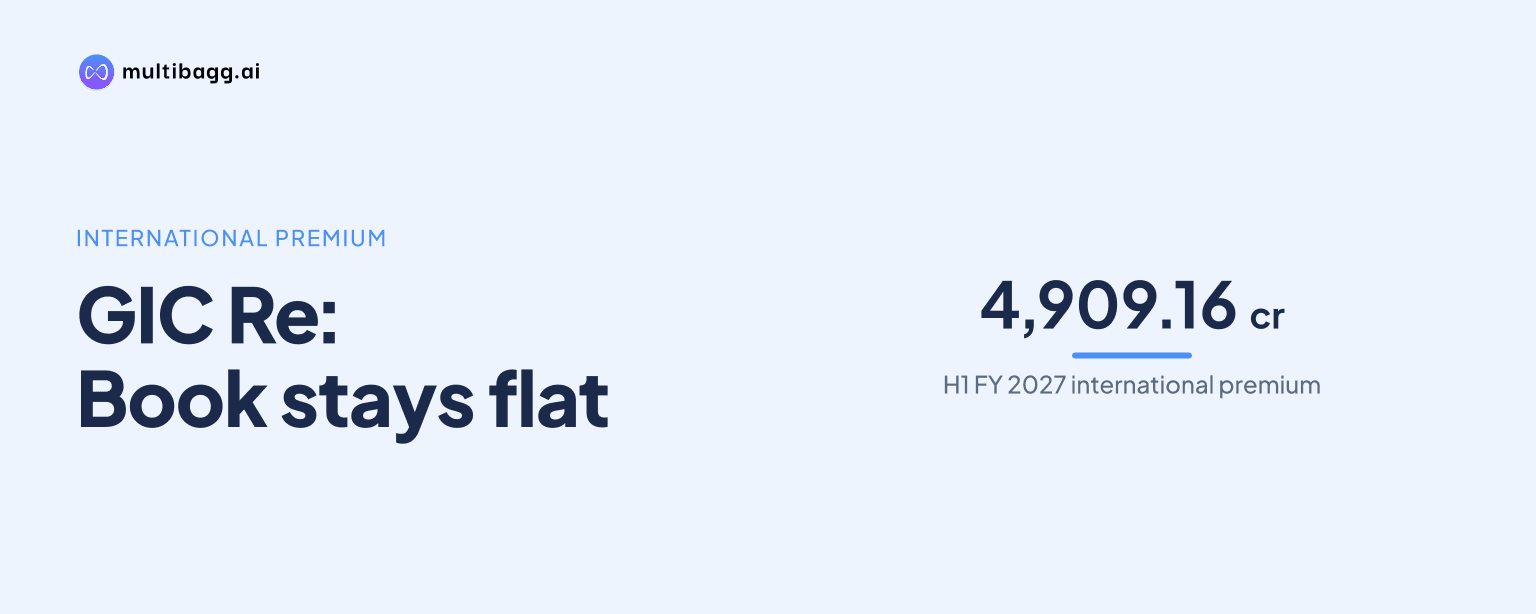
General Insurance Corporation of India, or GIC Re, is targeting the 1 January renewal season to grow an overseas portfolio that remained flat at Rs 4,909.16 crore in H1 FY 2027, while management said abundant traditional and alternative reinsurance capital would keep global competition elevated for another year.
Know General Insurance Corporation of India inside out
Results, valuation, peers and who's buying, in one view.
Why is GIC Re focused on the January renewal season?
GIC Re is focused on 1 January because much of its overseas business renews on that date, making the season the immediate test of whether the foreign book can resume growth. International premium was broadly unchanged year on year at Rs 4,909.16 crore in H1 FY 2027, and management said the half-year view is more useful for this portfolio because of renewal seasonality.
Management said GIC Re has its rating back and has expanded outreach to international brokers to see more opportunities. The company described broker outreach as an initiative intended to support an increase in the foreign book during the 1 January renewals. It did not provide an overseas premium-growth target for H2 FY 2027 or FY 2028.
The international business accounted for 20% of GIC Re's Rs 24,703.57 crore gross premium income in H1 FY 2027, compared with 80% for domestic business. Domestic premium rose 15.9% year on year to Rs 19,794.41 crore, while international premium was broadly unchanged, making the January renewal outcome important for the overseas growth outlook.
What is limiting GIC Re's overseas premium growth?
GIC Re said the overseas reinsurance market has abundant capital from traditional reinsurers and alternative-capital providers, and management expects competitive pressure to persist for another year. Management also said loss trends during the past two to three years had remained below the long-term average, a factor that will be considered in January and possibly April renewal pricing.
Management's feedback from international conferences was that the global outlook appeared stable and underwriting discipline was expected to hold. GIC Re said it would pursue growth where pricing, terms and risk-adjusted returns meet its expectations, rather than disclose a volume-led growth plan for H2 FY 2027.
The domestic pricing setting differed from the overseas market. GIC Re said insurers had controlled a slide in domestic property premiums, with rates holding from 10 September through the call date. For overseas markets, however, management identified plentiful capacity as the main competitive factor.
Has GIC Re's international underwriting performance improved?
GIC Re's international combined ratio improved to 108.24% in H1 FY 2027 from 119.87% in H1 FY 2026, a reduction of 11.63 percentage points. Management called the progress encouraging but said the portfolio had not yet achieved underwriting profitability.
An analyst cited an overseas loss ratio of 80% in H1 FY 2027, following 66% in Q1 FY 2027, and management addressed the change. Management said the property book had performed well because of its underwriting approach and relatively benign catastrophe activity, while additional provisioning in Motor and Cargo for an American runoff treaty raised loss ratios.
GIC Re exited that American runoff treaty in December 2021. Management said it believed loss reserves on the treaty should be maintained for longer and characterised the additional reserve position as conservative accounting because the incurred-but-not-reported, or IBNR, proportion was small.
At the company level, GIC Re's combined ratio was 107.39% in H1 FY 2027, compared with 107.41% in H1 FY 2026. Its incurred claims ratio eased to 86.19% from 86.45%, but underwriting loss increased to Rs 1,709.06 crore from Rs 1,234.59 crore, showing that the nearly unchanged half-year combined ratio did not produce a lower underwriting loss.
Got a follow-up? Ask IRIS
How do reserves and catastrophe losses affect GIC Re's results?
GIC Re said proportional-treaty accounts and obligatory statements can reach it with a lag, meaning some catastrophe losses may be reported in later quarters. For the Gujarat floods, management said it had provided about Rs 450 crore to Rs 500 crore, while adding that market losses were not yet fully reflected in its financial results.
The appointed actuary said IBNR strengthening reflects the volume and type of business written and emerging loss experience, rather than a fixed policy to increase reserves. Management also referred to about Rs 440 crore of Gujarat flood provisions, strengthening for the current crop year amid reported drought conditions, and reserve releases on certain other classes and contracts.
Management said there had been more reserve strengthening than reserve releases for previous periods, while describing overall results as stable. GIC Re did not disclose a separate quantified natural-catastrophe loss run rate for Q2 FY 2027 and said it proposed to provide explicit natural-catastrophe guidance from FY 2028.
GIC Re's Q2 FY 2027 incurred claims ratio rose to 87.39% from 81.50% a year earlier, while the combined ratio increased to 110.23% from 109.15%. Those quarterly changes contrast with relatively stable H1 ratios and reflect management's warning that reserve movements, reporting lags and catastrophe development make two quarters insufficient to establish a trend.
What financial capacity does GIC Re have for overseas opportunities?
GIC Re reported a solvency ratio of 4.18 at 30 September 2026, up from 3.85 at 30 September 2025. Management said its capital base, customer relationships and solvency position allow it to support clients and consider opportunities in domestic and international markets while maintaining underwriting discipline.
Net worth excluding fair-value changes was Rs 53,402.32 crore at 30 September 2026, compared with Rs 46,669.38 crore a year earlier. Including fair-value changes, net worth was Rs 93,138.68 crore, compared with Rs 88,709.19 crore, providing the balance-sheet context for management's selective approach to January renewals.
Profit after tax declined to Rs 4,377.66 crore in H1 FY 2027 from Rs 4,619.02 crore in H1 FY 2026. Profit before tax decreased to Rs 5,591.79 crore from Rs 5,716.30 crore, while investment income increased to Rs 7,503.78 crore from Rs 7,105.41 crore, indicating that higher investment income did not offset underwriting and claims-related pressures in the half year.
Conclusion
GIC Re enters the 1 January renewal period with international premium flat at Rs 4,909.16 crore in H1 FY 2027, but with the overseas combined ratio reduced to 108.24% from 119.87% a year earlier. Management's strategy combines broker engagement and its rating with selective underwriting in a market where global capacity remains plentiful.
The next disclosed milestone is the 1 January renewal outcome, which management said should give a clearer indication of the foreign portfolio's annual direction. Other disclosed matters to watch are competitive capacity, January and possible April pricing, catastrophe-loss development and GIC Re's proposed introduction of explicit natural-catastrophe guidance in FY 2028.