










GIC Re international ratio falls to 108% as domestic mix hits 80%
Key highlights
- GIC Re’s international combined ratio declined from 138% in FY22-23 to 108% in H1 FY26-27.
- Domestic business reached 80% of GIC Re gross premium in H1 FY26-27, up from 69% in FY22-23.
- GIC Re’s international incurred claims ratio fell to 80% in H1 FY26-27 from 113% in FY22-23.
- Non-obligatory business accounted for 63% of GIC Re domestic business in H1 FY26-27.
powered by IRIS
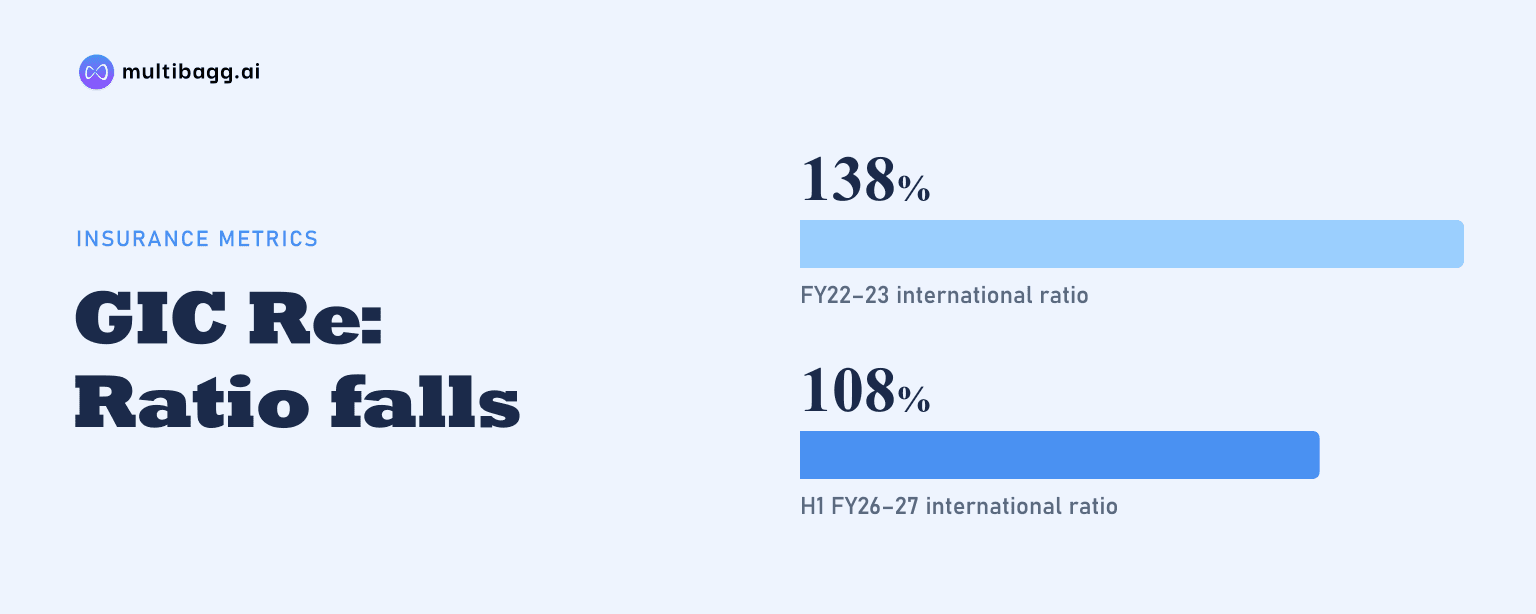
General Insurance Corporation of India (GIC Re) reduced its international combined ratio to 108% in H1 FY26-27 from 138% in FY22-23, while domestic business rose to 80% of gross premium from 69%. Its international incurred claims ratio also declined to 80% from 113% over the same period.
Know General Insurance Corporation of India inside out
Results, valuation, peers and who's buying, in one view.
How has GIC Re’s geographic premium mix changed?
GIC Re’s domestic gross-premium share rose to 80% in H1 FY26-27, while international business accounted for 20%. Domestic business was 69% in both FY22-23 and FY23-24, making the latest share 11 percentage points higher than in either of those years.
The change occurred in stages, with domestic business rising to 75% in FY24-25 and remaining at 75% in FY25-26 before reaching 80% in H1 FY26-27. International business moved from 31% in FY22-23 and FY23-24 to 25% in FY24-25 and FY25-26, then declined to 20% in the latest half-year.
The larger domestic weighting sits alongside GIC Re’s reinsurance support for 59 direct general and life insurers in India. GIC Re identifies property, agriculture or crop, liability, motor, life and health as key segments, while its international presence extends to around 137 countries.
How did GIC Re’s combined ratios change by geography?
GIC Re’s international combined ratio declined by 30 percentage points to 108% in H1 FY26-27 from 138% in FY22-23. It reduced to 126% in FY23-24, 121% in FY24-25 and 120% in FY25-26 before the latest half-year figure.
Domestic combined ratios followed a different course, rising from 95% in FY22-23 to 106% in FY23-24, then easing to 104% in FY24-25 and 102% in FY25-26. The domestic ratio rose again to 107% in H1 FY26-27, leaving the international ratio only one percentage point higher at 108%, compared with a 43-point gap in FY22-23.
The presentation separately lists boxed values of 109% in FY22-23, 112% in FY23-24, 109% in FY24-25, 106% in FY25-26 and 107% in H1 FY26-27, without defining that label on the page. GIC Re’s overview reports a standalone combined ratio of 107.4% for H1 FY26-27, compared with 106.0% for FY25-26.
Got a follow-up? Ask IRIS
What do GIC Re’s incurred claims ratios show?
GIC Re’s international incurred claims ratio fell to 80% in H1 FY26-27 from 113% in FY22-23, a 33-percentage-point reduction. The reported ratio was 99% in FY23-24, 97% in FY24-25 and 92% in FY25-26 before reaching 80% in the half year.
Domestic incurred claims ratios were below international ratios in the first four periods shown, but reached 88% in H1 FY26-27 against 80% internationally. Domestic claims were 80% in FY22-23, rose to 89% in FY23-24, then moved to 85% in FY24-25 and 83% in FY25-26.
The relative position therefore reversed across the disclosed period. International incurred claims were 33 percentage points above domestic claims in FY22-23, at 113% versus 80%, but were eight percentage points below domestic claims in H1 FY26-27, at 80% versus 88%; the presentation’s boxed values were 91% and 86%, respectively, in those periods.
How is GIC Re’s domestic business mix changing?
GIC Re’s non-obligatory business represented 63% of domestic business in H1 FY26-27, up from 58% in FY25-26 and 60% in FY22-23. Obligatory business accounted for the remaining 37% in H1 FY26-27, compared with 42% in FY25-26 and 40% in FY22-23.
The domestic split also changed during the intervening years: obligatory business was 43% in FY23-24 and 40% in FY24-25, while non-obligatory business was 57% and 60%, respectively. The shift to 63% non-obligatory business coincides with domestic business reaching 80% of GIC Re’s gross premium in H1 FY26-27.
GIC Re receives obligatory cessions on every policy from domestic general insurers under the framework outlined in the presentation. The company separately reports the obligatory and non-obligatory domestic mix, so the 37% and 63% proportions describe the composition of domestic business rather than its share of total gross premium.
Which product lines changed in H1 FY27?
GIC Re reported health at 27% of gross premium in H1 FY27, up from 21% in FY26, while life increased to 9% from 6%. Fire declined to 25% from 32% over the same comparison, representing the largest movement among the listed product lines.
Agriculture reinsurance was unchanged at 8% in FY26 and H1 FY27, while motor declined to 15% from 17% and miscellaneous business remained at 16%. In FY25, fire was 33%, health 23%, motor 15%, life 5%, agriculture reinsurance 8% and miscellaneous business 16%.
Conclusion
GIC Re’s reported portfolio data show a greater domestic concentration and a narrowing difference between geographic underwriting measures. Domestic business increased from 69% to 80% of gross premium between FY22-23 and H1 FY26-27, while the international combined ratio fell from 138% to 108% and international incurred claims declined from 113% to 80%.
The unresolved issue is whether the H1 FY26-27 mix and underwriting pattern continue through a full year. GIC Re provides no forward target for domestic share, the 63% non-obligatory domestic mix or segment-level combined ratios, leaving future company disclosures to show whether the 80% domestic share and 108% international ratio persist.