










GIC Re H1 profit relied on Rs 7,504 crore investment income
Key highlights
- GIC Re reported Rs 4,378 crore of profit after tax in H1 FY26-27.
- GIC Re recorded a Rs 1,709 crore underwriting loss in H1 FY26-27.
- GIC Re generated Rs 7,504 crore of investment income in H1 FY26-27.
- GIC Re's combined ratio was 107.4% in H1 FY26-27 versus 106.0% in FY25-26.
powered by IRIS
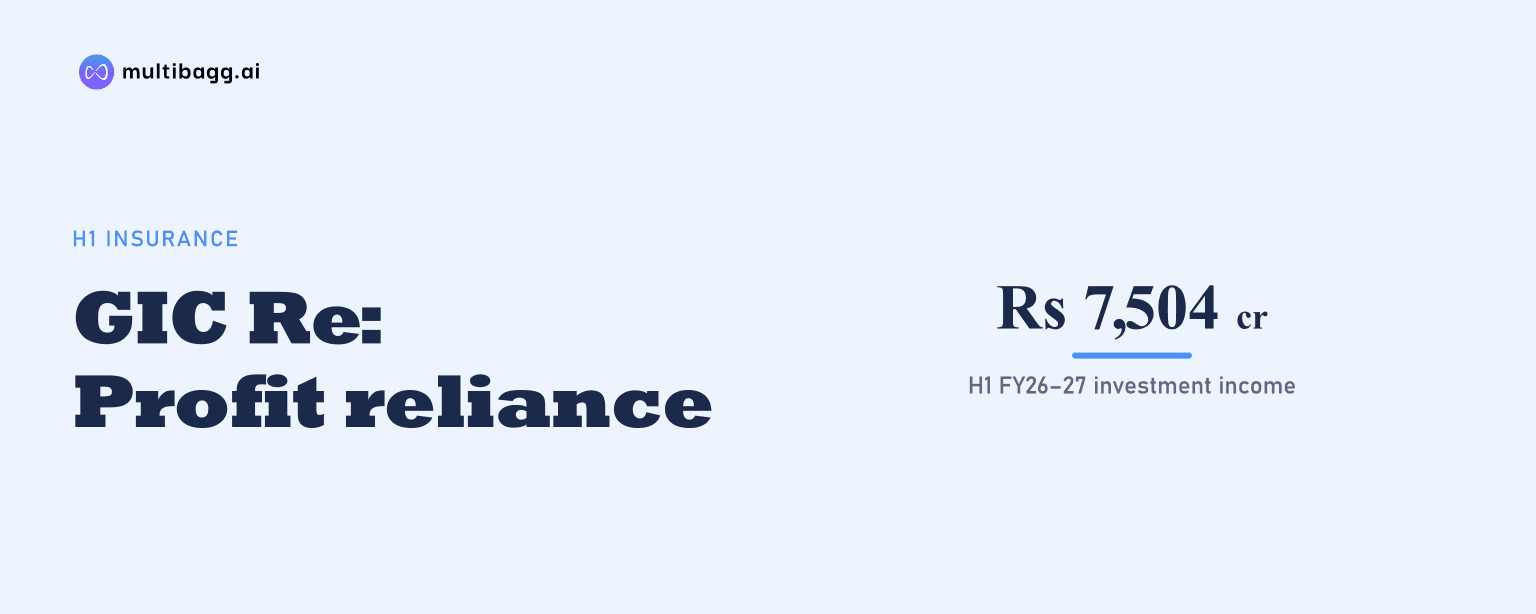
GIC Re reported Rs 4,378 crore of profit after tax in the first half (H1) of financial year (FY) 2026-27 despite a Rs 1,709 crore underwriting loss, as investment income reached Rs 7,504 crore. The standalone table shows a 107.4% combined ratio, above the 106.0% reported for FY25-26.
Know General Insurance Corporation of India inside out
Results, valuation, peers and who's buying, in one view.
Why did GIC Re make a profit despite an underwriting loss?
GIC Re made a profit because its Rs 7,504 crore of investment income exceeded its Rs 1,709 crore underwriting loss in H1 FY26-27. Profit before tax was Rs 5,592 crore, while the Rs 1,214 crore tax provision resulted in reported profit after tax of Rs 4,378 crore. The presentation also records Rs 116 crore of other income less outgo for the half year.
The distinction matters because GIC Re separately reports the underwriting result and investment income in its standalone financial table. Underwriting remained loss-making in H1 FY26-27, while investment income was larger than both the underwriting loss and the Rs 5,592 crore profit before tax. The table also reports a Rs 172 crore profit on exchange, but does not provide a detailed bridge between every listed line item and pre-tax profit.
How did GIC Re's H1 FY26-27 underwriting metrics compare?
GIC Re's combined ratio increased to 107.4% in H1 FY26-27 from 106.0% in FY25-26, while its incurred claims ratio rose to 86.2% from 85.4%. The presentation defines the combined ratio as the sum of the loss ratio and expense ratio. A combined ratio above 100% means claims and underwriting-related expenses exceeded earned premiums in the reported period.
The rise in the claims ratio occurred alongside an increase in net commission as a share of net premium, to 20.2% in H1 FY26-27 from 19.6% in FY25-26. Expenses of management were 1.0% of net premium in both periods. FY25-26 is a full-year period and H1 FY26-27 is a half-year period, so the absolute figures show reported scale rather than like-for-like growth.
What does GIC Re's longer financial record show about underwriting?
GIC Re's underwriting loss narrowed from Rs 5,488 crore in FY20-21 to Rs 1,763 crore in FY25-26 across the six full financial years shown. The loss was Rs 4,266 crore in FY21-22, Rs 2,341 crore in FY22-23, Rs 4,007 crore in FY23-24 and Rs 3,352 crore in FY24-25. The sequence was not linear, although the latest full-year loss was below each of the earlier full-year losses listed except FY22-23.
GIC Re's combined ratio declined from 112.0% in FY20-21 and 112.1% in FY21-22 to 106.0% in FY25-26. It was 109.3% in FY22-23, 111.8% in FY23-24 and 108.8% in FY24-25. H1 FY26-27's 107.4% ratio was below the levels recorded from FY20-21 through FY24-25, but above FY25-26's 106.0%, leaving underwriting below break-even in the reported half year.
Got a follow-up? Ask IRIS
How important was investment income to GIC Re's earnings?
GIC Re reported investment income in every period shown, rising from Rs 8,821 crore in FY20-21 to Rs 13,089 crore in FY25-26. The intermediate annual figures were Rs 9,562 crore in FY21-22, Rs 10,594 crore in FY22-23, Rs 11,620 crore in FY23-24 and Rs 12,773 crore in FY24-25. H1 FY26-27 investment income of Rs 7,504 crore accompanied a Rs 1,709 crore underwriting loss.
Profit after tax increased from Rs 1,920 crore in FY20-21 to Rs 8,392 crore in FY25-26, after reaching Rs 2,006 crore in FY21-22, Rs 6,313 crore in FY22-23, Rs 6,497 crore in FY23-24 and Rs 6,701 crore in FY24-25. In H1 FY26-27, GIC Re reported Rs 4,378 crore of profit after tax from Rs 5,592 crore of pre-tax profit. The table supports the conclusion that investment income has been central to reported profitability while the underwriting result remained negative in every displayed period.
What operational changes does GIC Re disclose alongside these results?
GIC Re says implementation of Indian Accounting Standards, or Ind AS, is in progress and it is upgrading software by moving to SAP S4HANA. The presentation does not disclose a completion date, expected financial effect, or a change in reported underwriting or investment income associated with Ind AS implementation.
GIC Re also lists Project Parivartan for human-resources digital transformation, EGRC software for enterprise risk management and workflow management moving towards a paperless office. Its product initiatives include parametric alternative risk transfer covers through GIC Re Emerging Solutions. The governance framework identifies an Information Security Risk Management Committee, a cyber-security policy and framework, and a business-continuity plan and procedure manual.
Conclusion
GIC Re's H1 FY26-27 results show that Rs 7,504 crore of investment income supported Rs 4,378 crore of profit after tax while underwriting recorded a Rs 1,709 crore loss. The 107.4% combined ratio was higher than FY25-26's 106.0%, although the H1 underwriting loss was close to the Rs 1,763 crore loss reported for the full prior year and far below the Rs 5,488 crore loss in FY20-21.
The next disclosures to watch are GIC Re's progress on Ind AS implementation, for which management gives no completion date or quantified accounting effect, and updates on SAP S4HANA, Project Parivartan and parametric alternative risk transfer covers. Future standalone results will also show whether the combined ratio moves from the 107.4% reported in H1 FY26-27.