










GIC Re's equities account for Rs 39,648 crore uplift
Key highlights
- GIC Re’s total portfolio market value was Rs 1,62,019 crore on 30.09.2026, compared with a Rs 1,22,282 crore book value.
- GIC Re’s equity portfolio had a Rs 39,648 crore market-value uplift, from Rs 21,175 crore at book value to Rs 60,823 crore at market value.
- GIC Re reported that 99.53% of debt instruments were in sovereign and AAA-rated bonds on 30.09.2026.
- GIC Re reported that 48.88% of its debt portfolio matures after more than five years.
powered by IRIS
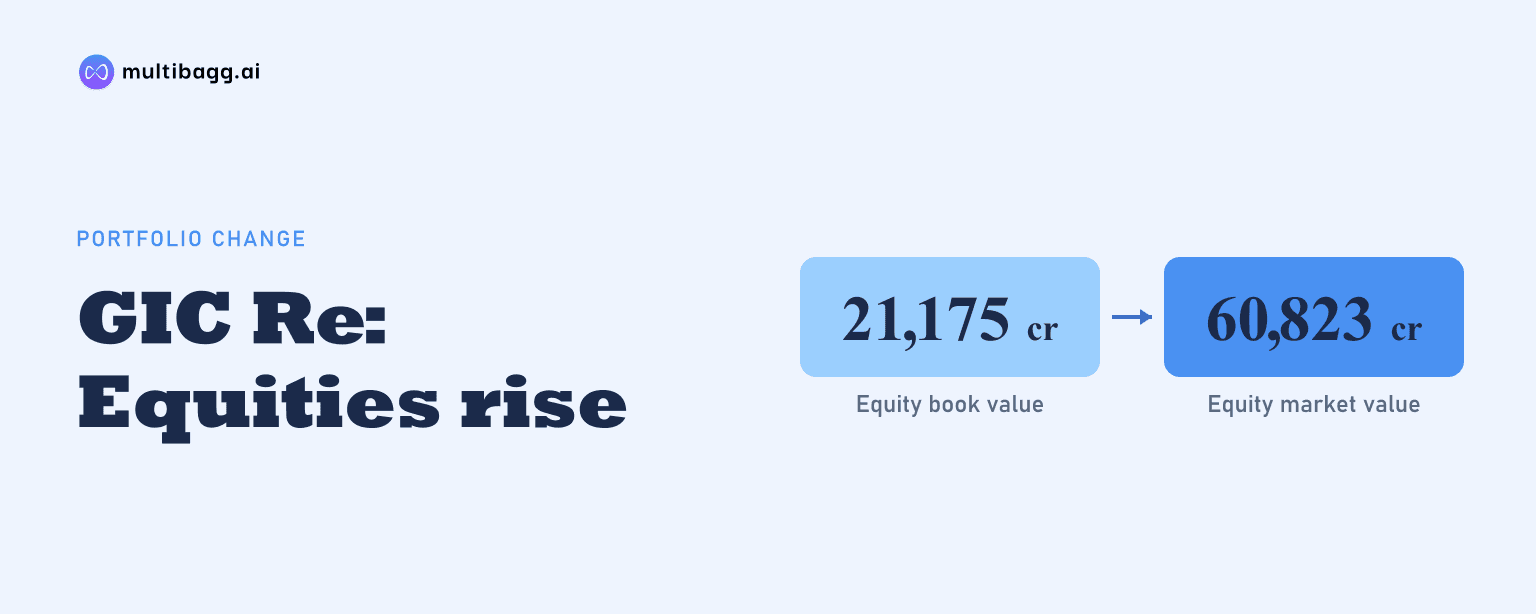
GIC Re’s equity portfolio had a Rs 39,648 crore implied market-value uplift as of 30.09.2026, rising from a Rs 21,175 crore book value to Rs 60,823 crore at market value. That difference accounted for nearly all of the Rs 39,737 crore gap between the portfolio’s Rs 1,62,019 crore market value and Rs 1,22,282 crore book value.
Know General Insurance Corporation of India inside out
Results, valuation, peers and who's buying, in one view.
How large is GIC Re’s investment portfolio uplift?
GIC Re’s investment portfolio was valued at Rs 1,62,019 crore at market value on 30.09.2026, compared with Rs 1,22,282 crore at book value, implying a Rs 39,737 crore uplift. This compares two valuation bases reported at the same date, rather than representing a disclosed realised gain or investment return.
Equities supplied Rs 39,648 crore of the difference, with their Rs 60,823 crore market value exceeding the Rs 21,175 crore book value. Fixed income was reported at Rs 89,037 crore under both measures, while money-market instruments rose by Rs 115 crore to Rs 11,918 crore and other assets were Rs 26 crore lower at market value.
The calculation indicates that equity supplied about 99.8% of the portfolio-level uplift. Money-market holdings made a smaller positive contribution, other assets partly offset it, and fixed income showed no difference between the two reported values. The presentation provides no earlier market and book values, so it does not show how the uplift changed over time.
What changed in GIC Re’s asset mix at market value?
GIC Re’s equity weighting was 37.54% at market value, compared with 17.32% at book value, on 30.09.2026. The 20.22-percentage-point difference reflects the reported valuation gap between equity’s Rs 60,823 crore market value and Rs 21,175 crore book value, not a disclosed purchase or sale.
Fixed income remained the largest category in rupee terms at Rs 89,037 crore on both bases, but its share fell from 72.81% at book value to 54.95% at market value. Money market represented 9.65% of book value and 7.36% of market value, while other assets accounted for 0.22% and 0.15%, respectively.
Fixed income and money market together represented 82.46% of the Rs 1,22,282 crore book-value portfolio, compared with 62.31% of the Rs 1,62,019 crore market-value portfolio. Equity’s market-value uplift is the disclosed mechanism behind most of this difference in portfolio composition.
Got a follow-up? Ask IRIS
How is GIC Re managing debt credit quality and maturities?
GIC Re reported that 99.53% of debt instruments were in sovereign and AAA-rated bonds as of 30.09.2026. Management said this allocation eliminated credit risk in the portfolio and stated that it intends to continue focusing on high-quality bonds to minimise risks; the presentation does not provide a rupee split between sovereign and AAA holdings.
The fixed-income portfolio was Rs 89,037 crore at both book and market value, equal to 72.81% of the book-value portfolio and 54.95% of the market-value portfolio. This contrasts with the Rs 39,648 crore equity valuation difference and means fixed income did not generate the reported aggregate uplift.
GIC Re reported that 48.88% of its debt portfolio matures after more than five years, 42.19% matures in one to five years, and 8.93% matures within one year. The more-than-five-year bucket was the largest, exceeding the one-to-five-year bucket by 6.69 percentage points.
GIC Re described the maturity profile as supporting asset-liability management, or ALM, which matches asset cash flows with expected liabilities. The presentation provides this breakdown only as percentages at 30.09.2026, without debt-maturity values in rupees or a prior-period comparison.
What does GIC Re say about its equity investment approach?
GIC Re says it focuses on index-based stocks with strong return on equity, or ROE, and outstanding order books. Its stated approach also includes weeding out weaker scrips on each rise in the indices, although the presentation does not name indices, holdings, sectors, turnover or a benchmark.
The policy applies to equities reported at Rs 21,175 crore by book value and Rs 60,823 crore by market value on 30.09.2026. Equity therefore represented 17.32% of the book-value portfolio but 37.54% of the market-value portfolio, making it the principal driver of the total valuation difference.
GIC Re describes the overall portfolio as diversified and intended to provide steady and regular income flow. The reported values distinguish that income-flow objective from the valuation composition: fixed income was the largest asset category at Rs 89,037 crore, while equity accounted for almost all of the calculated difference between total market and book values.
The presentation does not disclose an investment return, realised gains, dividend income, duration, concentration limit or sensitivity analysis for the Rs 60,823 crore equity portfolio. The data therefore support a description of valuation levels and the stated stock-selection policy, but not a conclusion about investment performance over a defined period.
Conclusion
GIC Re reported a Rs 39,737 crore difference between market and book value on 30.09.2026, of which Rs 39,648 crore came from equity. The market-value portfolio is consequently more equity-weighted than the book-value portfolio, although fixed income remains the largest category in rupee terms at Rs 89,037 crore.
The next disclosed matter to watch is management’s plan to continue focusing debt investments on high-quality bonds after reporting 99.53% in sovereign and AAA-rated instruments. The presentation also sets out an index-based equity-selection approach, but provides no target allocation, return target or scheduled portfolio revaluation event.