










GIC Re says Gujarat flood losses remain partly unreported
Key highlights
- GIC Re booked Rs 450 crore to Rs 500 crore for Gujarat floods in Q2 FY 2027.
- GIC Re said reporting lags could move additional Gujarat flood claims into later quarters.
- GIC Re's Q2 FY 2027 incurred claims ratio was 87.39%, versus 81.50% in Q2 FY 2026.
- GIC Re's H1 FY 2027 underwriting loss was Rs 1,709.06 crore, up from Rs 1,234.59 crore.
powered by IRIS
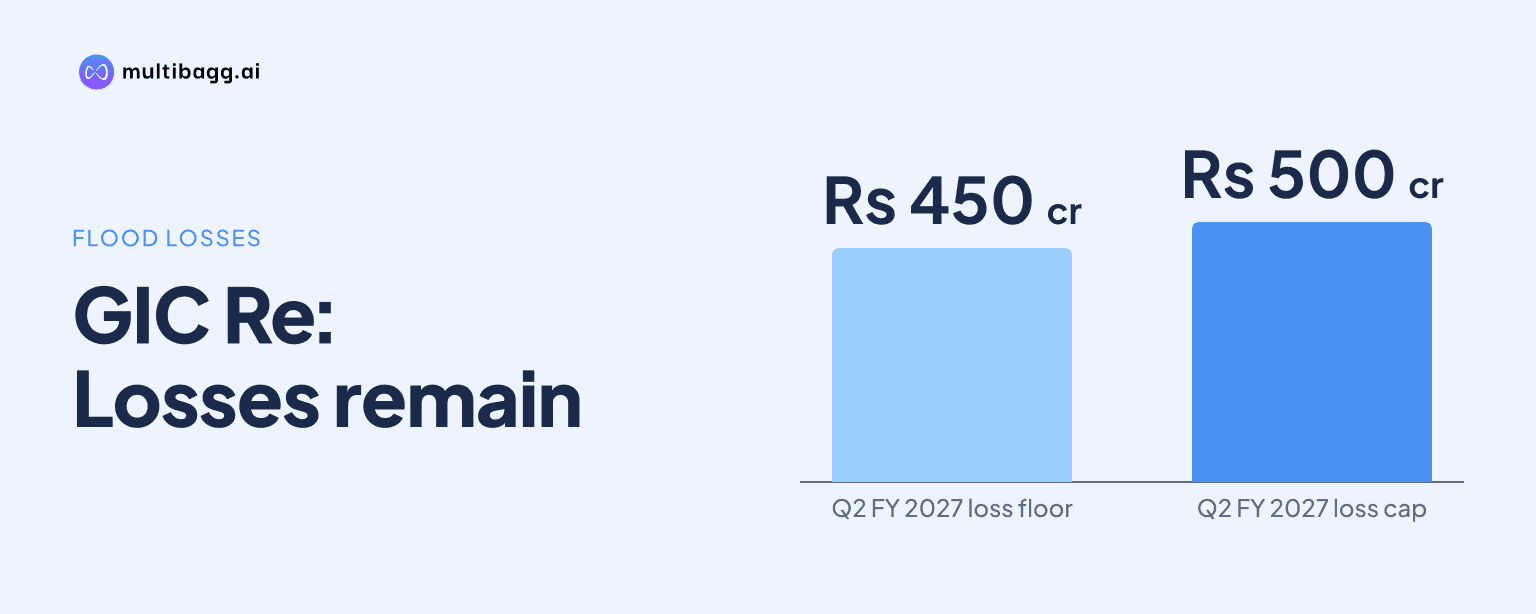
General Insurance Corporation of India Limited, or GIC Re, said its Q2 FY 2027 results include Rs 450 crore to Rs 500 crore for Gujarat floods, but the loss is only partly reported because proportional and obligatory treaty statements arrive with a lag. Management confirmed that additional claims could be provided in subsequent quarters.
Know General Insurance Corporation of India inside out
Results, valuation, peers and who's buying, in one view.
How much has GIC Re reserved for Gujarat floods?
GIC Re has provided Rs 450 crore to Rs 500 crore for Gujarat flood losses in Q2 FY 2027. Chairman and Managing Director Hitesh Joshi said the company had not ignored market losses, but that the full market impact was not yet reflected in its financial statements.
Management confirmed that the provision is already included in the Q2 FY 2027 claims ratio. In a later discussion, Appointed Actuary for Non-Life Business Sateesh Bhat referred to a provision of about Rs 440 crore for the Gujarat floods while explaining incurred but not reported, or IBNR, reserves. The call did not reconcile that reference with the earlier Rs 450 crore to Rs 500 crore range.
GIC Re did not provide an ultimate Gujarat flood-loss estimate, an industry loss estimate, or a normal catastrophe-loss run rate. When asked for natural catastrophe, or NATCAT, loss guidance, Joshi said management was developing explicit disclosures and proposed to begin providing them from FY 2028.
Why could Gujarat flood claims be reported later?
GIC Re said additional Gujarat flood claims could enter later quarters because quarterly accounts from proportional treaties and obligatory business reach the reinsurer after a reporting delay. Under those arrangements, the company depends on statements from insurers and counterparties to assess emerging claims.
Joshi said some reported flood-loss impact might appear in the next quarter. He also agreed with an analyst's interpretation that any Gujarat flood losses above the Rs 450 crore to Rs 500 crore amount already provided would be recognised through provisions in subsequent quarters.
The reporting lag is relevant to the domestic loss-ratio movement discussed on the call. An analyst cited a domestic loss ratio of 88% in H1 FY 2027, compared with 89% in Q1 FY 2027, despite industry flood losses. Management said two quarters were not enough to draw firm conclusions because reserve releases and strengthening from earlier underwriting periods also affect the result.
How did GIC Re's claims and underwriting results change?
GIC Re's Q2 FY 2027 incurred claims ratio rose to 87.39% from 81.50% in Q2 FY 2026, while the H1 FY 2027 ratio was 86.19%, compared with 86.45% a year earlier. Claims experience therefore deteriorated year on year in the quarter, but the half-year ratio was marginally lower.
GIC Re's combined ratio, which measures claims and operating costs relative to premium, increased to 110.23% in Q2 FY 2027 from 109.15% a year earlier. The H1 ratio was almost unchanged at 107.39%, versus 107.41%, but the H1 underwriting loss increased by Rs 474.47 crore to Rs 1,709.06 crore.
Gross premium income rose to Rs 11,228.21 crore in Q2 FY 2027 from Rs 9,601.70 crore in Q2 FY 2026. Q2 investment income increased to Rs 4,238.26 crore from Rs 3,791.67 crore, yet profit after tax declined to Rs 2,455.62 crore from Rs 2,866.79 crore during the same comparison.
Got a follow-up? Ask IRIS
What other reserve movements affected GIC Re's results?
GIC Re said Gujarat flood provisions are only one element of its reserve position. Bhat said IBNR strengthening reflects the volume and type of business written, as well as emerging loss experience, rather than a fixed corporate policy to increase reserves by a predetermined amount.
Management said the IBNR balance includes significant reserve strengthening for the current crop year because drought conditions were being reported. It also cited reserve releases for some previously over-reserved classes and strengthening on other contracts, making the half-year reserve outcome a net result of multiple movements.
The international portfolio also contained reserve effects. Chief Underwriting Officer Sanjay Mokashi said the property book benefited from relatively benign catastrophe activity, while Motor and Cargo reserves increased for an American runoff treaty that GIC Re exited in December 2021. He described maintaining reserves for that treaty as conservative accounting because its IBNR component was small.
International business improved on a half-year comparison, with its combined ratio falling to 108.24% in H1 FY 2027 from 119.87% in H1 FY 2026. Domestic premium was Rs 19,794.41 crore, up 15.9% year on year, while international premium was Rs 4,909.16 crore and broadly unchanged, with health contracts offsetting a smaller property book.
What is management's outlook for catastrophe losses and pricing?
Management said a 105% combined ratio for FY 2027 was achievable, but presented this as its view rather than formal guidance. Joshi said two full quarters remained and Q3 continued to be exposed to catastrophe activity globally, which could affect claims and reserve outcomes.
For cyclone losses in eastern India, GIC Re said it did not have a concrete estimate because insurer-level data had yet to be collated and passed through. Joshi said the company tends to bear 25% to 30% of any industry loss eventually reported, but management did not disclose a reserve amount for those events.
Management said domestic property insurance rates had held from September, based on discussions with prominent insurance-company customers. In overseas markets, it cited abundant traditional and alternative capital and expected competitive pressure for another year, while looking to the 1 January renewals for indications of international premium growth.
Conclusion
GIC Re's Q2 FY 2027 Gujarat flood provision of Rs 450 crore to Rs 500 crore represents a booked but incomplete view of the event, rather than a final loss estimate. The distinction matters because the Q2 incurred claims ratio increased to 87.39%, while the H1 underwriting loss rose to Rs 1,709.06 crore despite a broadly stable half-year combined ratio.
The next results will show whether delayed proportional and obligatory treaty statements require further Gujarat flood provisions. Investors can also watch for eastern cyclone-loss data, the outcome of the 1 January international renewals, and management's proposed introduction of explicit NATCAT guidance in FY 2028.