










GIC Re first-half profit falls 13% as underwriting loss widens
Key highlights
- GIC Re’s consolidated profit fell 13% to Rs 4,709.36 crore for the half year ended 30 September 2026, from Rs 5,404.13 crore a year earlier.
- Net premium earned increased to Rs 21,809.39 crore, while total expense rose to Rs 23,553.76 crore during the first half of 2026.
- GIC Re’s underwriting loss widened to Rs 1,744.37 crore from Rs 1,386.13 crore, pushing the combined ratio up to 106.79 from 106.36.
- Health recorded the largest disclosed underwriting loss at Rs 956.34 crore, while motor posted a loss of Rs 550.67 crore.
powered by IRIS
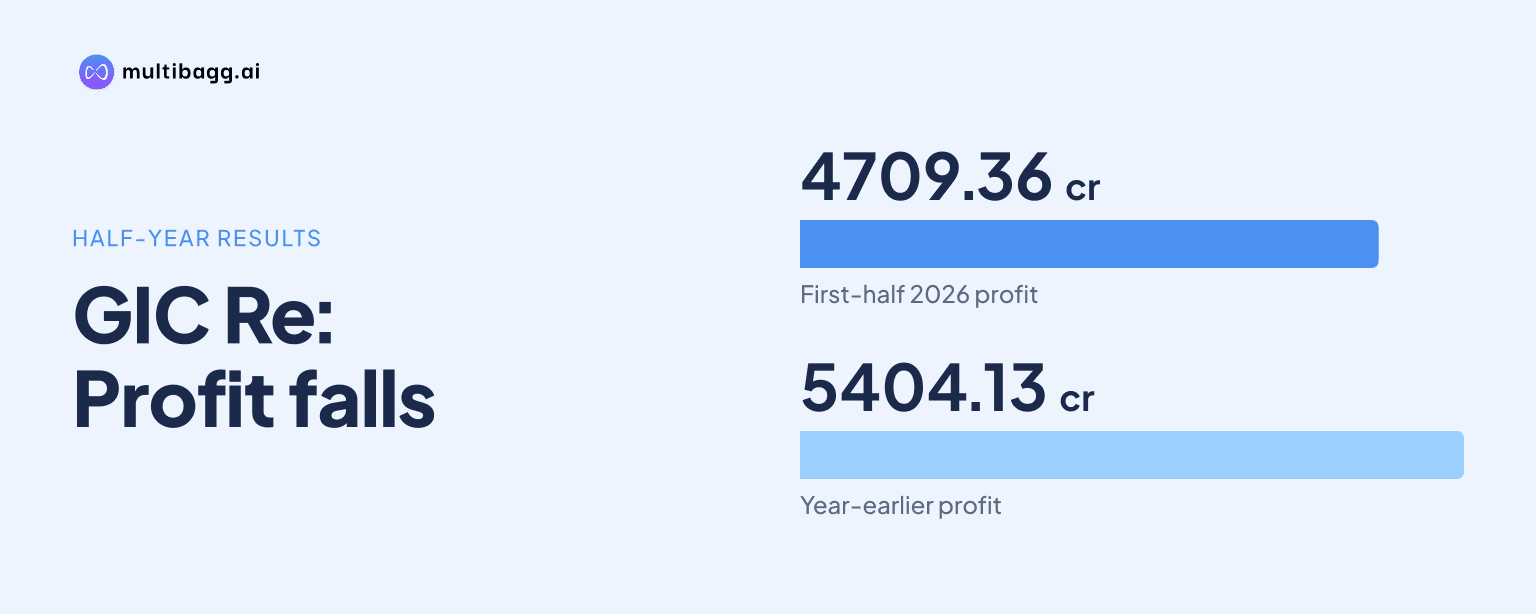
General Insurance Corporation of India, referred to as GIC Re, reported consolidated profit of Rs 4,709.36 crore for the half year ended 30 September 2026, down 13% from Rs 5,404.13 crore a year earlier. Net premium earned rose to Rs 21,809.39 crore and investment income increased, but the underwriting loss widened to Rs 1,744.37 crore from Rs 1,386.13 crore.
Know General Insurance Corporation of India inside out
Results, valuation, peers and who's buying, in one view.
Why did GIC Re’s first-half profit decline?
GIC Re’s first-half profit declined because higher insurance expenses outweighed growth in earned premium and investment income. Profit for the half year ended 30 September 2026 was Rs 4,709.36 crore, compared with Rs 5,404.13 crore in the corresponding 2025 period. Profit after tax fell to Rs 4,566.07 crore from Rs 4,870.78 crore, while GIC Re’s share of profit in associate companies declined to Rs 143.29 crore from Rs 533.35 crore.
The underwriting result moved further into loss during the six months. GIC Re reported an underwriting loss of Rs 1,744.37 crore, compared with a loss of Rs 1,386.13 crore a year earlier. Total expense increased to Rs 23,553.76 crore from Rs 21,585.34 crore, while net premium earned rose to Rs 21,809.39 crore from Rs 20,199.21 crore. The larger increase in expense left the underwriting loss Rs 358.24 crore wider year on year.
How did GIC Re’s premium and investment income change?
GIC Re increased gross premiums written by Rs 2,589.50 crore to Rs 24,712.89 crore for the half year ended 30 September 2026. Net premiums written, stated after reinsurance, rose to Rs 23,298.22 crore from Rs 20,411.15 crore. Net premium earned increased by Rs 1,610.18 crore to Rs 21,809.39 crore, although that increase did not keep pace with the Rs 1,968.42 crore rise in total expense.
Net income from investments increased to Rs 5,014.87 crore from Rs 4,834.27 crore in the prior-year half. Other income, recorded as foreign-exchange gain or loss, declined to Rs 169.33 crore from Rs 364.15 crore. Total income consequently rose by Rs 1,595.95 crore to Rs 26,993.58 crore, but operating profit, calculated as total income less total expense, declined to Rs 3,439.82 crore from Rs 3,812.29 crore.
The two quarters produced different movements in premium and investment income. In the quarter ended 30 September 2026, gross premiums written were Rs 11,171.37 crore, below Rs 13,541.51 crore in the quarter ended 30 June 2026. Net premium earned was Rs 10,711.61 crore, compared with Rs 11,097.77 crore in the June quarter, while investment income increased to Rs 2,827.94 crore from Rs 2,186.93 crore. Quarterly operating profit was Rs 2,310.21 crore, versus Rs 1,129.61 crore in the preceding quarter.
Which segments contributed most to GIC Re’s underwriting loss?
GIC Re’s health segment recorded the largest disclosed underwriting loss for the first half, at Rs 956.34 crore, compared with a loss of Rs 146.26 crore a year earlier. Health net premium increased to Rs 6,553.27 crore from Rs 4,563.30 crore, but its underwriting result deteriorated by Rs 810.08 crore. Motor remained loss-making, with its underwriting loss edging up to Rs 550.67 crore from Rs 548.00 crore.
Several lines improved despite the group-wide underwriting loss. Fire reported underwriting profit of Rs 311.49 crore, compared with an underwriting loss of Rs 46.52 crore in the prior-year half. Aviation reduced its loss to Rs 202.84 crore from Rs 353.47 crore, while life reduced its loss to Rs 139.64 crore from Rs 278.05 crore. Marine cargo moved in the other direction, with its loss widening to Rs 97.13 crore from Rs 18.89 crore.
Health produced the largest disclosed half-year net premium at Rs 6,553.27 crore, followed by fire at Rs 5,458.01 crore and motor at Rs 3,772.36 crore. Agriculture net premium declined to Rs 2,041.51 crore from Rs 2,461.98 crore. Life net premium rose to Rs 2,084.58 crore from Rs 1,064.02 crore, and its underwriting loss narrowed by Rs 138.41 crore despite the higher premium.
Got a follow-up? Ask IRIS
What do GIC Re’s reported ratios indicate?
GIC Re’s combined ratio was 106.79 for the half year ended 30 September 2026, compared with 106.36 in the corresponding 2025 half. The change coincided with the increase in the underwriting loss to Rs 1,744.37 crore. The incurred claim ratio rose to 85.42 from 85.13, and the expense of management ratio increased to 1.11 from 0.97.
The net retention ratio increased to 94.28 from 92.26 for the six-month periods compared. GIC Re reported a solvency ratio of 4.18 as at 30 September 2026, compared with 3.85 a year earlier and 4.21 at 31 March 2026. The company states that the solvency ratio used in the consolidated disclosure is the same as in its standalone financial statements, and that the expense of management ratio is calculated on net premium.
Investment-yield measures diverged depending on the treatment of unrealised gains. Yield on investments without unrealised gains was 11.22 for the first half, down from 11.73 in the prior-year period. Yield including unrealised gains was 8.62, up from 8.53. Basic and diluted earnings per share, not annualised, declined to Rs 26.84 from Rs 30.80, in line with the lower profit for the period.
How were GIC Re’s consolidated results reviewed?
GIC Re’s consolidated results for the quarter and half year ended 30 September 2026 were reviewed, rather than audited, by S H B A & CO LLP and S A R A & Associates. Their report is dated 30 October 2026. The reviewers stated that nothing had come to their attention indicating the results did not disclose the required information or contained a material misstatement.
The review covered subsidiaries including GIC Re South Africa Limited, GIC Re India Corporate Member Limited and GIC Perestrakhovanie LLC, alongside associate companies. It noted that some subsidiaries and associates had reporting dates different from GIC Re’s 30 September 2026 date. The report also said that unaudited accounts of certain subsidiaries reflected half-year net premiums before eliminations of Rs 94.91 crore and total assets before eliminations of Rs 9,691.12 crore.
The reviewers did not review interim financial information for one Indian branch and three foreign branches, including one run-off branch. Those branches had half-year net premiums before eliminations of Rs 1,124.08 crore and total assets before eliminations of Rs 13,850.24 crore as at 30 September 2026. Management represented that those interim financial results were not material to the group, while appointed actuaries certified liabilities including incurred but not reported claims, premium deficiency reserve and technical reserves.
Conclusion
GIC Re’s first-half result shows that increases in gross premiums, net premium earned and investment income did not prevent a 13% fall in consolidated profit. The central change was the underwriting loss widening by Rs 358.24 crore to Rs 1,744.37 crore, led by a Rs 956.34 crore health underwriting loss. The combined ratio also increased to 106.79 from 106.36.
The disclosed unresolved issue is whether the insurance lines contributing to the loss, particularly health and motor, change their underwriting outcome after 30 September 2026. GIC Re’s next reported figures will also show whether investment income, which rose to Rs 5,014.87 crore in the first half, continues to offset part of the underwriting deficit and whether the combined ratio changes from 106.79.