










GIC Re solvency reaches 418% after rising from 261% in FY23
Key highlights
- GIC Re’s solvency ratio was 418% in H1 FY26-27, versus 261% in FY22-23.
- GIC Re’s policyholders’ funds reached Rs 103,618 crore in H1 FY26-27, up from Rs 79,167 crore in FY22-23.
- GIC Re’s net worth excluding FVC increased to Rs 53,402 crore in H1 FY26-27 from Rs 32,356 crore in FY22-23.
- GIC Re’s combined ratio was 107.4% in H1 FY26-27, compared with 106.0% in FY25-26.
powered by IRIS
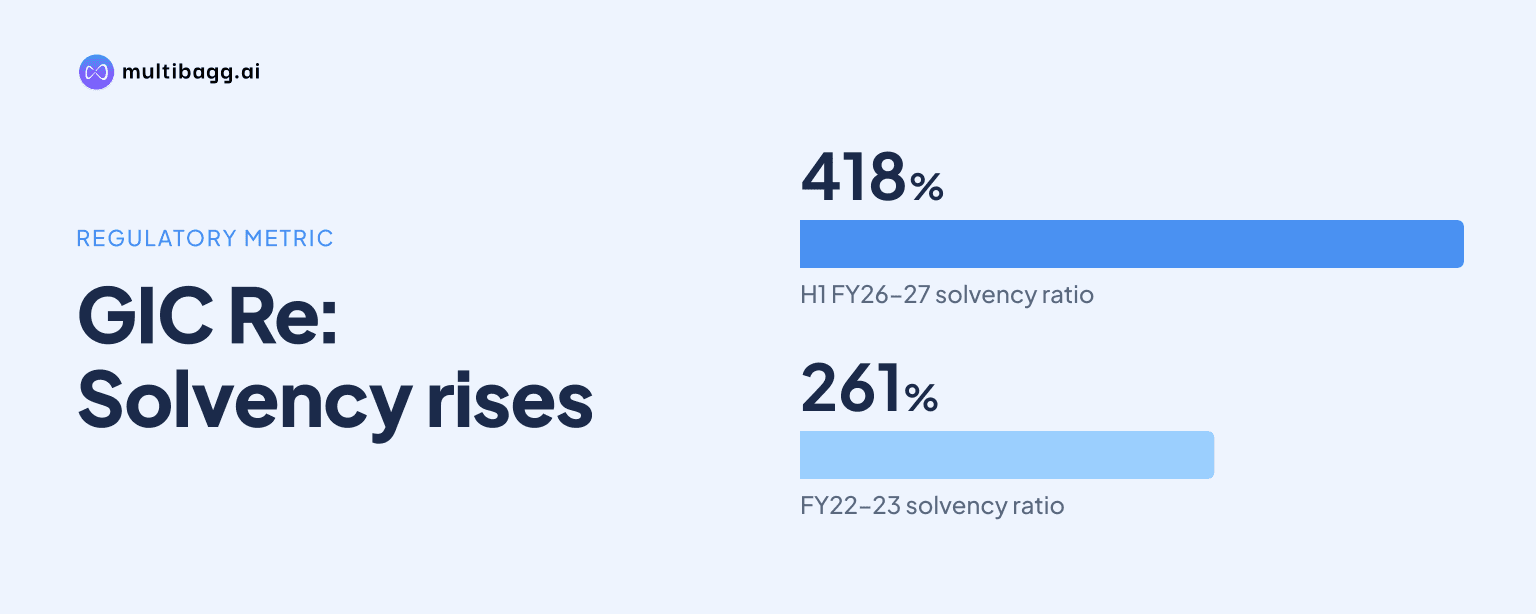
GIC Re reported a 418% solvency ratio in H1 FY26-27, compared with 261% in FY22-23, while net worth excluding fair value change (FVC) reached Rs 53,402 crore and policyholders’ funds reached Rs 103,618 crore. The H1 FY26-27 ratio was 3 percentage points below the 421% reported for FY25-26.
Know General Insurance Corporation of India inside out
Results, valuation, peers and who's buying, in one view.
How did GIC Re’s solvency ratio change?
GIC Re’s solvency ratio increased by 157 percentage points between FY22-23 and H1 FY26-27, although it eased from the preceding full-year level. The ratio rose from 261% in FY22-23 to 325% in FY23-24, then to 370% in FY24-25 and 421% in FY25-26, before standing at 418% in H1 FY26-27. The presentation does not state a regulatory minimum or set out the calculation of the ratio.
The largest increase occurred between FY22-23 and FY23-24, when the solvency ratio rose by 64 percentage points. The 3-percentage-point decline from FY25-26 to H1 FY26-27 is the only fall across the five reported periods, but the H1 FY26-27 reading remained 48 percentage points above FY24-25’s 370%.
What capital and policyholder-fund growth supports GIC Re?
GIC Re reported higher net worth and policyholders’ funds in every period shown from FY22-23 through H1 FY26-27. Net worth excluding FVC rose from Rs 32,356 crore in FY22-23 to Rs 53,402 crore in H1 FY26-27. Net worth including FVC increased from Rs 63,750 crore to Rs 93,139 crore over the same span.
Policyholders’ funds increased by Rs 24,451 crore between FY22-23 and H1 FY26-27. The largest full-year increase in net worth excluding FVC was Rs 8,194 crore in FY25-26, from Rs 43,107 crore in FY24-25 to Rs 51,301 crore. Over H1 FY26-27, net worth including FVC rose by Rs 9,109 crore from the FY25-26 figure of Rs 84,030 crore.
How do GIC Re’s underwriting and returns compare with solvency?
GIC Re’s incurred claims and combined ratios declined from FY23-24 through FY25-26, while both measures increased in H1 FY26-27. The incurred claims ratio moved from 92.3% in FY23-24 to 88.4% in FY24-25 and 85.4% in FY25-26, before reaching 86.2% in H1 FY26-27. The combined ratio followed a similar path, declining from 111.8% to 106.0% before rising to 107.4% in H1 FY26-27.
Profit after tax increased from Rs 6,313 crore in FY22-23 to Rs 8,392 crore in FY25-26, while H1 FY26-27 profit after tax was Rs 4,378 crore. Gross premium increased from Rs 36,592 crore in FY22-23 to Rs 44,007 crore in FY25-26, and net premium rose from Rs 33,644 crore to Rs 40,571 crore. H1 FY26-27 gross premium was Rs 24,704 crore and net premium was Rs 23,226 crore; these partial-period figures are not directly comparable with full-year totals.
Return on equity was 20.8% in FY22-23, declined to 15.5% in FY24-25, and was 16.4% in both FY25-26 and H1 FY26-27. The presentation states that return on equity is annualised. This measure increased by 0.9 percentage points from FY24-25 to FY25-26, while the solvency ratio increased by 51 percentage points over the same reported periods.
Got a follow-up? Ask IRIS
What does GIC Re plan to do with its capital?
GIC Re says its significant net worth will fuel growth and resilience through international expansion, selected Indian-market products and underwriting measures. It plans geographical diversification of its portfolio after a credit-rating upgrade and identifies the Afro-Asian region as an area where it has brand equity. It also identifies surety bonds, cyber-risk covers and parametric covers as diversified areas of expected Indian-market growth.
GIC Re says risk-based capital implementation could create solvency pressure for Indian insurers, potentially leading to higher cessions and a larger reinsurance market. This is management’s stated market scenario rather than a disclosed forecast. The presentation also states that GIC Re ranks 10th globally by scale and has an A- Excellent credit rating from AM Best, which management says it will seek to improve through balance-sheet strength, operating performance, market position and enterprise risk management.
GIC Re has started building catastrophe reserves for climate change and plans phased adoption of modelling capabilities for exposure management and value extraction. Its underwriting plan includes class-specific evaluation, removal of contracts with inadequate pricing and performance-based incentives by company or contract. GIC Re also says it is working to reduce attritional losses to improve the net incurred claims ratio, while expecting commission ratios to remain stable.
Conclusion
GIC Re’s capital measures expanded alongside a solvency ratio that increased from 261% in FY22-23 to 418% in H1 FY26-27. The ratio was marginally below FY25-26’s 421%, while policyholders’ funds rose to Rs 103,618 crore and net worth excluding FVC reached Rs 53,402 crore. The combined ratio was 107.4% in H1 FY26-27, compared with 106.0% in FY25-26.
Next, the disclosed matters to watch are GIC Re’s planned geographical diversification after a credit-rating upgrade and its underwriting actions on pricing and attritional losses. The company has also started building climate-change catastrophe reserves and plans phased modelling adoption, while management identifies risk-based capital implementation as a potential factor for Indian reinsurance cessions.