










GIC Re half-year profit falls 5.23% as underwriting loss widens
Key highlights
- GIC Re’s half-year profit after tax fell 5.23% to Rs 4,377.66 crore for the period ended 30.09.2026.
- Gross premium income increased 12.34% to Rs 24,703.57 crore, led by 15.9% growth in domestic premium.
- Underwriting loss widened 38.4% to Rs 1,709.06 crore, while investment income rose by Rs 398.37 crore to Rs 7,503.78 crore.
- The solvency ratio improved to 4.18 as of 30.09.2026 from 3.85 a year earlier, while total assets rose 7.46% to Rs 2,13,420.24 crore.
powered by IRIS
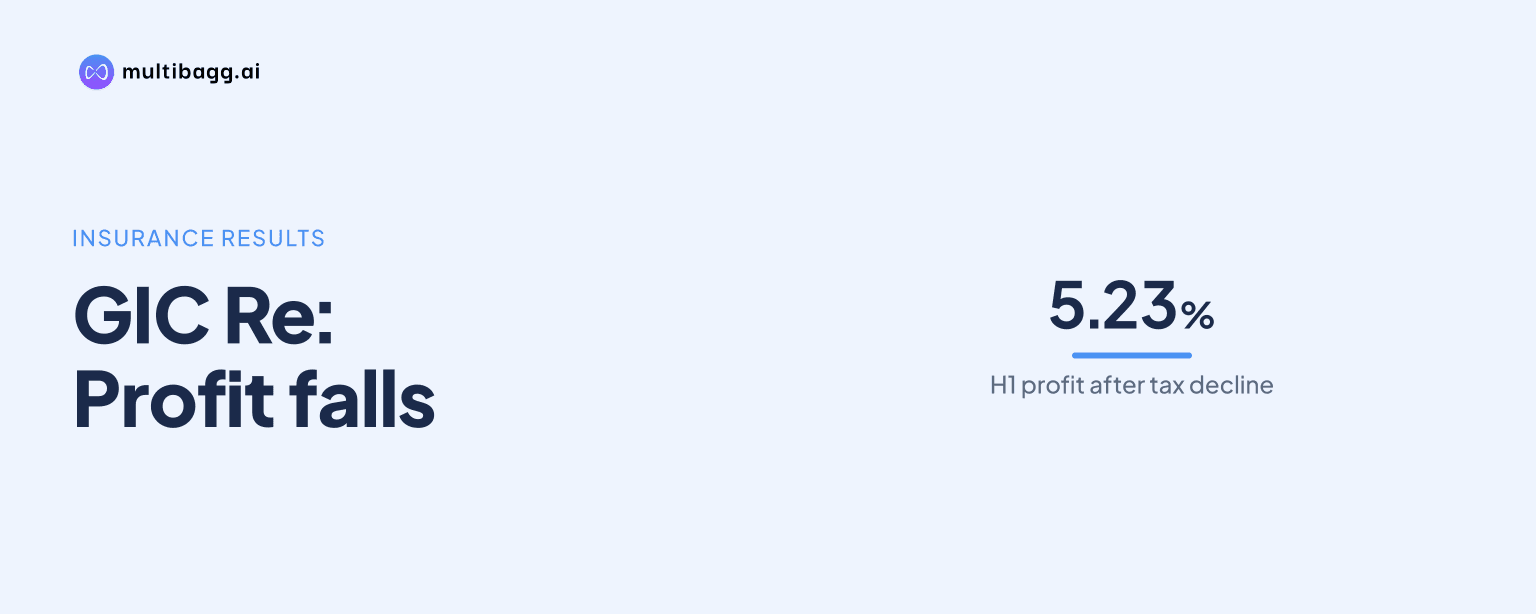
General Insurance Corporation of India reported profit after tax of Rs 4,377.66 crore for the half year ended 30.09.2026, down 5.23% from Rs 4,619.02 crore a year earlier. GIC Re’s gross premium grew 12.34%, but underwriting loss widened 38.4% to Rs 1,709.06 crore, exceeding the increase in investment income.
Know General Insurance Corporation of India inside out
Results, valuation, peers and who's buying, in one view.
Why did GIC Re's half-year profit decline?
GIC Re’s half-year profit declined because its underwriting loss increased by more than the rise in investment income. Underwriting loss was Rs 1,709.06 crore for the half year ended 30.09.2026, compared with Rs 1,234.59 crore in the corresponding 2025 period, a rise of Rs 474.47 crore or 38.4%. Profit before tax fell 2.18% to Rs 5,591.79 crore from Rs 5,716.30 crore.
The fall in profit after tax was larger than the reduction in pre-tax profit because tax increased to Rs 1,214.13 crore from Rs 1,097.28 crore. Profit after tax of Rs 4,377.66 crore was Rs 241.36 crore below the Rs 4,619.02 crore reported for the half year ended 30.09.2025. The filing does not identify individual reasons for the higher underwriting loss.
Investment income, net of expenses, increased by Rs 398.37 crore to Rs 7,503.78 crore for the six-month period from Rs 7,105.41 crore a year earlier. That increase was less than the Rs 474.47 crore widening in underwriting loss. Other income less outgoings also declined to Rs 116.34 crore from Rs 207.25 crore over the same half-year periods.
How much did GIC Re's premium income grow?
GIC Re’s gross premium income grew 12.34% to Rs 24,703.57 crore for the half year ended 30.09.2026, from Rs 21,989.71 crore a year earlier. Net premium rose to Rs 23,226.15 crore from Rs 20,299.32 crore, while earned premium increased to Rs 21,641.14 crore from Rs 20,013.01 crore.
Domestic business accounted for the increase in gross premium. Domestic gross premium rose 15.9% to Rs 19,794.41 crore and represented 80% of total premium, compared with Rs 17,080.66 crore and a 78% share in the prior-year period. International gross premium was broadly unchanged at Rs 4,909.16 crore, compared with Rs 4,909.05 crore, reducing its share to 20% from 22%.
The quarterly pattern showed a sequential reduction in premium in the quarter ended 30.09.2026. Gross premium was Rs 11,228.21 crore, below Rs 13,475.36 crore in the quarter ended 30.06.2026, though above Rs 9,601.70 crore in the quarter ended 30.09.2025. Net premium similarly declined sequentially to Rs 10,562.03 crore from Rs 12,664.12 crore.
Got a follow-up? Ask IRIS
What happened to GIC Re's claims and underwriting ratios?
GIC Re’s incurred claims increased to Rs 18,652.25 crore in the half year ended 30.09.2026 from Rs 17,300.47 crore a year earlier, while its incurred claims ratio edged down to 86.19% from 86.45%. The filing calculates that ratio as incurred claims relative to earned premium, which rose to Rs 21,641.14 crore from Rs 20,013.01 crore.
The combined ratio was broadly unchanged at 107.39%, compared with 107.41% in the previous corresponding half year. GIC Re defines the combined ratio as net incurred claims divided by net earned premium, plus management expenses and commission on reinsurance divided by net written premium. The reported underwriting loss was Rs 1,709.06 crore for the half year ended 30.09.2026.
Net commission rose to Rs 4,688.76 crore from Rs 4,085.58 crore, and represented 20.2% of net premium compared with 20.1% a year earlier. Expenses of management increased to Rs 235.60 crore from Rs 170.02 crore, with the associated ratio rising to 1.0% from 0.8%. The adjusted combined ratio increased to 85.92% from 83.74%.
The quarter ended 30.09.2026 had a higher combined ratio than the preceding quarter. It was 110.23%, compared with 104.88% in the quarter ended 30.06.2026 and 109.15% in the quarter ended 30.09.2025. Quarterly underwriting loss was Rs 985.19 crore, compared with Rs 723.87 crore in the preceding quarter.
What changed in GIC Re's balance sheet and solvency?
GIC Re’s total assets increased 7.46% to Rs 2,13,420.24 crore as of 30.09.2026, from Rs 1,98,612.62 crore as of 30.09.2025. Net worth excluding the fair value change account rose to Rs 53,402.32 crore from Rs 46,669.38 crore over the same dates.
Net worth including the fair value change account was Rs 93,138.68 crore on 30.09.2026, compared with Rs 88,709.19 crore one year before. The filing reported a solvency ratio of 4.18 at 30.09.2026, up from 3.85 at 30.09.2025. It did not provide a separate solvency target in the financial-performance announcement.
The period-end financial position measures increased while half-year profitability decreased. Total assets rose by Rs 14,807.62 crore and net worth excluding the fair value change account increased by Rs 6,732.94 crore, while profit after tax declined by Rs 241.36 crore. Asset and net-worth figures are measured at 30.09.2026, whereas profit covers the half year ended on that date.
Conclusion
GIC Re’s half-year results show that 12.34% gross-premium growth and a Rs 398.37 crore increase in investment income did not offset the Rs 474.47 crore increase in underwriting loss. Profit after tax fell to Rs 4,377.66 crore, while the combined ratio remained above 100% at 107.39% and the September-quarter ratio increased to 110.23%.
The next disclosed development to watch is management’s medium-term objective of a 60:40 domestic-to-international risk portfolio composition. The filing says the Lloyd’s of London syndicate fully capitalised by GIC Re is expected to scale up over the next few quarters toward that objective, while half-year gross premium remained weighted toward domestic business at 80%.