










Jai Balaji sees DI-pipe recovery only from next financial year
Key highlights
- Jai Balaji expects DI-pipe demand to improve in the next financial year or shortly before it.
- Jai Balaji’s DI-pipe utilisation is 30%-40%, versus management’s more than 60%-70% economic threshold.
- Jai Balaji has DI-pipe orders of around 80,000-90,000 tonnes and enquiries above 2 lakh tonnes.
- Management said Rs 16,500 crore of a Rs 67,000 crore annual budget had been spent in the first half.
powered by IRIS
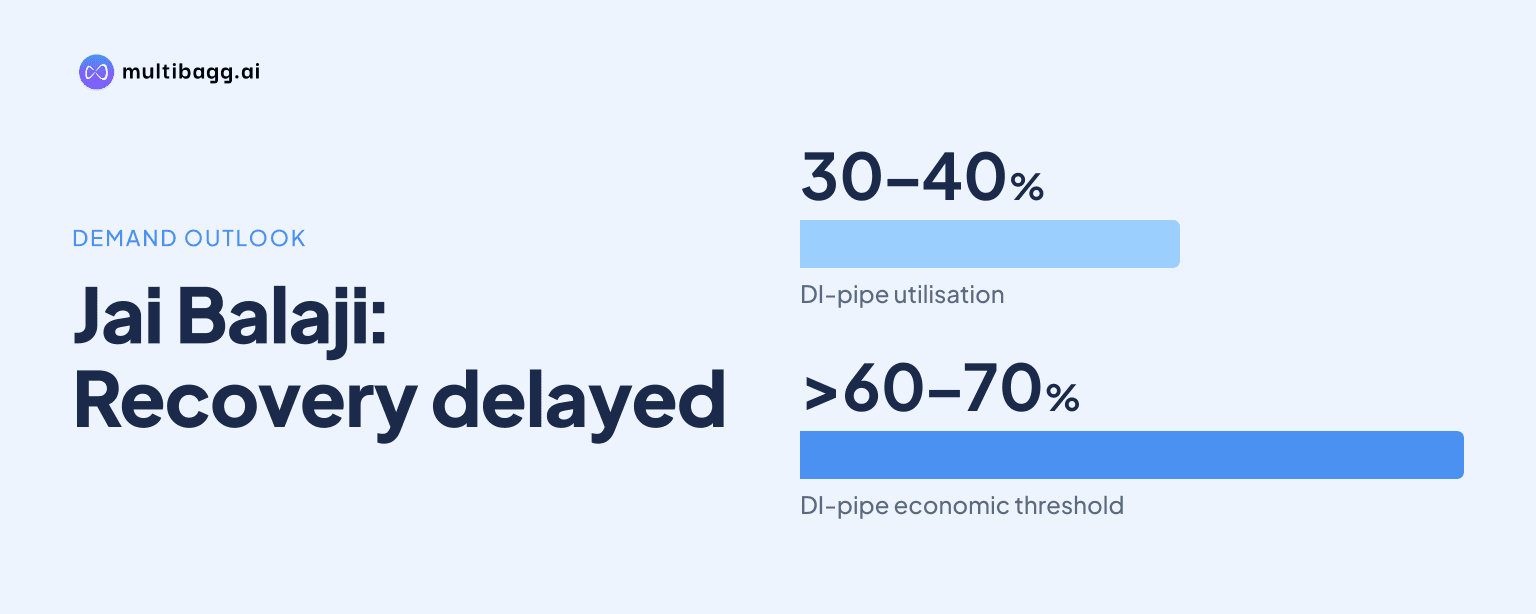
Jai Balaji Industries Limited expects ductile iron, or DI, pipe demand to improve in the next financial year or shortly before it, while Jai Balaji’s 5.5 lakh-tonne annual pipe capacity is running at about 30%-40% utilisation. Management said utilisation above 60%-70% would make the expanded DI-pipe operation economically attractive.
Know Jai Balaji Industries inside out
Results, valuation, peers and who's buying, in one view.
When does Jai Balaji expect DI-pipe demand to recover?
Jai Balaji expects a material DI-pipe demand improvement in the next financial year, or just before it, rather than in the next one or two quarters. Chairman and Managing Director Aditya Jajodia said government spending remained low, limiting the chance of a large near-term jump in orders. Management linked its timing expectation to the March 2028 completion deadline for the Jal Jeevan Mission, saying the programme’s funds would have to be deployed by then.
The company’s medium-term view is based on pending project execution and delayed disbursements, not on confirmed new orders. Varun Jajodia said the Jal Jeevan Mission outlay had been extended from 2024 to 2028, while AMRUT 2.0, irrigation schemes and river-linking projects could add to DI-pipe demand over the next two to three years. He also said river-linking demand would be smaller than demand associated with the Jal Jeevan Mission.
Why is Jai Balaji’s DI-pipe utilisation only 30%-40%?
Jai Balaji said DI-pipe utilisation is about 30%-40% because government funding and payments to contractors have not moved at the required pace. Management described DI pipes as a government-backed product, where procurement depends heavily on public spending. Contractors with older awarded tenders are reluctant to invest additional money in project execution until they receive their outstanding dues.
The current range remains well below the more than 60%-70% level that management said would make the pipe operation economically attractive. Jai Balaji has expanded DI-pipe capacity to more than 5.5 lakh tonnes per annum, meaning a recovery in contractor procurement could be served from installed capacity. Management said this demand gap has persisted for the previous four to five quarters, rather than emerging only in Q2 FY27.
Production fell to 37,000 tonnes in Q2 FY27 from 41,000 tonnes in Q1 FY27, a sequential reduction of 4,000 tonnes. Aditya Jajodia attributed that change to monsoon conditions, which restrict work in open and rural project areas. He said the quarter did not represent a further decline in an already subdued underlying demand environment.
What DI-pipe orders and enquiries does Jai Balaji have?
Jai Balaji reported a DI-pipe order book of around 80,000-90,000 tonnes and enquiries exceeding 2 lakh tonnes. Management said these enquiries have not translated promptly into procurement because contractors are awaiting fund releases. Around 50% of the existing order book is index-based and carries a price-variation clause, according to Varun Jajodia.
Management cited government budget execution as evidence of the funding constraint. It said Rs 16,500 crore had been spent in the first half from an annual budget of Rs 67,000 crore. Varun Jajodia said faster fund releases could improve cash rotation for contractors, allowing already awarded tenders and existing enquiries to convert into DI-pipe purchases.
Industry inventory conditions have changed alongside the slower ordering cycle. Management said earlier excess stocks had been liquidated and it did not foresee another severe decline in DI-pipe prices. It said rising coking-coal and other raw-material costs could support pipe pricing when demand improves, while producers were adjusting output toward utilisation around 60%-70% rather than 80%-100%.
Got a follow-up? Ask IRIS
How does the DI-pipe slowdown compare with Jai Balaji’s other businesses?
Jai Balaji’s Q2 FY27 financial performance grew despite subdued DI-pipe demand, supported by other commodity products and specialised ferroalloys. Revenue from operations rose 22% year on year, adjusted earnings before interest, tax, depreciation and amortisation rose 93%, and adjusted EBITDA margin increased to about 9% from 5%. Profit after tax rose about 192%, lifting the profit-after-tax margin to 5% from 2% a year earlier.
Specialised ferroalloys provided a contrast with DI pipes during Q2 FY27. Management said the segment accounted for about 28% of revenue and operated above 90% utilisation, compared with DI-pipe utilisation of 30%-40%. Jai Balaji expects specialised ferroalloy capacity to rise from 1.66 lakh tonnes to 1.9 lakh tonnes per annum and the segment’s revenue share to increase to 30%-31%.
Management said specialised ferroalloys generated margins of 15%-16% and expected that range to continue, although it did not expect realisations to rise further. Jai Balaji can also sell output as pig iron when DI-pipe sales do not materialise, providing an alternative outlet during the demand lull. That flexibility supports output, but does not alter management’s stated 60%-70% utilisation requirement for the pipe operation.
What capacity and funding plans could affect Jai Balaji’s recovery?
Jai Balaji is nearing completion of a Rs 1,112 crore investment programme, predominantly funded through internal accruals, after deploying the remaining Rs 36 crore in Q2 FY27. The programme expands blast-furnace capacity from 6.3 lakh tonnes to 7.5 lakh tonnes per annum, sinter capacity from 9 lakh tonnes to around 12 lakh tonnes, and specialised ferroalloy capacity to 1.9 lakh tonnes. Management targeted commissioning of the blast-furnace, sinter and ferroalloy expansions by the end of Q3 FY27.
The company has also arranged facilities to support working-capital requirements if DI-pipe sales increase. Net term debt was Rs 145 crore at the end of H1 FY27, compared with Rs 169 crore at the end of FY26, while gross debt was Rs 188 crore in Q2 FY27. Jai Balaji had working-capital limits of Rs 395 crore and an additional Rs 137 crore facility sanctioned by HDFC Bank.
Management said the new HDFC Bank facilities would reduce borrowing costs on packing credit, with the rate falling to 7% from 12% previously. It also said gross debt could decline from Rs 188 crore to Rs 140 crore by March under its repayment schedule, and potentially to Rs 100 crore-Rs 110 crore depending on cash surplus. Those comments were management expectations rather than financial guidance.
Conclusion
Jai Balaji’s DI-pipe recovery case depends on faster government disbursements and contractor execution, not on a near-term surge in enquiries. The company has more than 5.5 lakh tonnes of annual DI-pipe capacity but is operating at 30%-40% utilisation, below the more than 60%-70% level management identifies as economically attractive. Higher-utilisation specialised ferroalloys and the ability to sell some output as pig iron supported Q2 FY27 results while pipe demand remained subdued.
The next indicators are whether spending rises from the Rs 16,500 crore used in the first half of the Rs 67,000 crore annual budget, and whether the 80,000-90,000-tonne order book converts into deliveries. Management expects its blast-furnace, sinter and specialised ferroalloy projects to be commissioned by the end of Q3 FY27, and said it may announce the next investment phase after a hiatus of around one quarter.