










Jai Balaji plans 1.9 lakh-tonne specialty ferroalloy capacity
Key highlights
- Jai Balaji plans to increase specialty ferroalloy capacity from 1.66 lakh tonnes to 1.9 lakh tonnes annually by the end of Q3 FY27.
- Management estimates approximately Rs 400 crore to Rs 500 crore of revenue potential from the ferroalloy facility.
- Specialty ferroalloys contributed about 28% of Q2 FY27 revenue, and management expects 30% to 31% going forward.
- Management said ferroalloy EBITDA margins were 15% to 16%, compared with about 9% adjusted EBITDA margin company-wide in Q2 FY27.
powered by IRIS
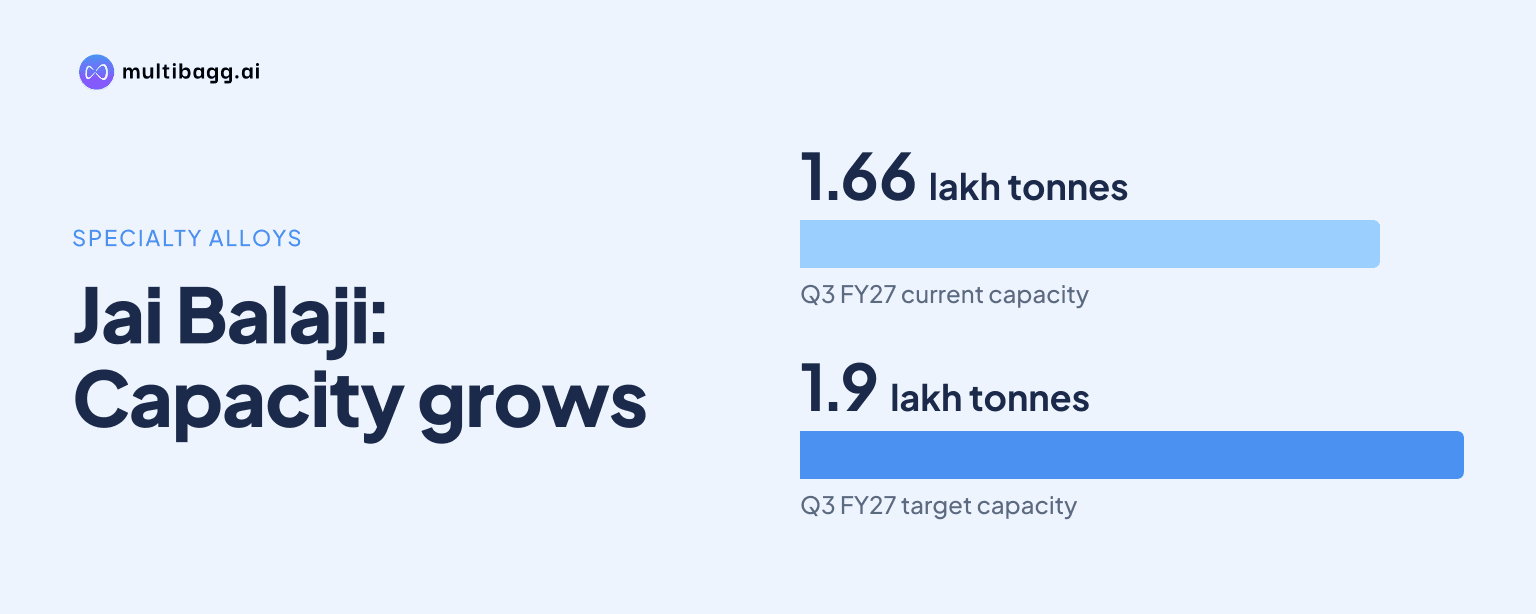
In Q2 FY27, Jai Balaji Industries Limited said it plans to lift specialty ferroalloy capacity to 1.9 lakh tonnes annually. Management estimated that the ferroalloy facility could generate approximately Rs 400 crore to Rs 500 crore in revenue and said commissioning of the expanded units was progressing towards the end of Q3 FY27.
Know Jai Balaji Industries inside out
Results, valuation, peers and who's buying, in one view.
Why is Jai Balaji expanding specialty ferroalloy capacity?
Jai Balaji is expanding specialty ferroalloys because management views higher-grade, customised products as a value-added growth area. On the November 17, 2026 earnings call, management said demand for specialised and high-performance steels was supporting ferroalloys, while improved realisations over recent quarters reflected favourable industry conditions.
The project forms part of Jai Balaji 2.0, the company’s strategy to increase specialised and value-added products, strengthen integrated manufacturing and maintain balance-sheet discipline. Specialty ferroalloys contributed about 28% of Q2 FY27 revenue, and management expects their share to increase to around 30% to 31%, although revenue from the expanded blast furnace is also expected to rise.
Jai Balaji said its specialty ferroalloys command premiums to benchmark ferroalloy prices because of product quality and customised specifications. Management also cited sales across more than 40 countries, long-standing domestic and overseas customer relationships, and a high-grade portfolio as the commercial base for adding capacity.
What capacity is Jai Balaji adding and when?
Jai Balaji is increasing specialty ferroalloy capacity from 1.66 lakh tonnes to 1.9 lakh tonnes per annum, alongside blast-furnace and sinter expansions. Management said the enhanced ferroalloy, blast-furnace and sinter facilities were progressing towards commissioning by the end of Q3 FY27.
The expansions are part of an overall Rs 1,112 crore investment programme, predominantly funded through internal accruals. Jai Balaji deployed the remaining Rs 36 crore during Q2 FY27, while management said two major modules remained to be completed and ancillary facilities were already operational. It gave an overall completion window from the end of November 2026 to January 2027.
Management said the ferroalloy addition would provide both extra production and integration of operations that were not fully integrated. In response to an analyst, it described the incremental ferroalloy capacity as 25,000 to 30,000 tonnes and said current utilisation in the segment was above 90%.
How much revenue and margin contribution does Jai Balaji expect?
Jai Balaji management estimates revenue potential of approximately Rs 400 crore to Rs 500 crore from the ferroalloy facility. It also said ferroalloy earnings before interest, tax, depreciation and amortisation, or EBITDA, margins were 15% to 16% and that it expected to sustain that range, subject to prevailing demand and prices.
In Q2 FY27, Jai Balaji reported revenue growth of 22% year on year and adjusted EBITDA growth of 93%, with adjusted EBITDA margin improving to about 9% from 5% a year earlier. Management attributed the increase to improved ferroalloy and pig-iron realisations, higher commodity-product production, operational efficiency and cost management. The 15% to 16% ferroalloy margin cited by management is above the overall Q2 margin.
Management said it did not expect ferroalloy realisations to improve further from November 2026 levels, but aimed to maintain prices and margins. Thermal-coal and coking-coal cost increases were expected to affect Q3 and Q4 FY27. Jai Balaji said commodity prices can generally be passed through in 15 to 20 days, while contracted ferroalloys and ductile iron pipes can take two to three months.
The blast-furnace upgrade is also part of the earnings plan. Management said EBITDA from the current blast furnace should improve by around 25% to 30% after the enhanced module starts, without providing a rupee estimate. It added that overall EBITDA margin could move from 9% towards 10% to 10.5%, with new volumes and a recovery in ductile iron pipe demand.
Got a follow-up? Ask IRIS
How does Jai Balaji plan to raise ferroalloy exports?
Jai Balaji plans to use additional capacity, customers in more than 40 countries and overseas inventory to increase specialty ferroalloy exports. Management said customers had become more willing over the previous two to three years to place long-term orders and enter agreements, while the company holds stocks in Europe and the United States for just-in-time service.
Management said India was becoming a supply option for international customers and expects both country coverage and volumes to increase as capacity rises towards 1.9 lakh tonnes. The call did not disclose current export revenue, export volume, named overseas markets or contract volumes, so the scale of incremental exports cannot be calculated from management’s comments.
Jai Balaji also operates three dedicated railway sidings for raw-material and finished-goods movement. Management said these sidings reduce transportation and turnaround time, supporting the integrated manufacturing model. It did not disclose a quantified logistics saving or a specific export-volume target linked to the sidings.
What could affect Jai Balaji's expansion outcome?
Jai Balaji’s expansion outcome will depend on commissioning, raw-material pass-through and demand for its product mix. Management said coal costs had already risen by November 2026 and expected the negative effect in Q3 and Q4 FY27, although it believes most cost increases can be passed to customers.
Ductile iron pipes remain a separate demand constraint within the portfolio. Jai Balaji has pipe capacity of more than 5.5 lakh tonnes per annum, but management put current utilisation at around 30% to 40%. It said utilisation above 60% to 70% would make the segment economically attractive, while the current order book was around 80,000 to 90,000 tonnes and about 50% was index-based.
Liquidity and working capital will also matter as capacity starts. Net term debt was Rs 145 crore at the end of H1 FY27, compared with Rs 169 crore at FY26-end, while gross debt was Rs 188 crore in Q2 FY27. Management said gross debt should fall to Rs 140 crore by March and potentially Rs 100 crore to Rs 110 crore depending on cash surplus; working-capital limits were Rs 395 crore plus a Rs 137 crore HDFC Bank facility.
Conclusion
Jai Balaji is placing specialty ferroalloys at the centre of its value-added growth plan, combining a move to 1.9 lakh tonnes of annual capacity with an existing export presence in more than 40 countries. Management expects the business’s revenue share to rise from about 28% in Q2 FY27 to 30% to 31%, while seeking to retain 15% to 16% EBITDA margins in the segment.
The immediate milestone is commissioning of the ferroalloy, blast-furnace and sinter expansions by the end of Q3 FY27. Management also said it would take a hiatus of around one quarter after completing the current capex phase before announcing the next investment plan, while coal-cost pass-through and export-volume growth remain matters to watch.