










Jai Balaji Industries Limited Q2 PAT rises 192%, margin hits 5%
Key highlights
- Jai Balaji Industries reported Q2 FY27 revenue of ₹1,652 crore, up 22% year-on-year.
- Adjusted EBITDA rose 93% to ₹135 crore and margin improved to about 9% from 5%.
- Q2 FY27 PAT increased 192% to ₹77 crore, while PAT margin rose to 5% from 2%.
- Net debt stood at ₹145 crore in Q2 FY27, against gross debt of ₹188 crore.
powered by IRIS
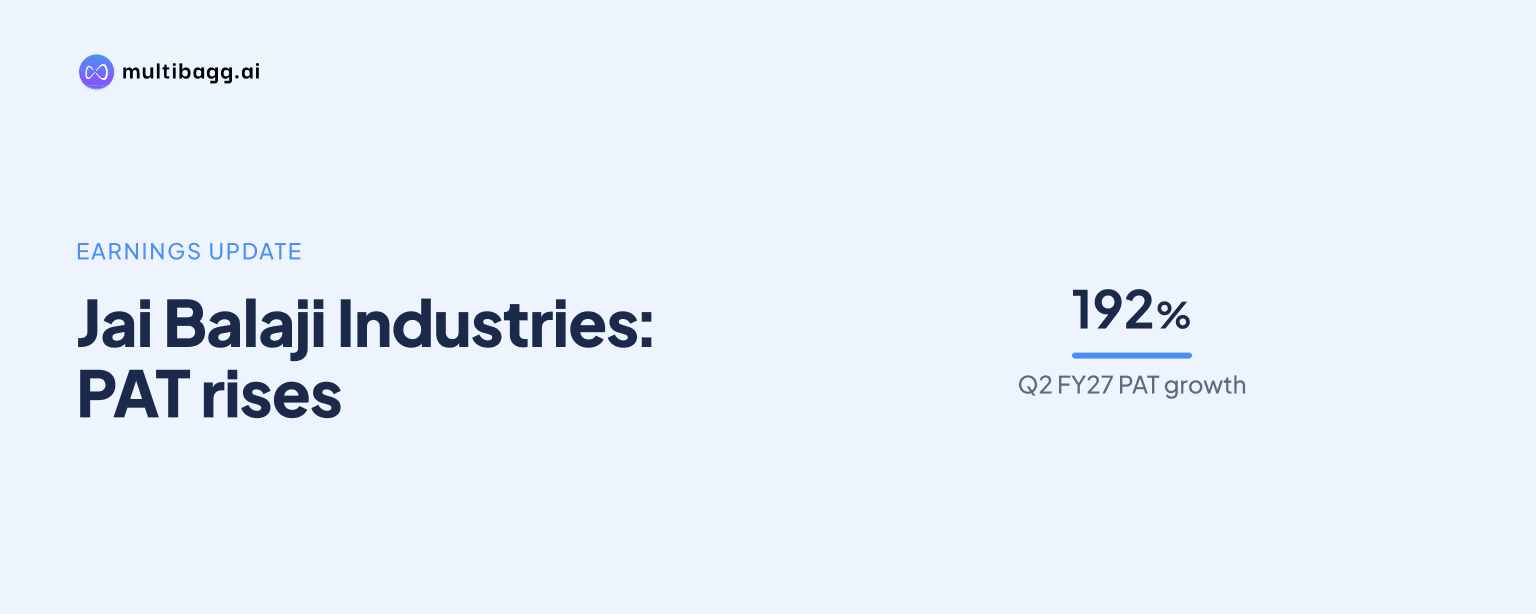
Jai Balaji Industries Limited reported Q2 FY27 revenue of ₹1,652 crore, up 22% year-on-year, while profit after tax rose 192% to ₹77 crore and PAT margin improved to 5% from 2%. The result reflected higher volumes, better realisations and operational efficiencies across its manufacturing operations.
Know Jai Balaji Industries inside out
Results, valuation, peers and who's buying, in one view.
What did Jai Balaji Industries report for Q2 FY27?
Jai Balaji Industries reported broad-based growth in revenue and profitability in the quarter ended Q2 FY27. Revenue from operations increased 22% year-on-year to ₹1,652 crore. Adjusted EBITDA rose 93% year-on-year to ₹135 crore, nearly doubling from the corresponding quarter a year earlier.
The operating performance translated into a substantial improvement in margins. Adjusted EBITDA margin increased to about 9% from 5% in Q2 FY26. Profit before tax grew by about 50% year-on-year, while profit after tax increased 192% year-on-year to ₹77 crore. PAT margin rose to 5% from 2%, indicating that the improvement extended beyond operating profit.
What drove the improvement in quarterly profitability?
Jai Balaji Industries attributed the Q2 outcome to higher volumes across key products, improved realisations and enhanced operational efficiency. Management said the company’s integrated manufacturing operations and cost discipline supported the increase in profitability as revenue expanded.
Specialised ferroalloys remained a key growth driver during the period, according to the earnings-call summary. The company also linked the margin improvement to favourable realisation trends across its product portfolio. These factors helped adjusted EBITDA grow substantially faster than revenue, resulting in the four-percentage-point expansion in EBITDA margin.
The rise in PAT was sharper than the increase in operating profit. The available call disclosures confirm a 192% year-on-year increase in PAT and a rise in PAT margin to 5%, but they do not provide a detailed reconciliation of all below-EBITDA cost items. Investors can therefore track whether the improved profitability is maintained as product realisations, volume growth and input costs evolve.
How is Jai Balaji Industries expanding capacity and managing debt?
Jai Balaji Industries is continuing a capacity-expansion programme alongside its focus on reducing borrowings. Chairman and Managing Director Aditya Jajodia said two major modules remained pending: the blast furnace and the ferroalloy module. Management indicated that the balance ₹36 crore was deployed during Q2 toward the programme, with completion targeted between the end of November and January.
The company has stated that DI pipe capacity is 5.5 lakh tonnes per annum and ferroalloy capacity is expected to reach 1.9 lakh tonnes per annum. Capacity additions are relevant because management has identified specialised ferroalloys as an important contributor to growth, while the blast-furnace module forms part of the broader integrated manufacturing base.
On the balance sheet, President of Finance Vijay Bagri said gross debt stood at ₹188 crore at the end of Q2 FY27, while net debt was ₹145 crore. Management guidance cited in the call summary indicates an aim to reduce gross debt to about ₹100 crore by March 2027. The company’s progress on this target will depend on cash generation, working-capital movements and capital-expenditure requirements.
Got a follow-up? Ask IRIS
What does DI pipe demand mean for the business outlook?
Jai Balaji Industries said near-term DI pipe demand remains soft and its recovery is dependent on a faster release of government funding. The earnings-call summary put the DI pipe order book at about 80,000 to 90,000 tonnes, with roughly half comprising indexed-base orders.
This makes public spending an important factor for the DI pipe business. Management expects demand recovery in the next financial year as funds are released, but the timing remains dependent on government spending activity. The call did not provide a specific revenue forecast from DI pipes or a confirmed schedule for demand normalisation.
For investors, this creates a contrast within the operating portfolio. Q2 profitability benefited from volumes, realisations and efficiencies, while the DI pipe segment faces a demand variable outside the company’s direct control. A sustained recovery in DI pipe orders would be relevant for capacity utilisation, but the available disclosure does not quantify the potential financial effect.
How did the first half of FY27 compare with the quarter?
Jai Balaji Industries also reported growth for the first half of FY27. Revenue from operations increased 23% year-on-year, while adjusted EBITDA rose about 64%. H1 adjusted EBITDA margin was about 9%, compared with 6% in the year-earlier period.
H1 PAT increased about 67% year-on-year and PAT margin reached about 5%. The half-year figures show that the Q2 improvement followed a broader first-half increase in revenue and profitability, although the quarterly pace of adjusted EBITDA and PAT growth was stronger than the reported H1 growth rates.
The company has indicated an adjusted EBITDA margin target of 10% to 10.5%. Q2 margin of about 9% puts the company below that range, while remaining well ahead of the 5% margin recorded in the year-ago quarter. Future results will show whether improved realisations and efficiency gains can support further margin expansion while capacity projects are completed.
Conclusion
Jai Balaji Industries delivered stronger Q2 FY27 financial performance, with revenue rising 22%, adjusted EBITDA increasing 93% and PAT growing 192%. Margin expansion to about 9% at the EBITDA level and 5% at the PAT level shows that earnings grew faster than sales during the quarter.
The next developments to watch are the completion of the pending blast-furnace and ferroalloy modules, the company’s plan to reduce gross debt toward about ₹100 crore by March 2027, and the pace of government funding that could support DI pipe demand recovery. These disclosed factors will be central to assessing operating momentum through the rest of FY27.