










Jai Balaji Industries Limited targets Rs 140 crore gross debt
Key highlights
- Jai Balaji targets gross debt of Rs 140 crore by March, versus Rs 188 crore in Q2 FY27.
- Jai Balaji reported net debt of Rs 145 crore at H1 FY27, compared with net term debt of Rs 169 crore at FY26 end.
- HDFC Bank packing credit could reduce Jai Balaji's applicable borrowing cost to 7% from 12%, management said.
- Jai Balaji said inventory increased by approximately Rs 200 crore in H1 FY27, while debt repayments were approximately Rs 60 crore-Rs 70 crore.
powered by IRIS
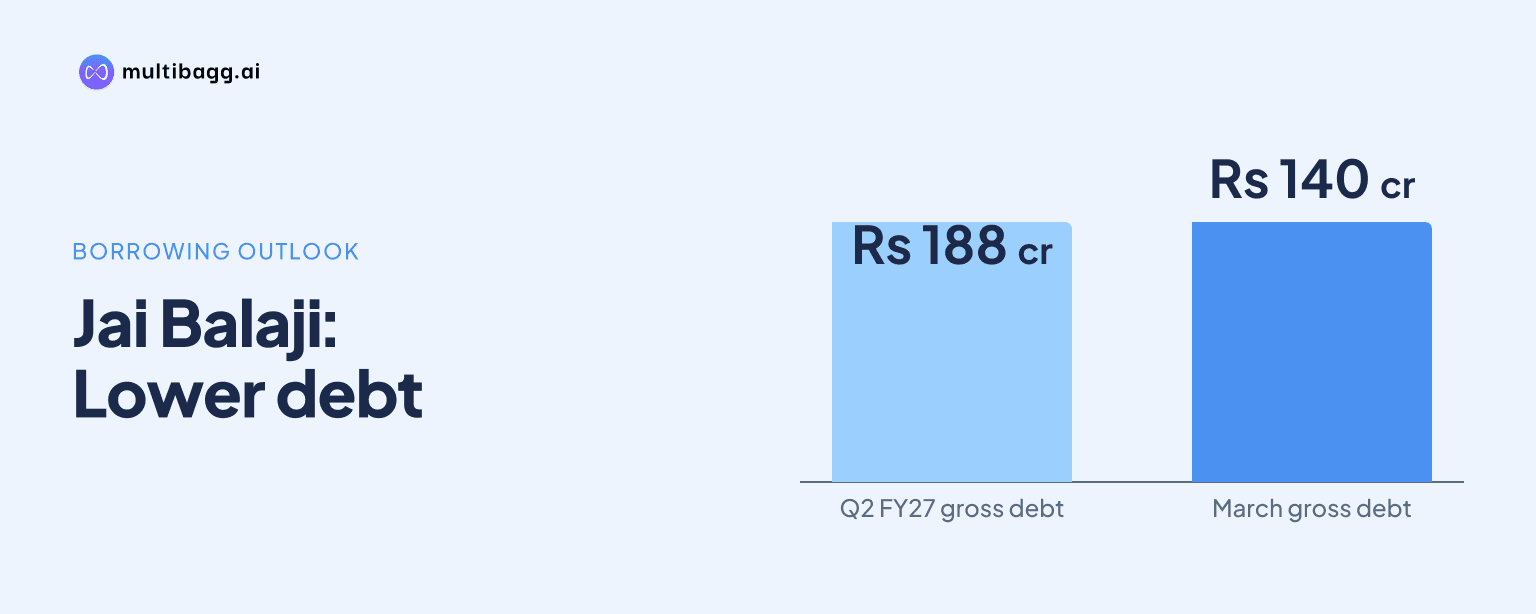
Jai Balaji Industries Limited expects gross debt to decline to Rs 140 crore by March from Rs 188 crore in Q2 FY27, under its repayment schedule and alongside a shift in working-capital funding toward banks. Management said HDFC Bank packing-credit facilities could reduce the applicable borrowing cost to 7% from 12%.
Know Jai Balaji Industries inside out
Results, valuation, peers and who's buying, in one view.
What is Jai Balaji's gross-debt target by March?
Jai Balaji expects gross debt to fall to Rs 140 crore by March from Rs 188 crore in Q2 FY27. Joint Chief Financial Officer Raj Kumar Sharma said this expected reduction follows the repayment chart, making it a scheduled debt-repayment objective rather than a disclosed asset-sale or equity-funding plan.
The company reported net debt of Rs 145 crore at the end of H1 FY27, compared with net term debt of Rs 169 crore at the end of FY26. Sharma said gross debt could subsequently decline to Rs 100 crore-Rs 110 crore if cash surplus becomes available, but management did not provide a date for reaching that range.
The March objective applies specifically to gross debt, while the Rs 145 crore number reported at H1 FY27 is net debt. This distinction matters because the source did not state a March net-debt target or specify the cash balance that would reconcile gross and net debt at that date.
Why did Jai Balaji's working capital absorb cash in H1 FY27?
Jai Balaji said inventory increased by approximately Rs 200 crore in H1 FY27, while debt repayments were approximately Rs 60 crore-Rs 70 crore. Sharma gave these factors in response to an analyst's question about approximately Rs 290 crore of cash outflow associated with trade payables, other liabilities and provisions.
Management did not disclose a precise closing inventory figure or its product-level composition on the call. Sharma said an assessment based only on trade payables and creditors would not explain the cash-flow movement because inventory levels had also risen materially during H1 FY27.
Chairman and Managing Director Aditya Jajodia said free cash flow was already being generated but would initially be used mainly for working-capital purposes. He also said it could be used for the next growth phase once management announces it, following a hiatus of around one quarter after the current capital-expenditure programme is completed.
How will HDFC Bank funding change Jai Balaji's borrowing costs?
Jai Balaji has started using HDFC Bank packing-credit facilities, which management said would reduce the applicable borrowing cost to 7% from 12%. Sharma also said facility utilisation, previously at 70%, should decline as the new funding arrangements are used.
The company has sanctioned working-capital limits of Rs 395 crore, plus an additional Rs 137 crore HDFC Bank facility for working-capital and term-loan requirements. Management said the facilities are intended to position Jai Balaji for higher working-capital needs when ductile iron pipe production and sales recover.
Jai Balaji said its funding mix had shifted from being mainly with non-banking financial companies, or NBFCs, around one-and-a-half years earlier to include private-sector banks such as Kotak Bank and HDFC Bank. Management also said it was talking to public-sector banks and that one or two could join its lender list by the next quarter or later, although it named no bank or commitment.
Got a follow-up? Ask IRIS
What capex is nearing completion and how could it affect cash use?
Jai Balaji said its Rs 1,112 crore investment programme was nearly complete and predominantly funded through internal accruals. The company deployed the remaining Rs 36 crore during Q2 FY27, while management said overall completion was targeted in a window from the end of November to January FY27.
The programme expands blast-furnace capacity to 7.5 lakh tonnes per annum from 6.3 lakh tonnes, sinter capacity to around 12 lakh tonnes per annum from 9 lakh tonnes, and specialised ferroalloy capacity to 1.9 lakh tonnes per annum from 1.66 lakh tonnes. Management said the enhanced blast furnace, sinter and specialised ferroalloy modules were progressing toward commissioning by the end of Q3 FY27.
Jajodia said the enhanced blast-furnace module could improve the earnings before interest, tax, depreciation and amortisation, or EBITDA, generated by the current blast furnace by around 25%-30%. He did not provide a rupee estimate, and management said near-term free cash flow would first be directed mainly to working capital and potentially to later growth plans.
Can Jai Balaji's operating performance support deleveraging?
Jai Balaji reported 22% year-on-year revenue growth in Q2 FY27, while adjusted EBITDA increased 93% and the adjusted EBITDA margin rose to around 9% from 5%. Management said profit after tax, or PAT, rose nearly 192% year on year, with the PAT margin increasing to 5% from 2%.
For H1 FY27, revenue from operations increased 23% year on year, adjusted EBITDA rose approximately 64%, and the adjusted EBITDA margin improved to 9% from 6%. Management attributed the change to better realisations in ferroalloys and pig iron, higher production across commodity products, and operational efficiency measures.
Ductile iron pipe demand remains a funding consideration because Jai Balaji has more than 5.5 lakh tonnes per annum of pipe capacity available for a recovery. Management said it did not expect a large demand jump in the next one or two quarters while government spending remained low, although it cited enquiries exceeding 2 lakh tonnes and an order book of around 80,000-90,000 tonnes.
Conclusion
Jai Balaji's stated route to Rs 140 crore of gross debt by March combines scheduled repayments with internal-accrual-funded capex nearing completion and greater use of bank facilities. The reported net-debt reduction to Rs 145 crore at H1 FY27 from Rs 169 crore at FY26 end occurred alongside an approximately Rs 200 crore inventory increase, showing that working capital remains a material use of cash.
The next disclosed milestones are commissioning of the blast furnace, sinter and specialised ferroalloy modules by the end of Q3 FY27 and a possible next investment-plan announcement after around one quarter. Management also expects ductile iron pipe demand to improve in the next financial year or shortly beforehand, subject to government fund releases and project execution.