










Kanohar Electricals Limited retains FY27 28% EBITDA guidance
Key highlights
- Kanohar reported a 32.3% EBITDA margin in H1 FY27 and a 35.0% margin in Q2 FY27.
- Kanohar retained FY27 EBITDA-margin guidance at a level similar to FY26’s 28%.
- Kanohar’s order book reached Rs 2,711.2 crore on September 30, 2026, up 34% from June 30, 2026.
- Kanohar maintained FY27 revenue guidance of Rs 950 crore after reporting Rs 345.7 crore in H1 FY27.
powered by IRIS
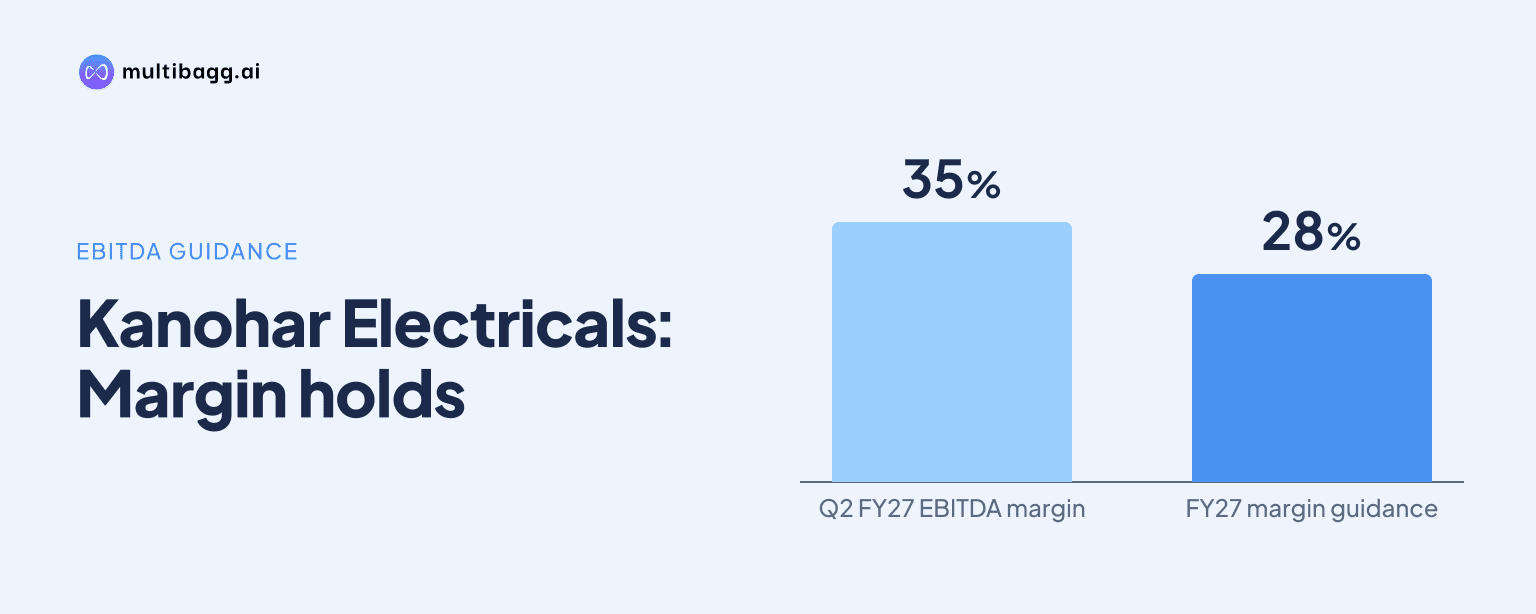
In the first half (H1) of financial year (FY) 2027, Kanohar Electricals Limited retained earnings before interest, tax, depreciation and amortisation (EBITDA) margin guidance at FY26’s 28% level despite reporting a 32.3% H1 margin and a 35.0% second-quarter margin. Management cited order-level and quarterly variation, alongside full-year operating expenses.
Know Kanohar Electricals inside out
Results, valuation, peers and who's buying, in one view.
Why did Kanohar retain 28% EBITDA-margin guidance?
Kanohar retained FY27 EBITDA-margin guidance at a level similar to FY26’s 28% because management said margins can differ between individual orders, quarters and the full year. It said there was no one-off in the H1 FY27 outcome, when EBITDA was Rs 111.8 crore on revenue from operations of Rs 345.7 crore.
An analyst asked whether the 32.3% H1 margin made guidance of 27% to 28% conservative, particularly given higher volumes and operating leverage. Management said volume can create operating leverage, but maintained that quarterly and order-level movements, as well as full-year operational expenses, required a prudent FY27 view.
Management did not provide a numerical bridge from the 32.3% H1 margin to its 28% FY26 reference point. It said that after Q3 FY27 it may be in a better position to assess the full-year outcome, leaving the present guidance unchanged despite the Q2 FY27 EBITDA margin of 35.0%.
How did Kanohar’s H1 margin compare with Q2 performance?
Kanohar’s Q2 FY27 EBITDA margin was 35.0%, above its 32.3% H1 FY27 margin and the 28% FY26 level referenced in guidance. Q2 revenue from operations was Rs 208.6 crore, while EBITDA was Rs 73.1 crore, compared with H1 revenue of Rs 345.7 crore and EBITDA of Rs 111.8 crore.
H1 FY27 revenue grew 109% year on year, while EBITDA increased 162% year on year. Profit after tax rose 165% year on year to Rs 81.2 crore, and the faster growth in EBITDA than revenue coincided with the 32.3% H1 margin.
Q2 gross profit was Rs 95.4 crore, equal to a 45.8% gross margin, compared with Rs 152.9 crore and a 44.2% gross margin in H1 FY27. The 1.6-percentage-point difference shows that Q2 gross margin was above the H1 level, but management did not offer a product-level calculation that would explain the difference.
What does the order book say about Kanohar’s margins?
Kanohar said the order book had a broadly similar gross-margin profile to business already executed, but it did not disclose an EBITDA margin for the backlog. The order book stood at Rs 2,711.2 crore on September 30, 2026, up 34% from Rs 2,026 crore on June 30, 2026.
Management distinguished that gross-margin observation from its EBITDA guidance. It said gross margins were broadly similar between FY26 and FY27, while EBITDA margin can still vary due to order mix, quarterly timing and operational expenses across the full year.
Kanohar said it focuses on 400 kilovolt (kV) power transformers, shunt reactors and Scott-connected transformers, and that these products broadly have similar margin profiles. It declined to quantify the gross-margin difference between 400 kV and 765 kV equipment on one side and 220 kV and 132 kV equipment on the other.
The Q2 FY27 revenue mix illustrates the product concentration behind reported results. Transformers contributed 89.5% of revenue and engineering, procurement and construction accounted for 10.5%; power transmission represented 57.1% of revenue, renewable energy 34.0%, railways 7.0% and power distribution 1.9%.
By voltage class, 400 kV transformers contributed 46.6% of Q2 revenue, followed by 220 kV at 34.0%, 132 kV at 7.0% and equipment below 132 kV at 1.9%. Management said shunt reactors for renewable-grid integration and 400 kV power transformers made meaningful contributions to H1 FY27 revenue.
Got a follow-up? Ask IRIS
Which execution factors could affect FY27 margins?
Kanohar maintained FY27 revenue guidance of Rs 950 crore based on its current production plan, after reporting Rs 345.7 crore in H1 FY27. Management said the first half is typically softer, but cautioned that FY26’s pattern of roughly Rs 175 crore of H1 revenue and Rs 650 crore for the full year should not be assumed to recur exactly.
The company said its Rs 2,711.2 crore order book had delivery schedules of 24 to 30 months, mainly because of larger order sizes and their specified delivery dates. Management said the longer timeline was not due to manufacturing constraints, and added that similar year-on-year growth could be expected in FY28.
Kanohar sold about 2,130 megavolt-amperes (MVA) in Q2 FY27 against annualised capacity of 19,200 MVA. Management said annual capacity equates to about 5,000 MVA on a quarterly basis, and therefore viewed Q2 utilisation differently from a calculation based on the annual capacity figure.
Existing capacity is expected to be sufficient through FY28, according to management, with additional brownfield capacity required in FY29. Kanohar said capacity could reach about 38,000 MVA by the end of Q4 FY28, and that the planned expansion is intended for the domestic market rather than exports.
Input availability remains a planning variable. Management said lead times for high-voltage bushings can range from 12 to 24 months depending on their rating, while it sees no supplier delivery-timeline constraint for continuously transposed conductors. It said production plans had not changed, although component availability must be planned carefully.
Conclusion
Kanohar’s 32.3% H1 FY27 EBITDA margin and 35.0% Q2 margin were above the FY26 28% level used for FY27 guidance. Management said the performance did not contain a one-off and that order-book gross margins are broadly similar to executed work, but it has not translated those points into a higher EBITDA-margin target because order mix, quarterly variation and annual operating expenses can change the result.
The next disclosed checkpoint is Q3 FY27, after which management said it may have better visibility on the full-year number. Execution against the Rs 950 crore FY27 revenue plan, delivery timing within the Rs 2,711.2 crore order book and readiness of roughly 38,000 MVA capacity by the end of Q4 FY28 are the stated developments to watch.