










KANOHAR transformer utilisation reaches 46% in FY26 from 16.5%
Key highlights
- KANOHAR's transformer utilisation rose to 46.0% in FY26 from 16.5% in FY24.
- KANOHAR's aggregate transformer capacity was 19,200 MVA in both FY25 and FY26.
- KANOHAR says it was one of five companies with 500 MVA, 400 kV short-circuit certification as of 31 March 2026.
- Power transformers represented 57.09% of KANOHAR's FY26 revenue mix and Scott transformers represented 25.29%.
powered by IRIS
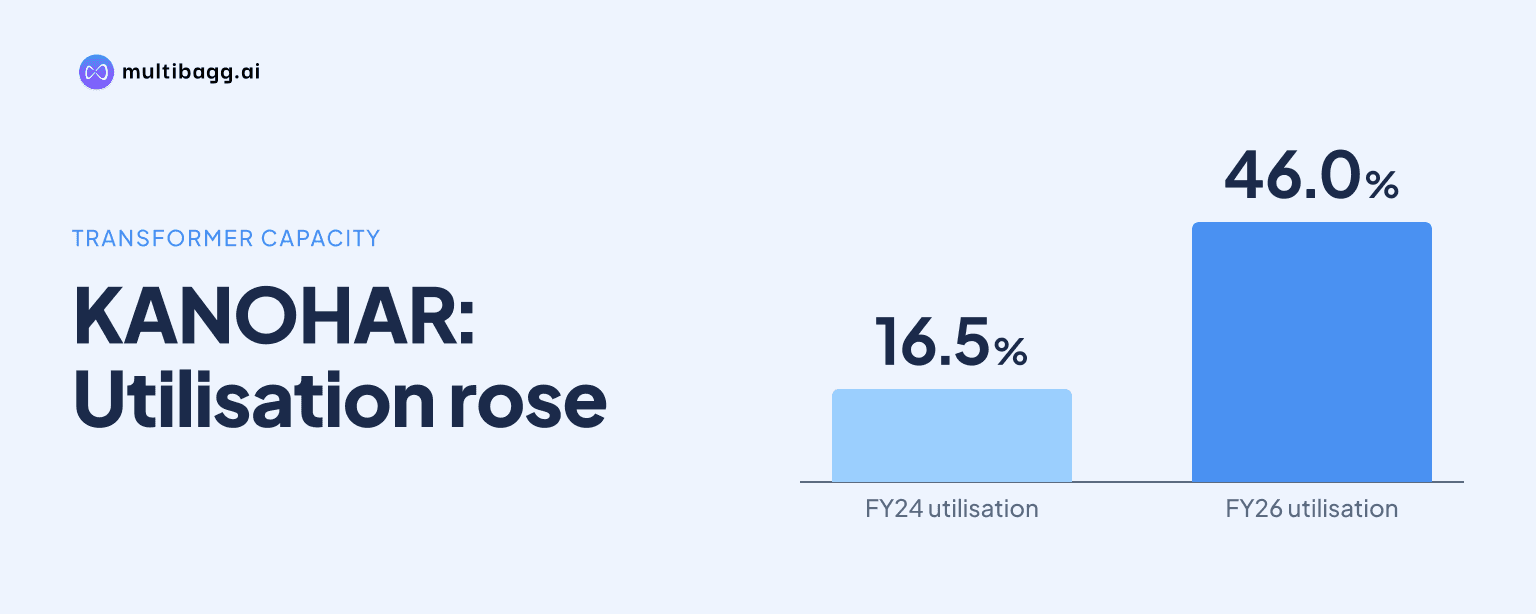
KANOHAR raised transformer manufacturing capacity utilisation to 46.0% in FY26 from 16.5% in FY24, while aggregate annual capacity reached 19,200 megavolt-amperes (MVA) in FY25 and remained at that level in FY26. The company also cites short-circuit certification for 500 MVA, 400 kilovolt (kV) transformers and more than 200 successfully tested transformer ratings.
Know Kanohar Electricals inside out
Results, valuation, peers and who's buying, in one view.
How did KANOHAR's transformer capacity utilisation change?
KANOHAR's utilisation increased by 29.5 percentage points from FY24 to FY26, reaching 46.0% on a 19,200 MVA capacity base. Capacity rose by 4,200 MVA between FY24 and FY25, while utilisation increased in both years shown, from 16.5% to 29.7% and then to 46.0%.
The FY25-to-FY26 increase occurred with aggregate capacity unchanged at 19,200 MVA. KANOHAR does not disclose production volumes, plant-level utilisation, order inflow or a future utilisation target, so the presentation does not specify the pace at which the remaining stated capacity could be used.
Where is KANOHAR's transformer manufacturing capacity located?
KANOHAR operates two manufacturing sites in Meerut, Uttar Pradesh, with aggregate transformer manufacturing capacity of 19,200 MVA per annum. Its Gangol facility, established in 1997, is specified for equipment up to 500 MVA and 400 kV, while its Rithani facility, established in 1983, is specified for equipment up to 25 MVA and 66 kV.
As of 30 June 2026, KANOHAR said its manufacturing facilities were also equipped to manufacture 765 kV power transformers. The company identifies in-house transformer tanks and radiators as part of its backward integration, and lists a lighting impulse test set, vapour phase drying oven and vertical winding machine among its manufacturing equipment.
KANOHAR says its in-house laboratories are accredited by the National Accreditation Board for Testing and Calibration Laboratories. The presentation links in-house tanks and radiators to quality control, cost optimisation and reduced vendor dependency, but does not quantify component output, cost savings or a separate capacity allocation for 765 kV transformers.
What high-voltage testing credentials does KANOHAR cite?
KANOHAR says it had successfully tested more than 200 transformer ratings and was one of five companies in India with short-circuit test certification for 500 MVA, 400 kV transformers as of 31 March 2026. The presentation describes short-circuit testing as a key entry barrier for high-voltage transformer manufacturers in India.
For railway applications, KANOHAR says it is one of four manufacturers certified by the Research Designs and Standards Organisation (RDSO) to manufacture 100 MVA, 132 kV Scott transformers. It also says it is one of two manufacturers certified to manufacture 100 MVA, 220 kV Scott transformers; these are separate product specifications and certification comparisons.
KANOHAR introduced Scott transformers in FY25. Its disclosed Scott transformer range includes 100 MVA equipment at 220/2x55 kV and 132/2x55 kV, designed to convert three-phase power to two-phase power for high-speed railway corridors.
Got a follow-up? Ask IRIS
What accounted for KANOHAR's FY26 revenue mix?
KANOHAR reported power transformers as its largest FY26 revenue category at 57.09%, followed by Scott transformers at 25.29%. Traction transformers accounted for 0.92% and distribution units for 0.13%, while shunt reactors were listed as a renewable-network product without an FY26 revenue-mix figure.
Engineering, procurement and construction (EPC) transmission-line solutions represented 9.69% of FY26 revenue mix and EPC substation solutions represented 6.75%. Together, the two EPC categories accounted for 16.44%, while the four transformer categories with reported percentages accounted for 83.43%; the disclosed percentages total 99.87% because shunt reactors are marked not available.
KANOHAR's power-transformer range extends to 500 MVA and 400 kV, while its traction transformer range includes 30.24 MVA equipment at 132 kV and 220 kV. Its shunt reactors extend to 125 MVAR and 400 kV for reactive-power compensation and voltage stabilisation in solar and wind networks.
How does KANOHAR link manufacturing with EPC work?
KANOHAR says its combined transformer manufacturing and EPC capabilities allow it to participate in hybrid contracts involving equipment supply and project execution. Its substation EPC scope includes turnkey air-insulated and gas-insulated substations, plus bay augmentation up to the 400 kV class.
KANOHAR's transmission-line EPC work covers turnkey installation across 132 kV, 220 kV and 400 kV lines. The company says the integrated model can support access to larger tenders, a single-window offering and a higher share of project value, although the presentation gives no tender win-rate, project-value or contract-margin data.
As of 30 September 2026, Central Government customers represented 55.6% of KANOHAR's disclosed customer mix, State Government customers 43.1% and private entities 1.3%. Rajasthan was its largest disclosed geographic market at 31.5%, followed by Gujarat at 26.6% and Karnataka at 18.9%.
Conclusion
KANOHAR's disclosures show utilisation rising from 16.5% in FY24 to 46.0% in FY26 after capacity expanded to 19,200 MVA in FY25. The company pairs that capacity base with high-voltage testing credentials, including its stated one-in-five position for 500 MVA, 400 kV short-circuit certification, and railway Scott transformer certifications.
The next disclosure to watch is whether KANOHAR turns its stated 765 kV manufacturing readiness, disclosed as of 30 June 2026, into reported product mix, capacity or delivery data. Management's plan includes higher-value 765 kV transformers, shunt reactors, special railway transformers, deeper backward integration and broader EPC capabilities, but the presentation gives no investment amount, timetable or utilisation target for those initiatives.