










Kanohar Electricals Limited order book rises 34%, backs FY27
Key highlights
- Kanohar’s order book rose 34% sequentially to Rs 2,711.2 crore at September 30, 2026.
- Q2 FY27 order inflow was Rs 867.3 crore, including a central PSU order exceeding Rs 250 crore.
- H1 FY27 revenue grew 109% year on year to Rs 345.7 crore, while EBITDA margin was 32.3%.
- Management retained FY27 revenue guidance of about Rs 950 crore and expects Gangol expansion by the beginning of FY29.
powered by IRIS
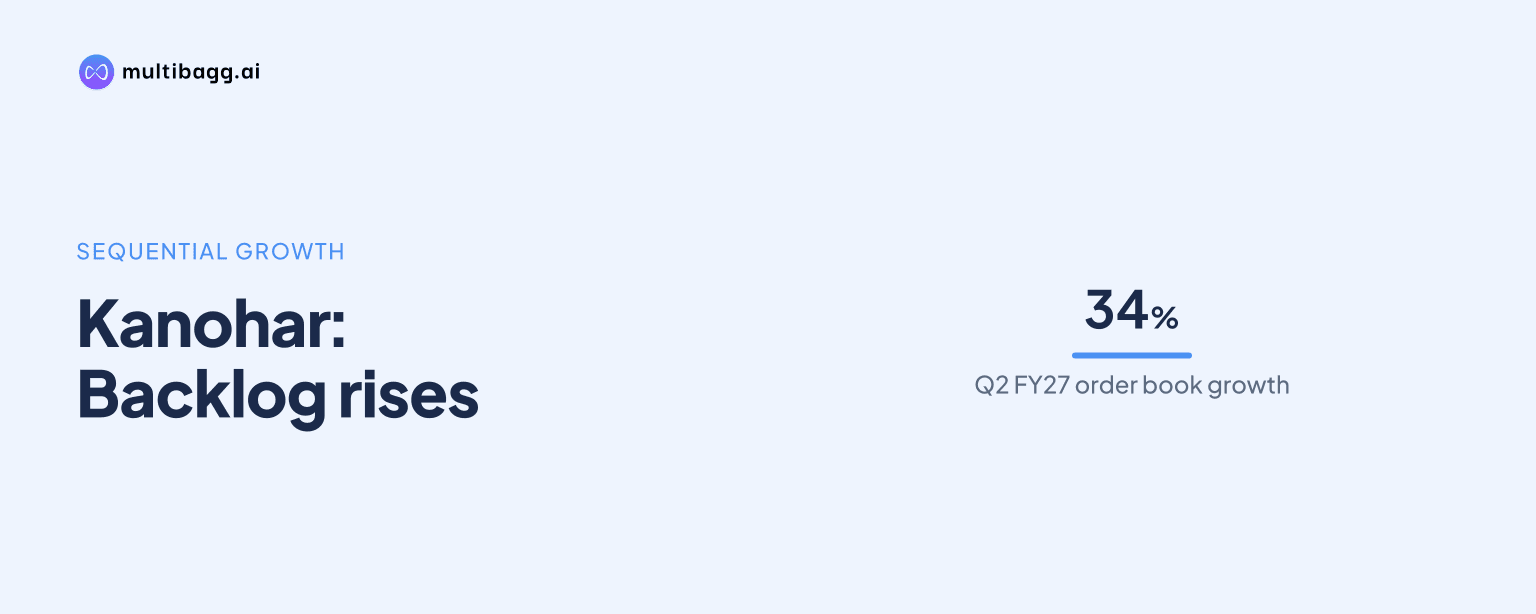
Kanohar Electricals Limited’s order book rose 34% sequentially to Rs 2,711.2 crore at September 30, 2026, from Rs 2,026 crore at June 30, giving management a stated 24-to-30-month revenue visibility. Kanohar retained its FY27 revenue guidance of about Rs 950 crore after H1 FY27 revenue reached Rs 345.7 crore.
Know Kanohar Electricals inside out
Results, valuation, peers and who's buying, in one view.
Why did Kanohar’s order book increase in Q2 FY27?
Kanohar’s order book increased because it secured Rs 867.3 crore of orders during Q2 FY27, including a central public sector undertaking order exceeding Rs 250 crore. The backlog reached Rs 2,711.2 crore at September 30, 2026, compared with Rs 2,026 crore at June 30, 2026, a reported sequential increase of 34%.
The Rs 2,711.2 crore book remains concentrated in Kanohar’s manufacturing categories. Power transformers accounted for about 78% of the September 30 backlog, while shunt reactors contributed about 10%. Management said larger order sizes and contracted delivery schedules, rather than manufacturing constraints, were the main reasons the execution horizon extends to 24 to 30 months.
Kanohar did not disclose the share of the order book scheduled specifically for FY28. Management said similar year-on-year growth could be expected in FY28, while limiting its FY28 outlook to that statement. The company linked the longer delivery schedule to order sizes and delivery terms rather than to an identified shortage of current capacity.
What products are behind Kanohar’s backlog and revenue mix?
Kanohar’s backlog is principally tied to power transformers, with shunt reactors and Scott-connected transformers identified by management as additional contributors. In H1 FY27, transformers produced nearly 88% of revenue, compared with about 76% in H1 FY26, increasing the manufacturing share of the Rs 345.7 crore H1 revenue base.
Power transformers accounted for about 56% of H1 FY27 revenue and grew 88% year on year. Shunt reactors accounted for about 22% of H1 revenue, versus a negligible contribution in the corresponding prior-year period. Scott-connected transformers for railways contributed about 9%, adding two further equipment categories to the revenue mix.
The voltage mix also moved toward larger equipment. Products rated 220 kilovolts and above, including 400 kilovolt products, formed nearly 78% of H1 FY27 revenue, compared with approximately 53% in H1 FY26. In Q2 FY27, 400 kilovolt transformers accounted for 46.6% of revenue and 220 kilovolt equipment for 34%, while 132 kilovolt products contributed 7%.
Got a follow-up? Ask IRIS
Can Kanohar meet its Rs 950 crore FY27 revenue target?
Kanohar said it expects to meet its previously communicated FY27 revenue target of approximately Rs 950 crore, based on its current production plan and existing order book. H1 FY27 revenue was Rs 345.7 crore, up 109% year on year, while Q2 revenue was Rs 208.6 crore, up 112% year on year.
The target requires a larger second-half contribution than the first-half result. Management said the second half is traditionally stronger for the industry and expects that seasonality to continue. It also said FY26’s pattern should not be applied mechanically: H1 FY26 revenue was roughly Rs 175 crore and full-year FY26 revenue was Rs 650 crore, but the same H1-to-H2 proportion may not recur every year.
The revenue mix has already shifted toward manufacturing. Transformers represented 89.5% of Q2 FY27 revenue of Rs 208.6 crore, compared with 10.5% for engineering, procurement and construction, or EPC. By end-user segment, power transmission accounted for 57.1% of Q2 revenue, renewable energy 34%, railways 7%, and power distribution 1.9%.
What does Kanohar say about margins and execution capacity?
Kanohar said the order book has a broadly similar margin profile to work already executed, but retained full-year earnings before interest, tax, depreciation and amortisation, or EBITDA, margin guidance broadly in line with FY26. EBITDA margin was 35% in Q2 FY27 and 32.3% in H1 FY27; management cited order-to-order, quarter-to-quarter and full-year operating-cost variation for retaining its guidance.
H1 FY27 gross profit increased 114% year on year to Rs 152.9 crore, equal to a 44.2% gross margin. EBITDA rose 162% to Rs 111.8 crore, while profit after tax, or PAT, grew 165% to Rs 81.2 crore. In Q2, EBITDA was Rs 73.1 crore, up 167%, and PAT was Rs 53.9 crore, up 180%.
Current capacity was not identified as the cause of the 24-to-30-month order-book schedule. Kanohar reported about 2,130 megavolt-amperes, or MVA, sold in Q2 FY27. Management calculated utilisation at about 10.5% against annual capacity of 19,200 MVA, while noting that annual capacity equates to roughly 5,000 MVA on a quarterly basis.
Kanohar’s planned brownfield expansion at the Gangol facility remains on track for completion by the beginning of FY29. Management said existing capacity is sufficient until FY28 and additional capacity will be needed in FY29. It also said the project is intended to double capacity by then, although construction may occur in phases.
Conclusion
Kanohar’s Rs 2,711.2 crore order book, up 34% from Rs 2,026 crore in one quarter, gives management a 24-to-30-month execution base while power transformers account for about 78% of backlog. The revenue mix has also changed, with transformers rising to nearly 88% of H1 FY27 revenue and 220 kilovolt-and-above products reaching nearly 78%, from about 53% a year earlier.
The next measure to watch is delivery against management’s approximately Rs 950 crore FY27 revenue plan after H1 revenue of Rs 345.7 crore, particularly in the seasonally stronger second half. Management also points to the Gangol brownfield project, expected by the beginning of FY29, as the capacity addition needed after FY28, while it has not provided a precise FY28 backlog-execution split.