










Kanohar order book rises 34% to Rs 2,711.2 crore in Q2
Key highlights
- Kanohar’s order book was Rs 2,711.2 crore on September 30, 2026, up 34% from Rs 2,026.0 crore on June 30, 2026.
- Kanohar secured about Rs 867.3 crore of fresh orders during Q2FY27.
- Power transformers accounted for 78.5% of Kanohar’s September 2026 order book.
- Government clients accounted for 89.1% of Kanohar’s September 2026 order book.
powered by IRIS
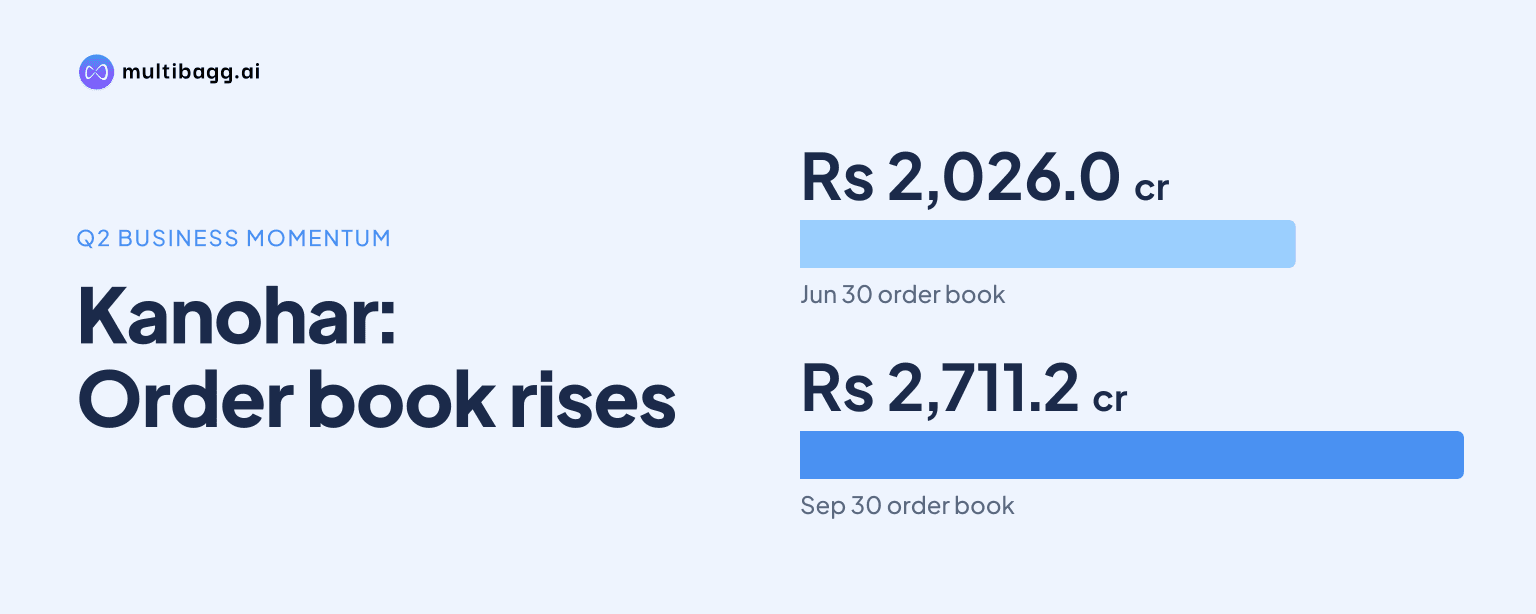
Kanohar Electricals Limited reported a Rs 2,711.2 crore consolidated order book on September 30, 2026, up 34% from Rs 2,026.0 crore on June 30, after securing about Rs 867.3 crore of Q2FY27 orders. Kanohar expects the backlog to be executed over the next 24 to 30 months, with government clients representing 89.1%.
Know Kanohar Electricals inside out
Results, valuation, peers and who's buying, in one view.
How much did Kanohar’s order book grow in Q2FY27?
Kanohar’s order book increased by Rs 685.2 crore, or 34%, between June 30, 2026 and September 30, 2026. The consolidated backlog stood at Rs 2,711.2 crore at the September reporting date, compared with Rs 2,026.0 crore at the end of June.
Kanohar separately disclosed fresh Q2FY27 orders of about Rs 867.3 crore. This amount exceeds the Rs 685.2 crore net increase in the reported order book, and the presentation does not provide a bridge between new orders, execution during the quarter and any other movements in backlog.
Kanohar expects to execute the Rs 2,711.2 crore September 2026 backlog over the next 24 to 30 months. That timeframe extends the disclosed work beyond the balance of FY27, although the presentation does not allocate the order book by quarter, financial year, contract or project.
Which products make up Kanohar’s order book?
Power transformers account for 78.5% of Kanohar’s September 2026 order book, making them the largest disclosed product category. Shunt reactors account for 10.0% and engineering, procurement and construction, or EPC, solutions account for 7.5% of the Rs 2,711.2 crore backlog.
Scott transformers represent 2.6% of the order book, while distribution transformers represent 1.3%; traction transformers are reported at 0.0%. The disclosed product split therefore places 92.4% of the backlog in transformer and reactor equipment categories, with EPC solutions forming the remaining material non-equipment category.
The backlog mix partly reflects the change in Kanohar’s H1FY27 revenue mix. Transformers contributed 87.8% of H1FY27 revenue, up from 76.0% in H1FY26, while EPC fell to 12.2% from 24.0%. Within transformer revenue, power transformers grew 88% year on year and shunt reactors accounted for 21.7%, compared with 0.1% in H1FY26.
How concentrated is Kanohar’s order book by customer type?
Government clients account for 89.1% of Kanohar’s order book as of September 30, 2026, while private-sector clients account for 10.9%. The disclosed customer split means nearly nine-tenths of the Rs 2,711.2 crore backlog is classified by Kanohar as government business.
Kanohar does not name the government or private-sector customers in the presentation. It also does not disclose the number of contracts, payment terms, customer-level order values or a comparison with government-client exposure in earlier periods.
The client concentration applies to an order book expected to be executed over 24 to 30 months. Kanohar has not provided a segment-level schedule showing when government and private-sector orders are expected to convert into revenue, nor has it disclosed cancellation data for the September 2026 backlog.
Got a follow-up? Ask IRIS
How did Kanohar perform in Q2FY27 and H1FY27?
Kanohar reported Q2FY27 revenue of Rs 208.6 crore, up 112% from Rs 98.2 crore in Q2FY26, and earnings before interest, tax, depreciation and amortisation, or EBITDA, of Rs 73.1 crore, up 167% from Rs 27.4 crore. EBITDA margin rose to 35.0% from 27.8%, while profit after tax increased 180% to Rs 53.9 crore from Rs 19.3 crore.
For H1FY27, Kanohar’s revenue rose 109% to Rs 345.7 crore from Rs 165.6 crore in H1FY26. EBITDA increased 162% to Rs 111.8 crore, and EBITDA margin increased by 6.5 percentage points to 32.3%; profit after tax rose 165% to Rs 81.2 crore and the corresponding margin increased to 23.5% from 18.5%.
Management attributed the H1FY27 growth to higher volumes and a broader product mix. Products rated at 220 kilovolts, or kV, and 400 kV contributed nearly 78% of H1FY27 revenue, versus about 53% in H1FY26, while 400 kV products alone represented 55.9% of revenue, compared with 48.7% a year earlier.
What has Kanohar said about FY27 execution and capacity?
Kanohar management expects FY27 revenue of about Rs 950 crore with an EBITDA margin profile similar to FY26. Management linked that guidance to H1FY27 performance and the order pipeline; it is a forward-looking target rather than a reported financial result.
Kanohar also said its brownfield expansion at the Gangol unit is on track for commissioning by FY29. The presentation does not disclose the project’s capital cost, planned capacity addition or interim milestones, but reports capital work-in-progress of Rs 16.2 crore at September 2026, compared with Rs 14.0 crore at March 2026.
Property, plant and equipment stood at Rs 32.5 crore in September 2026, against Rs 30.8 crore in March 2026. Kanohar does not specifically assign the Rs 1.7 crore increase in property, plant and equipment or the Rs 2.2 crore increase in capital work-in-progress to the Gangol expansion.
Conclusion
Kanohar entered the second half of FY27 with a Rs 2,711.2 crore order book, 34% above its June 2026 level, led by power transformers at 78.5% and government clients at 89.1%. The order position sits alongside H1FY27 revenue growth of 109% to Rs 345.7 crore and an EBITDA margin increase to 32.3% from 25.8%.
The next disclosed markers are order-book execution over the stated 24-to-30-month period, progress toward management’s FY27 revenue target of about Rs 950 crore and commissioning of the Gangol brownfield expansion by FY29. Kanohar has not disclosed a financial-year backlog schedule, customer-level contract details or capacity addition from the expansion.