










Kanohar Electricals Posts 112% Q2 Revenue Growth in FY27
Key highlights
- Kanohar Electricals Limited reported Q2 FY27 revenue of ₹208.6 crore, up 112.4% year-on-year.
- Q2 FY27 profit after tax was ₹53.9 crore, up 179.7% year-on-year, with a 25.8% PAT margin.
- H1 FY27 revenue reached ₹345.7 crore, up 109% year-on-year.
- Kanohar reported an order book of ₹2,711.2 crore and reaffirmed FY27 revenue guidance of about ₹950 crore.
powered by IRIS
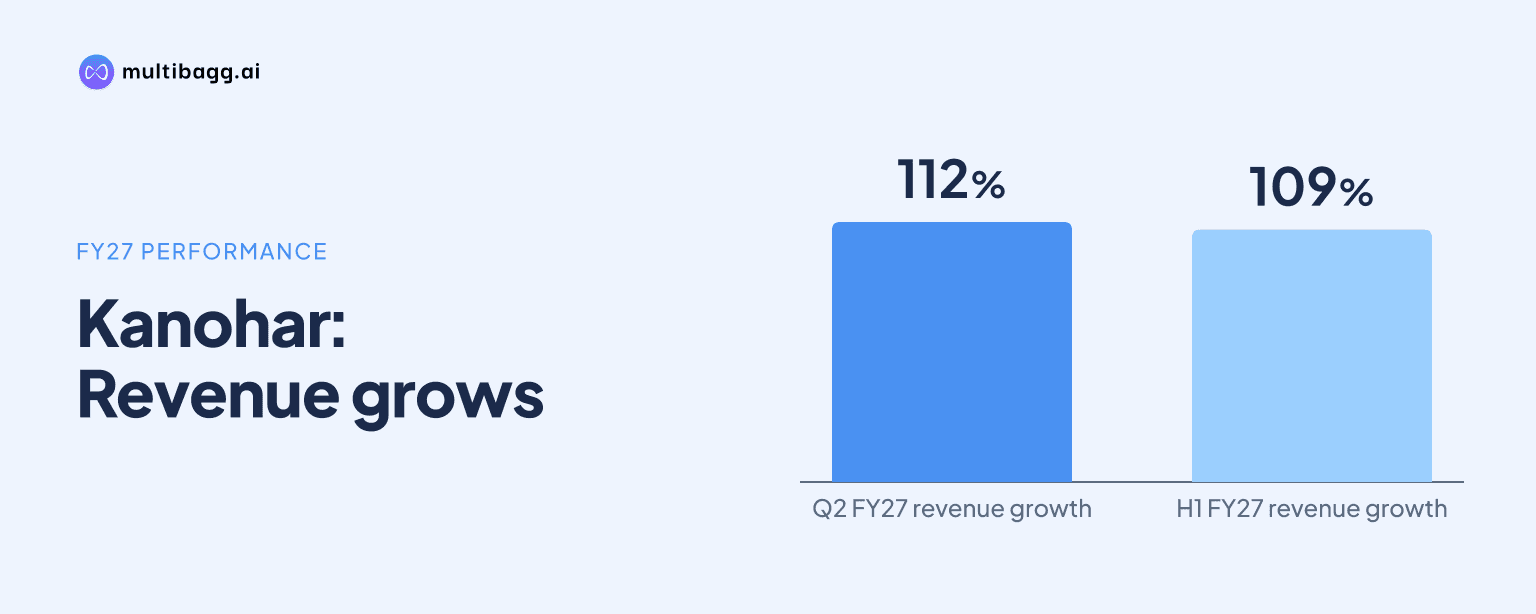
Kanohar Electricals Limited reported Q2 FY27 revenue of ₹208.6 crore, up 112% year-on-year, and posted profit after tax of ₹53.9 crore, up 179.7%, before hosting its November 3 earnings-call recording for investor access. The results indicate strong first-half growth and a higher operating-profit margin.
Know Kanohar Electricals inside out
Results, valuation, peers and who's buying, in one view.
What did Kanohar Electricals Limited announce?
Kanohar Electricals Limited announced that the audio recording of its earnings conference call covering the second quarter and first half of FY27 is available on its website. The call was held on November 3, 2026, following the release of the company's unaudited standalone financial results and investor presentation.
The recording gives shareholders and other market participants access to management's discussion of financial performance, order inflows and business updates. The company had earlier scheduled the call for 2:00 pm IST on November 3 to discuss results for the quarter and half-year ended September 30, 2026.
Kanohar released its Q2 and H1 FY27 investor presentation on November 2, 2026. Its Board of Directors also approved the unaudited standalone financial results at a meeting held that day. The results were prepared under Indian Accounting Standards, and the statutory auditors issued an unmodified Limited Review Report for the period ended September 30, 2026.
How did Kanohar perform in Q2 FY27?
Kanohar reported revenue from operations of ₹208.6 crore in Q2 FY27, representing year-on-year growth of 112.4%. Profit after tax rose 179.7% year-on-year to ₹53.9 crore, while the PAT margin expanded to 25.8%.
The company reported an EBITDA margin of 35.0% for the September quarter. Its detailed financial filing put revenue from operations at ₹208.59 crore and total expenses at ₹138.93 crore. Reported PAT was ₹53.87 crore, while total comprehensive income was ₹53.85 crore for the quarter.
The comparison base requires context. The company stated that its results for the quarter and half-year ended September 30, 2025 had been approved earlier but were not subject to limited review because quarterly submission requirements became applicable after its listing. The FY27 September-quarter results, in contrast, received an unmodified limited review from the statutory auditors.
What were the first-half numbers and order-book updates?
Kanohar reported H1 FY27 revenue of ₹345.7 crore, up 109% year-on-year. The company reported an EBITDA margin of 32.3% and a PAT margin of 23.5% for the first half.
The company also disclosed fresh orders of about ₹867.3 crore. These orders expanded its order book to ₹2,711.2 crore, providing an update on the business pipeline alongside the reported financial growth.
Kanohar reaffirmed its FY27 revenue guidance of about ₹950 crore and said it expects EBITDA margins to remain stable. The disclosure provides a management target rather than a reported full-year outcome, so investors will need to track subsequent quarterly results and execution against the stated order book.
Got a follow-up? Ask IRIS
Why does the earnings-call recording matter to investors?
The earnings-call recording matters because it allows investors who could not attend the live session to review management commentary alongside the published Q2 and H1 financial data. The presentation and recording are particularly relevant for assessing the revenue growth, margins, fresh orders and the company's reiterated FY27 revenue guidance.
The available disclosures show that Kanohar's Q2 PAT growth of 179.7% exceeded its revenue growth of 112.4%, alongside a reported PAT margin of 25.8%. The recorded discussion may help investors understand the context management provided on business performance, although the announcement itself only confirms that the audio has been hosted on the company's website.
The order book of ₹2,711.2 crore is another key disclosed metric for following the company's operations. It is substantially larger than the company's FY27 revenue guidance of about ₹950 crore, but the filings provided do not specify the timing or revenue recognition schedule for individual orders.
How could the update affect market assessment of Kanohar?
The update gives investors a fuller set of disclosed information to assess Kanohar's Q2 and H1 FY27 performance. Revenue growth, profitability margins, fresh orders and the FY27 guidance are the principal reported indicators, while the call recording adds access to the management discussion around those figures.
No share-price movement, valuation measure or market reaction was provided in the source material. As a result, the available information supports an assessment of the company's operating and financial disclosures, but not a conclusion on how the market priced the results.
For customers and operating stakeholders, the company has reported a growing order book and fresh order inflows. However, the announcements do not provide project-level details, customer names, geographic exposure or changes in delivery schedules. The reported figures should therefore be read within the limits of the company's disclosed standalone results and presentation.
Conclusion
Kanohar delivered strong reported growth in Q2 FY27, with revenue reaching ₹208.6 crore and PAT reaching ₹53.9 crore. The company also reported H1 revenue of ₹345.7 crore, fresh orders of about ₹867.3 crore and an order book of ₹2,711.2 crore, while making the earnings-call recording available for investor review.
The next disclosures to watch are the company's progress toward its FY27 revenue guidance of about ₹950 crore, the stability of EBITDA margins, and updates on execution of the reported order book. Subsequent quarterly results will provide the reported evidence on these stated targets and operating metrics.