










LIC’s ANANDA individual policy share rises to 12.48% in FY26
Key highlights
- LIC’s ANANDA policy share increased to 12.48% of total individual policies in FY26 from 8.49% in FY25.
- ANANDA completed 23.01 lakh policies in FY26, compared with 14.74 lakh in FY25.
- Activated ANANDA agents increased to 3.81 lakh in FY26 from 2.94 lakh in FY25.
- LIC reported 91.48 lakh app users and 2.42 crore WhatsApp-enabled or opted-in customers by March 2026.
powered by IRIS
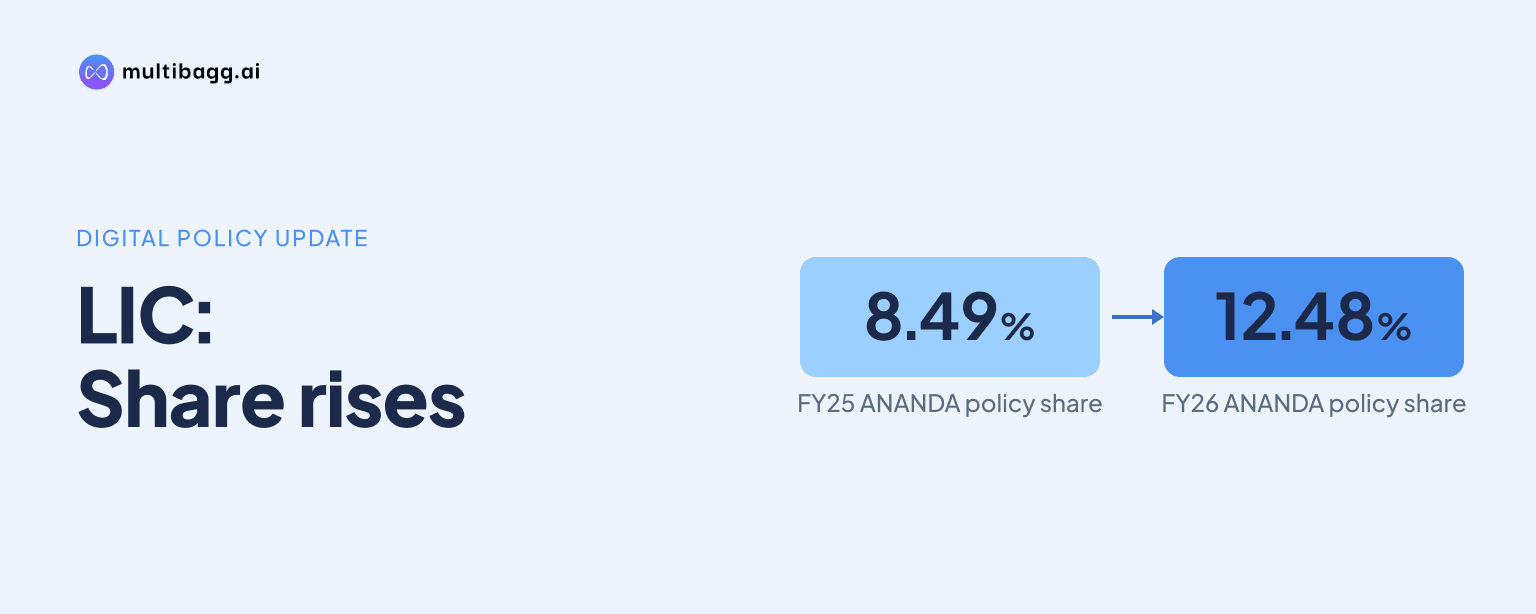
Life Insurance Corporation of India (LIC) processed 23.01 lakh policies through ANANDA in the financial year ended March 2026 (FY26), lifting the platform’s share of total individual policies to 12.48% from 8.49% in FY25. Activated ANANDA agents rose to 3.81 lakh from 2.94 lakh, alongside the increase in digitally completed new-business policies.
Know Life Insurance Corporation of India inside out
Results, valuation, peers and who's buying, in one view.
How much did LIC’s ANANDA usage grow in FY26?
LIC’s ANANDA processed 23.01 lakh policies in FY26, compared with 14.74 lakh in FY25, while its share of total individual policies rose by 3.99 percentage points to 12.48%. The platform’s completed-policy volume increased by 8.27 lakh policies year on year. LIC specifies that the share is calculated against total individual policies.
LIC’s figures show concurrent growth in policy completions and agency activation. Activated ANANDA agents increased by 0.87 lakh in FY26, while ANANDA’s policy share exceeded one in every eight individual policies. LIC notes that the figures may not add up to totals because of rounding.
What does LIC’s ANANDA platform do for policy sales?
LIC describes ANANDA, or Atma Nirbhar AnandBusiness Digital App, as a digital application that enables agents to process new business digitally. The application was launched during COVID to allow agents to conduct business without meeting customers face to face. LIC presents ANANDA 2.0 as serving agents, brokers, intermediaries, employees and advisors connecting with customers on the move.
The platform is designed to ease customer onboarding for LIC’s agency force and is integrated with WhatsApp. This role differs from LIC PAY Direct, which enables premium payment through the customer portal or without login. ANANDA’s 23.01 lakh FY26 completed policies therefore measure digital new-business processing rather than digital premium collections or service requests.
How did LIC’s digital collection mix change in FY26?
LIC’s National Automated Clearing House (NACH) and direct-debit channel accounted for 31.49% of total transactions in FY26, up from 28.24% in FY25, making it the largest collection channel shown. Merchant transactions declined to 21.84% from 23.48%, while cash-counter transactions fell to 19.65% from 21.02%.
Other apps increased by 1.29 percentage points to 18.01% in FY26 and include Amazon Pay, Bajaj Finserv, CRED, Free Charge, GPay, InstaPay, JustDial, MobiKwik, PhonePe and Paytm. In contrast, the LIC portal/app share declined by 1.28 percentage points to 8.22%; banks and franchises declined from 0.99% to 0.77%, and bill pay moved from 0.05% to 0.02%.
Got a follow-up? Ask IRIS
Which LIC digital tools expanded customer and agent access?
LIC reported 91.48 lakh customer-app users in FY26, compared with 83.95 lakh in FY25, and stated an app rating of 4.56 out of 5.0 as of March 31, 2026. Website registered customers were 241 lakh in FY26, unchanged from FY24 and one lakh higher than FY25’s 240 lakh. These figures distinguish rising app usage from the relatively stable registered website base.
WhatsApp services began in December 2022, and 2.42 crore customers had opted in or enabled them by March 2026. LIC also lists eight online service requests, including e-NACH, unit-linked fund switches, National Electronic Fund Transfer registration, mode changes, Aadhaar-based address changes, Permanent Account Number registration, nomination or assignment changes, and loan payment or repayment.
LIC’s customer tools also include the Jeevan Saakshya mobile app for Aadhaar-based digital life certificates for individual pension policyholders and staff pensioners. LIC Mitra, its artificial-intelligence chatbot, provides policy status, first unpaid premium date, last paid premium date, forms and product information. For agents and supervisors, Super Saathi includes sales and ANANDA applications, commission tracking, renewal management, agent insights and team views.
What technology plan has LIC disclosed after ANANDA 2.0?
LIC has disclosed that its new Datalake platform is operational and that its lakehouse infrastructure will support artificial-intelligence and machine-learning use cases intended to advance business objectives and growth. The DIVE app is presented as a one-stop shop for insurance and policy-servicing needs, with features covering customer login, profile updates, National Electronic Fund Transfer updates, renewals and maturity or survival claims.
LIC says DIVE is designed to accelerate digital engagement and self-service adoption while improving customer convenience, operational efficiency and service accessibility. Its displayed renewal workflow allows customers to select policies and instalments for premium payment, while the maturity workflow identifies policies with upcoming claims. These functions extend digital processes beyond ANANDA’s new-policy processing into servicing after issuance.
Conclusion
LIC’s FY26 data show expansion across two parts of its digital operating model: ANANDA completed 23.01 lakh new policies and reached a 12.48% share of individual policies, while NACH and direct debit became 31.49% of collection transactions. Customer-app users increased to 91.48 lakh, and WhatsApp participation reached 2.42 crore customers by March 2026.
The next development to watch is whether the operational Datalake and lakehouse support the artificial-intelligence and machine-learning use cases that LIC says are intended to advance business objectives and growth. LIC also says DIVE is designed to broaden self-service across renewals, profile updates and claims, while ANANDA 2.0 is intended to support customer onboarding by the agency force.